
If you’re getting into running, one of the first questions that comes up is surprisingly simple.
How often should you run?
You might wonder if running every day is the best way to improve, or if a few runs per week are already enough to make progress. It can feel like more should always be better, but at the same time, there’s a sense that doing too much might backfire.
The confusion comes from the fact that there isn’t one perfect number that works for everyone.
But there is a range that works for you.
And that range depends on how your body responds to training, how well you recover, and how consistently you can repeat your week.
In this article, you’ll understand how running frequency actually works, what different numbers of runs per week really mean in practice, and how to choose a structure that fits your current level without creating unnecessary fatigue.
Modern running watches allow you to track pace, distance, heart rate, cadence, VO2 max and much more during workouts.
If you’re choosing one for training, see our guide to the Best Running Watches for Running (2026).
There is no one number that works for every runner.
The biggest mistake is trying to find a single correct answer and then applying it without context. It feels like there should be a clear rule, but running does not work that way.
Frequency is not something you choose in isolation. It emerges from a combination of your experience, your current fitness, how well you recover between runs, and what you are actually trying to improve.
That is why two runners can follow very different structures and both be progressing. One may run three times per week and feel consistent and fresh, while another runs five times and handles the load just as well. The difference is not in the number itself, but in how well that number fits the runner.
This is also where many people run into problems without realizing it. They increase frequency because it sounds productive, without considering whether their body can support it. Over time, that mismatch often leads to the exact situation described in what happens if you run too fast too often, where the overall load becomes harder to sustain even if each individual run seems manageable.
The more useful shift is to stop asking what the best number is in general, and start asking what the right number is for you.
That question is harder, but it leads to better decisions.
There is no perfect weekly frequency —
only what fits your current level and recovery.
Running 2-3 times per week
It is where many runners find their footing.
It is simple enough to maintain, but still frequent enough to create meaningful progress. For someone at the beginning, or returning after a break, this range often feels manageable in a way that invites consistency instead of pressure.
This structure works well because it leaves space between runs. That space is not empty time. It is where adaptation happens. Your body absorbs the stress from each session, rebuilds, and comes back slightly stronger. When the next run arrives, you are ready for it instead of carrying leftover fatigue.
As a result, each run tends to feel relatively fresh. Your energy remains stable across the week, and recovery becomes predictable. You are not constantly negotiating tired legs or forcing sessions when your body is not ready. That alone makes it easier to keep going week after week.
This is also why it aligns closely with how to run more without getting injured, because the balance between stress and recovery stays naturally controlled. You are doing enough to improve, but not so much that the system becomes unstable.
The trade-off is that progress tends to be steady rather than fast. With fewer sessions, there is less total volume and fewer opportunities to create adaptation within a single week. But for many runners, this is exactly why it works. It keeps the process sustainable.
Over time, that consistency becomes more valuable than trying to do more too soon.
2–3 runs per week is enough to build a solid foundation — especially if you stay consistent.
Running 3-4 times per week
It is where training begins to feel more complete.
For many runners, this is the point where things start to connect. You are no longer just fitting runs into your week. You are beginning to build a structure, even if it is still simple.
This range often works well for runners who have already established some consistency. The body has adapted enough to handle a slightly higher frequency, and recovery between sessions remains manageable. That balance is what makes this range so effective.
With three to four runs per week, your training starts to take on more shape. You can build endurance more deliberately, and you have enough room to introduce variation without overwhelming your system. One run can stay easy, another can be slightly more demanding, and a longer run can begin to anchor the week.
What changes is not just the number of runs, but how they relate to each other.
Your effort becomes more predictable, because the rhythm of the week starts to repeat. You begin to recognize how different runs should feel, and that clarity makes it easier to stay within the right intensity. This is where many runners start to understand how to balance easy runs and hard runs, because the structure itself encourages better decisions.
At the same time, recovery still holds the system together. There is enough load to create progress, but not so much that fatigue begins to accumulate uncontrollably. That is why this range often becomes a long-term baseline for many runners.
If you want to turn this into something more deliberate, build a weekly running structure becomes the natural next step. It helps you organize these runs into a pattern that supports both progress and consistency without adding unnecessary complexity.
3–4 runs per week is the sweet spot for most runners —
enough to improve, without overloading your system.
Running 5+ times per week
It can be very effective, but only when your body is ready to handle it.
At this level, frequency is no longer just about doing more. It becomes about how well you can absorb that volume. Runners who benefit most from this approach usually have a solid aerobic base, some experience with consistent training, and a good sense of how their body responds from one day to the next.
What changes here is the overall rhythm of training.
Running starts to feel like a regular part of your daily life rather than something you fit in a few times per week. Individual runs often feel lighter, not because they are easier in isolation, but because the load is distributed more evenly across the week. Consistency becomes the main driver, not intensity.
This is also where many runners begin to better understand what a balanced running week looks like, because managing five or more sessions requires a clearer relationship between effort, recovery, and structure.
But the risk increases just as quickly as the potential benefit.
If recovery does not keep up, fatigue begins to accumulate in a way that is not always obvious at first. Easy runs start to feel heavier, small signs of strain become more frequent, and the overall system becomes less stable. This is often how runners drift into the pattern described in what happens if you run too much, where volume increases faster than the body can adapt.
That is why this level requires more awareness.
You need to keep easy runs genuinely easy, notice when effort starts to creep up, and make small adjustments before fatigue builds too far. Without that control, higher frequency does not create better progress. It simply creates more stress.
If you start to notice that your easy runs feel harder as your volume increases, why your easy runs feel too hard explains what is usually happening beneath the surface and how to bring the balance back.
5+ runs per week can accelerate progress —
but only if your recovery and control are in place.
How to choose what’s right for you
There is no perfect number, but there is a number that fits your current situation.
The starting point is always where you are right now. A runner who is just beginning does not need the same frequency as someone who has been training consistently for months or years. What matters is not what sounds optimal, but what your body can repeat without breaking the rhythm of your week.
A useful way to think about this is through recovery.
Your schedule should leave enough space for your body to absorb each run. When frequency is right, your legs do not feel constantly heavy, your energy stays relatively stable, and your runs feel controlled rather than forced. That balance is what allows progress to build over time.
This is closely connected to how to know if you are recovering properly between runs, because frequency only works when recovery supports it. If recovery starts to fall behind, the number of runs stops being productive, even if it looks good on paper.
The next layer is how your runs actually feel.
When your frequency fits, your easy runs remain manageable, your effort stays within control, and you are not constantly trying to hold a pace that feels slightly out of reach. That sense of control is a better signal than any fixed number.
It is also why many runners benefit from understanding what a good training day actually feels like, because that internal reference helps you recognize whether your current structure is working.
If you decide to increase frequency, the change should be gradual.
Adding one run at a time allows your body to adapt without overwhelming the system. Keeping that added run easy helps maintain balance while you observe how your body responds. Over time, this approach builds capacity in a way that is stable rather than fragile.
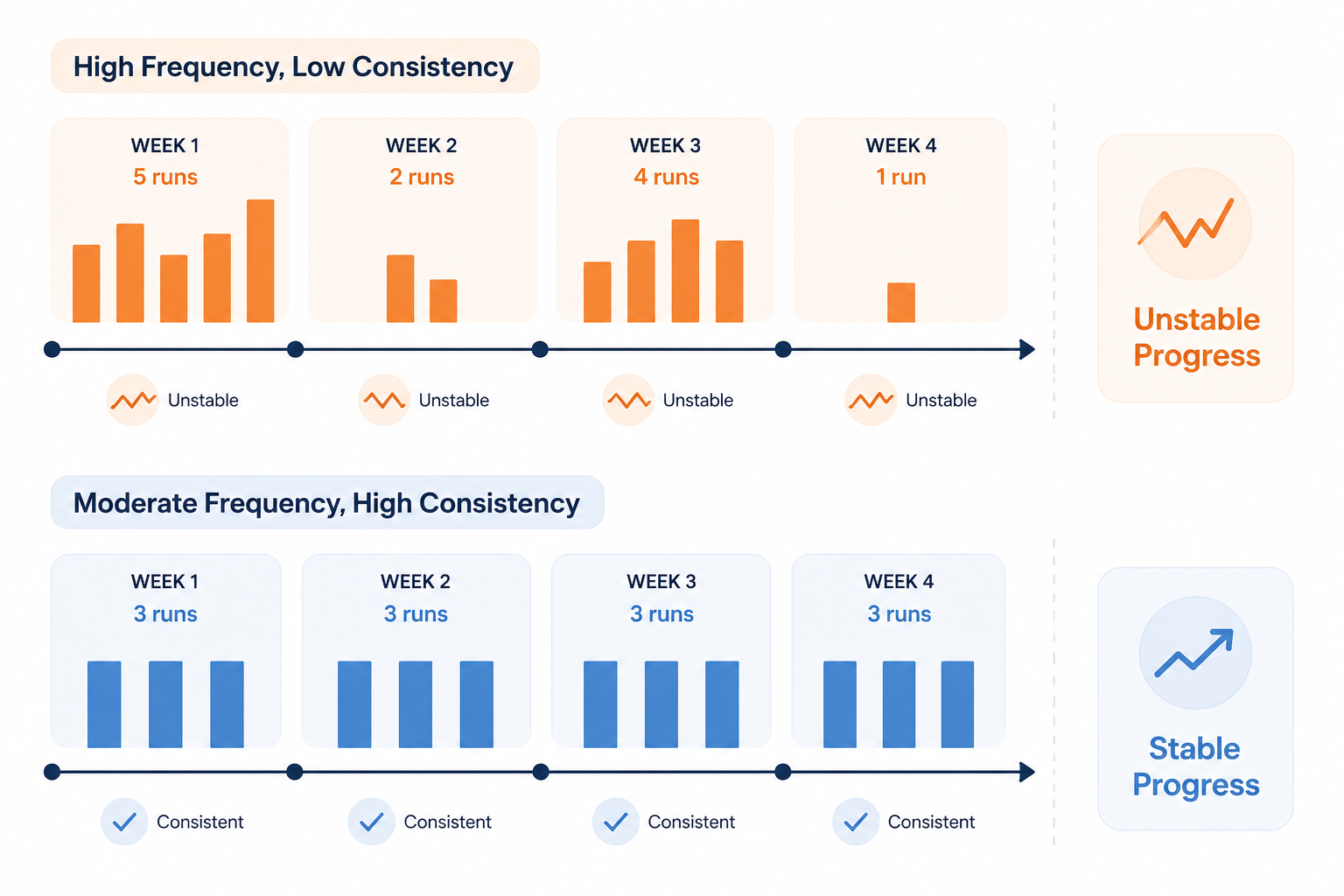
The right frequency is the one you can sustain —
not the one that looks best on paper.
Common mistakes when choosing how often to run
Most runners do not struggle because they lack motivation.
They struggle because they make decisions that their body cannot support.
The most common pattern is doing too much too soon. It usually starts with good intent. You feel motivated, you want to improve, and adding more runs seems like the obvious next step. But when frequency increases faster than your body can adapt, fatigue begins to build quietly in the background.
At first it may feel manageable. Then runs start to feel slightly heavier, recovery becomes less predictable, and the overall rhythm of your week starts to break. This is often how runners drift into the situation described in how to increase weekly running volume safely, where the problem is not effort itself, but how quickly it was added.
Another common mistake is copying other runners.
It is easy to assume that a schedule that works for someone else should work for you. But training is highly individual. Differences in fitness, recovery capacity, and experience all influence how often you can run. When those differences are ignored, the same plan can produce very different results.
A more subtle mistake is ignoring how your runs actually feel.
You may hit your planned number of runs, complete every session, and stay consistent on paper. But if effort is creeping up, if easy runs no longer feel easy, or if you are constantly pushing to maintain pace, the structure is no longer working as intended. This is where understanding what does easy pace actually mean becomes important, because frequency only works when effort stays controlled.
There is also a tendency to turn every run into a hard run.
Running more often does not mean running harder. In fact, the opposite is usually true. As frequency increases, most runs should become easier to allow recovery to keep up. When every session feels demanding, fatigue accumulates and progress slows, even though the total number of runs has increased. This is often the pattern behind what happens if you run too fast too often, where intensity quietly replaces balance.
Finally, many runners chase consistency in numbers rather than consistency in training.
They try to hit the same frequency every week, even when life, stress, or recovery suggests otherwise. But rigid consistency can become fragile. Real consistency is not about repeating the exact same schedule. It is about maintaining a rhythm that your body can sustain over time.
It is not the number of runs that creates problems.
It is how well that number fits your ability to recover.
Why consistency matters more than frequency
It is easy to think that more runs automatically lead to better results.
But progress does not come from isolated weeks. It comes from what you can repeat.
A runner who trains three times per week consistently will often improve more than someone who runs five times one week and two times the next. The difference is not in peak effort, but in stability.
When training is consistent, your body knows what to expect. Stress and recovery stay in balance, and adaptation can build layer by layer. This is closely connected to why consistency matters more than intensity, because improvement depends more on what you repeat than on what you occasionally achieve.
Consistency also creates clarity.
Your runs feel more predictable, your effort becomes easier to manage, and small changes become easier to notice. That is where progress becomes visible, not in single strong sessions, but in weeks that hold together.
What consistency actually looks like in practice
Consistency is not about perfection.
It is about choosing a structure that fits your life and your current capacity, and then repeating it often enough that it becomes stable. Your runs feel manageable, your recovery stays on track, and your week does not depend on constant adjustments.
This does not mean every week looks identical. Some weeks will be lighter, others slightly heavier. But the overall pattern remains recognizable.
When that happens, progress becomes more reliable.
This is also why frequency can be misleading. You can run five times in one week and feel productive, but if the following week drops to two runs because of fatigue, the overall rhythm is lost. On the other hand, running three times per week with consistency creates a stable foundation that your body can build on.
Where to go next
Understanding how often to run is only the first step.
It tells you how many times you go out, but it does not tell you what those runs should look like or how they should work together. Without that structure, even the right frequency can feel uncoordinated.
The next step is learning how to organize those runs into a simple and effective week.
That usually means combining easier runs, one slightly harder effort, and a longer run in a way that supports both progress and recovery. If you want to turn your current frequency into something more structured, build a weekly running structure shows how to put those pieces together into a system you can actually follow.
Conclusion
Choosing how often to run is not about finding the highest number you can manage.
It is about finding a rhythm you can repeat.
Mistakes usually happen when frequency increases faster than recovery, when effort is not controlled, or when structure is copied without context. But when your training matches your capacity, those problems begin to disappear.
Consistency becomes easier, and progress becomes more stable.
In the long run, that matters more than any single number.
Frequency tells you how often to run — structure tells you what to do.
Frequently Asked Questions
How many times a week should I run?
It depends on your level and recovery.
- beginners: 2–3 times per week
- intermediate: 3–4 times per week
- experienced: 5+ times per week
The right number is what you can sustain.
Is running every day a good idea?
For most runners, no.
Daily running requires:
- strong recovery
- controlled effort
- experience
Otherwise, fatigue builds quickly.
Can I improve running only 3 times a week?
Yes.
Running 3 times per week can:
- build endurance
- improve consistency
- support steady progress
Especially if done consistently.
Should I increase my running frequency?
Only if:
- you recover well
- your runs feel controlled
- your current routine feels stable
Add gradually, not suddenly.
As your weekly frequency increases, comfort and efficiency matter more.
The right running shoes help you: reduce unnecessary strain, support consistent training andmaintain smooth movement.
If you’re unsure what to choose, take a look at our guide to the Best Running Shoes for Daily Training (2026).