
Some runs feel difficult almost immediately.
You start at what should be an easy pace, but within minutes your breathing becomes heavier than expected, your legs already feel slightly tired, and maintaining rhythm requires more effort than it should.
For many runners, this becomes frustrating very quickly.
It feels like fitness should already be better by now. You assume something is wrong with your endurance, your conditioning, or your ability to handle running itself.
But getting tired quickly is extremely common, especially in runners whose effort stays slightly too high too often.
And in most cases, the problem is not a lack of toughness.
It is usually a mismatch between effort, recovery, pacing, and aerobic development.
That is important because the solution is rarely pushing harder.
It is usually learning how to make running more sustainable for the body in the first place.
Modern running watches allow you to track pace, distance, heart rate, cadence, VO2 max and much more during workouts.
If you’re choosing one for training, see our guide to the Best Running Watches for Running (2026).
Getting Tired Quickly Is More Common Than Most Runners Think
If you get tired surprisingly early during runs, you are not alone.
In fact, it is one of the most common frustrations runners experience, especially during the first years of consistent training.
The pattern is usually familiar.
The run starts feeling manageable, but within minutes your breathing becomes noticeably heavier, your legs begin losing freshness, and the effort rises faster than expected. Sometimes it happens even on relatively short or easy runs.
What makes this confusing is that it does not match what most runners expect fitness to feel like.
You assume you should be able to hold the pace longer. You expect running to start feeling easier once you train more consistently. And when that does not happen immediately, it becomes easy to think something is wrong with your endurance.
But the body rarely works that simply.
Most runners assume getting tired quickly automatically means poor fitness. In reality, it is often much more connected to pacing, effort control, aerobic development, and accumulated fatigue than runners initially realize.
This is also why Why Running Doesn’t Get Easier becomes such an important concept. Improvement does not always mean effort suddenly feels comfortable. Very often, runners are simply operating at intensities that are still slightly too high for their current aerobic system to support sustainably.
Getting tired quickly is extremely common.
And in most cases, the cause is not a lack of toughness. It is usually a mismatch between the effort you are asking from the body and the effort the body is currently prepared to sustain.
Most Runners Start Slightly Too Fast Without Realizing It
The most common reason runners fatigue early is surprisingly simple.
They begin the run at an intensity that is slightly too high for their current fitness level.
The difficult part is that the pace rarely feels obviously fast at first.
It feels normal. Comfortable. Sustainable enough during the opening minutes.
That is exactly why the mistake is so common.
When effort starts slightly too high, heart rate rises earlier, breathing becomes more active sooner, and the body shifts toward a more demanding energy system before the aerobic system has fully stabilized.
At first nothing feels dramatically wrong.
Then the fatigue suddenly appears all at once:
breathing becomes harder to control, the legs lose rhythm, and the effort starts feeling much heavier than the pace itself seems to justify.
This is the trap many runners fall into repeatedly.
The problem is often not that you are incapable of running the distance. The problem is that you are spending too much energy too early in the run.
If you are unsure whether your easy pace has gradually drifted too high, Am I Running Too Fast? explains how moderate effort often disguises itself as controlled running long before the fatigue becomes noticeable.
In many cases, runners are not getting tired too quickly.
They are simply starting slightly too hard.
For runners struggling to understand what sustainable training pace actually looks like, the Running Pace Zone Calculator can help estimate more realistic pacing ranges based on recent race performance.
Your Aerobic Base May Still Be Developing
Even runners who train regularly often underestimate how long aerobic development actually takes.
The aerobic system is responsible for producing energy efficiently over long durations while keeping effort relatively stable and sustainable. It forms the foundation that allows pace to feel smoother and less stressful over time.
When that system is still developing, the body relies more heavily on higher-intensity energy pathways much earlier during runs.
That changes everything.
Breathing becomes more noticeable sooner. Effort rises faster. Fatigue accumulates earlier than expected, even at paces that do not initially seem aggressive.
This does not mean something is wrong.
It usually means the aerobic system simply has not fully adapted yet.
That phase is completely normal, especially for runners increasing consistency, mileage, or overall training frequency.
The mistake many runners make is assuming the solution is to push harder.
In reality, aerobic development usually improves through controlled intensity:
slower pacing, manageable effort, and consistent exposure to sustainable running stress.
This is why How to Run Slower Without Feeling Awkward becomes such an important adjustment for many runners. Slowing down often feels psychologically difficult before it starts feeling physically effective.
Getting tired early is often not a sign that endurance cannot improve.
It is a sign that the aerobic system is still learning how to support the effort more efficiently.
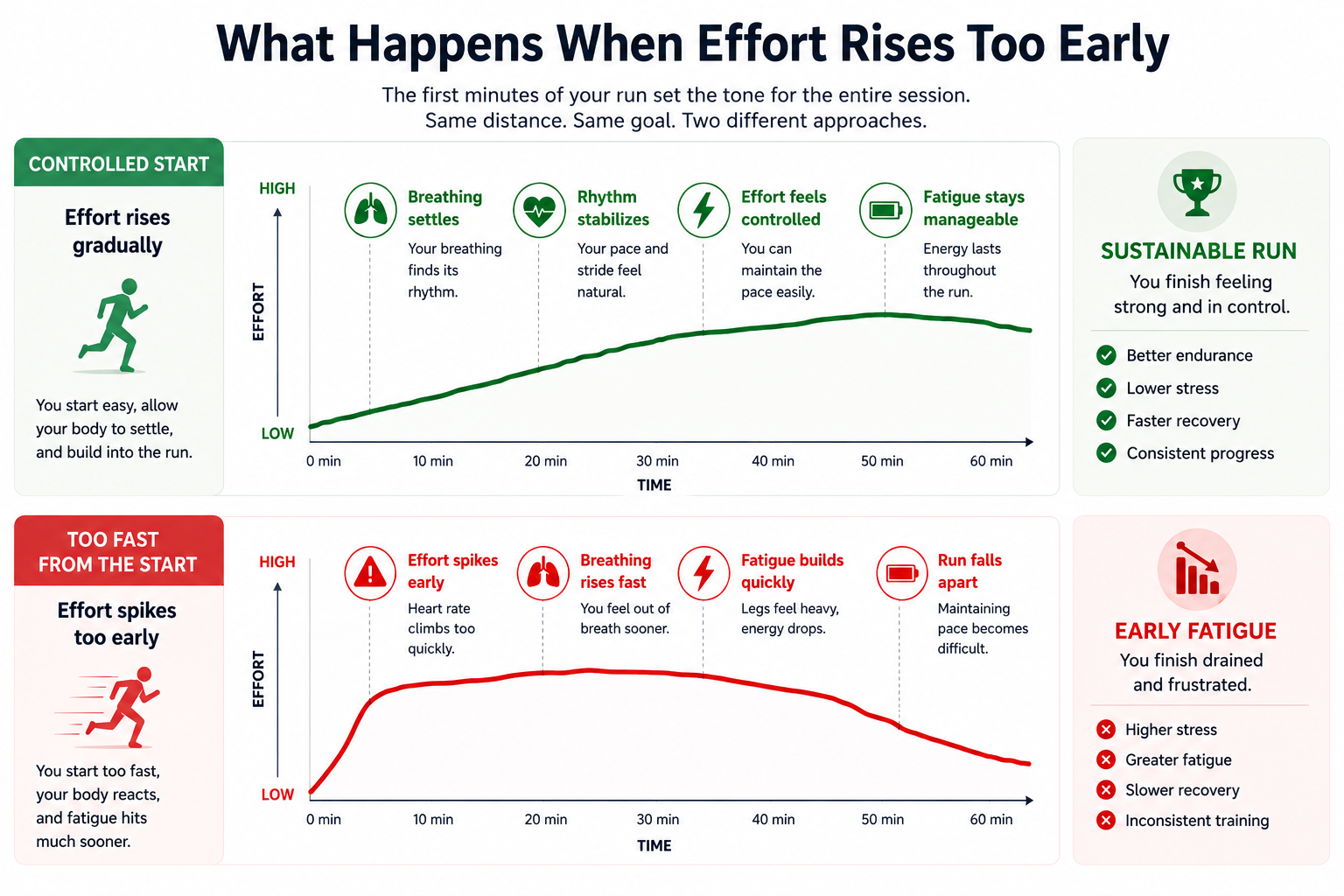
Early Effort Spikes Change The Entire Run
Even when pace itself does not appear extreme, effort can still rise too quickly during the opening phase of a run.
That early spike creates a chain reaction that affects the rest of the session.
At the beginning of a run, the body is still stabilizing:
heart rate is adjusting, breathing rhythm is settling, muscles are warming up, and movement efficiency is still improving minute by minute.
When the opening effort is slightly too aggressive, that stabilization process gets interrupted.
Instead of gradually easing into sustainable rhythm, the body immediately shifts toward a higher stress level. Fatigue begins accumulating earlier, breathing becomes more noticeable, and the run starts feeling difficult long before it physically should.
The difficult part is that runners rarely notice the exact moment this happens.
There is usually no dramatic warning sign.
The effort simply drifts upward quietly until the run suddenly feels much harder than expected.
This is why controlled openings matter so much.
Starting slightly slower than necessary often produces stronger and more sustainable runs overall because it allows the aerobic system enough time to stabilize naturally before the workload increases.
Many runners think the run should feel fully comfortable immediately.
In reality, the body often needs time to settle before movement starts feeling smooth.
Sometimes The Body Simply Has Not Settled Yet
Early fatigue is not always true fatigue.
Sometimes the body simply has not fully synchronized breathing, rhythm, and movement yet.
During the first phase of a run, breathing can feel uneven, stride rhythm slightly unstable, and overall effort more noticeable than it eventually becomes later in the session.
That temporary instability often creates the impression that fitness has suddenly disappeared.
But in many cases, the body is simply still adjusting.
Once breathing settles and movement rhythm becomes more automatic, the same pace often starts feeling much easier without any conscious change in speed.
This is one reason experienced runners often stay patient during the opening kilometers of a run.
They understand that the first minutes do not always reflect the true quality of the session.
The mistake is forcing rhythm too early.
Trying to immediately “lock into pace” often increases tension instead of allowing the body to stabilize naturally. The better approach is usually controlled patience:
slightly easier effort, relaxed breathing, and enough space for rhythm to settle on its own.
Early discomfort does not always mean exhaustion.
Sometimes it simply means the system has not fully synchronized yet.
External Conditions Influence Running More Than Most People Realize
Not every difficult-feeling run is caused by pacing or fitness alone.
External stress changes how running feels much more than many runners expect.
Temperature, humidity, sleep quality, hydration, work stress, recovery status, and nutrition can all influence how quickly effort rises during a run.
That is why identical paces can feel completely different on different days.
The numbers may appear the same: same route, same distance, similar speed.
But internally, the workload may be much higher.
This is where many runners make the mistake of forcing consistency instead of adapting intelligently.
They try to maintain the same pace despite the body clearly signaling higher effort.
Usually that only creates more fatigue, slower recovery, and less productive training overall.
Sustainable consistency does not come from forcing identical performances every day.
It comes from adjusting effort based on what the body can realistically support on that specific day.
How a run feels is not determined only by fitness.
It is also influenced by the total stress already present inside the system before the run even begins.
Pushing Through Early Fatigue Usually Makes The Problem Worse
When fatigue appears early, the natural instinct is to fight it.
Most runners immediately think:
I just need to push through this.
That response feels logical.
You assume the body will eventually adapt if you simply refuse to slow down.
But very often the opposite happens.
Effort continues rising, breathing becomes more strained, fatigue accumulates faster, and the body never fully settles into sustainable rhythm.
Instead of improving endurance, the run simply becomes more stressful.
This creates another hidden problem:
recovery quality starts declining afterward as well.
One slightly excessive run may not matter much alone. But repeated sessions performed above sustainable intensity gradually create chronic fatigue patterns that make future runs feel harder too.
This is one reason What Happens if You Run Too Fast Too Often becomes so important over time. The body usually tolerates occasional excessive effort. What creates problems is the repeated accumulation of slightly too much stress without enough stabilization between sessions.
The better response to early fatigue is usually adjustment, not force.
Sometimes that means slowing down. Sometimes it means shortening the run slightly. Sometimes it simply means allowing effort to settle naturally instead of trying to overpower the feeling mentally.
Endurance improves best when the body can consistently absorb the training, not when every run becomes a battle against fatigue.
What Actually Helps Most
If you get tired quickly during runs, the solution is usually not increasing intensity.
It is improving control.
Starting slower, allowing the body time to settle, monitoring breathing instead of chasing pace, and keeping overall effort more sustainable often changes running far more than harder training does initially.
Endurance develops gradually.
The aerobic system improves through repetition, consistency, and manageable stress that the body can repeatedly recover from over time.
That process often feels slower than runners want.
But it works.
This is also why What Is a Good Heart Rate for Running can help runners understand effort more clearly. Learning how sustainable effort actually feels is one of the biggest turning points in long-term endurance development.
If you are unsure whether your easy effort is drifting too high, the Heart Rate Zone Calculator for Running can help estimate more sustainable aerobic intensity based on real running effort instead of generic formulas.
You usually do not fix early fatigue by becoming tougher.
You fix it by learning how to run with better control.
If you’re unsure what to choose, take a look at our guide to the Best Running Shoes for Daily Training (2026).
Frequently Asked Questions
Why do I get tired so fast when running?
The most common reason is starting at an effort level that is slightly too high for your current fitness. When effort rises too quickly, breathing becomes heavier earlier and fatigue builds much faster than expected.
Is it normal to feel tired early in a run?
Yes. Especially if your aerobic base is still developing, recovery is incomplete, or your body has not fully settled into rhythm yet. Occasional difficult-feeling runs are completely normal.
Does getting tired quickly mean I am out of shape?
Not necessarily. In many cases, runners are simply running at intensities their aerobic system cannot yet sustain comfortably for long periods.
Should I push through the fatigue?
Usually no. Pushing through early fatigue often increases stress without improving adaptation. It is often better to slow slightly and allow the body to stabilize naturally.
How long does it take for running to feel easier?
Aerobic development takes time. Most runners begin noticing more stable breathing, better endurance, and lower perceived effort after several weeks or months of consistent controlled training.
Conclusion
Getting tired quickly during runs is rarely a sign that you are simply incapable of endurance.
More often, it reflects how the body is responding to effort, pacing, aerobic development, recovery, and accumulated stress.
That distinction matters because it changes the solution completely.
The answer is usually not pushing harder.
It is learning how to run at an intensity the body can repeatedly absorb and stabilize over time.
Once runners develop better effort control, easier pacing, and more patience during the opening phase of runs, endurance often improves much more naturally than expected.
And over time, the runs that once felt overwhelming begin feeling steady instead.