
Most runners do not struggle because they train too little. They struggle because their training lacks balance.
Some run too hard, too often, turning most of their week into effort that is difficult to recover from. Others stay too comfortable and never apply enough stimulus to improve. And many end up somewhere in between, where every run feels somewhat hard, but nothing actually moves forward.
The problem is not the amount of training. It is how that training is distributed.
The goal is not to choose between easy and hard running.
It is to understand how they work together.
Because progress does not come from either one on its own. It comes from the balance between them.
Your training works best when the basics are right.
Along with pacing and recovery, the right running shoes help you stay comfortable, consistent, and injury-free.
If you’re unsure what to choose, see our guide to the Best Running Shoes for Daily Training (2026).
Easy and Hard Runs Do Different Jobs
Not every run is meant to feel the same.
Easy runs are where most of your development takes place. They build your aerobic base, support recovery, and allow you to train consistently without accumulating unnecessary fatigue.
Hard runs serve a different role.
They introduce a stimulus your body needs in order to adapt. They challenge your system, helping to improve speed, strength, and overall capacity. Without them, progress eventually plateaus.
But the key is that these two types of runs are not interchangeable.
If all your runs start to feel the same, you lose the benefit of both.
When everything is too easy, there is not enough stimulus to improve. When everything is too hard, recovery breaks down and consistency becomes difficult to maintain.
That is why improvement is never about relying on one type of run. It comes from how these efforts are combined within a structure you can sustain over time. This is explained in more detail in What Actually Improves Your Running Over Time, where the interaction between different training elements becomes clearer.
The Most Common Mistake
The mistake is simple, but very common.
Easy runs are no longer truly easy.
Over time, many runners drift into a middle zone without realizing it. The effort is not relaxed enough to support recovery, but not demanding enough to create a meaningful stimulus. It feels like you are doing something productive, but the training never fully serves either purpose.
That is where the problem begins.
Instead of alternating between easy and hard, everything starts to feel similar. There is a constant level of effort, a constant layer of fatigue, and very little variation in how your body is being challenged.
And that leads to a very specific outcome.
You feel like you are working hard, but nothing is actually building. Progress slows down, recovery becomes less predictable, and the overall structure of your training starts to lose clarity.
This is exactly what happens when you run just slightly too hard, too often. It is not a single mistake, but a pattern that develops gradually, as explained in What Happens If You Run Too Fast Too Often, where this middle-zone effect becomes easier to recognize.
Easy Runs Should Feel Controlled
An easy run should not require effort to maintain.
It should feel steady, relaxed, and sustainable from start to finish. Not effortless, but controlled enough that you are never trying to hold it together. You should be able to finish the run and feel like continuing would still be possible.
That is the signal you are looking for.
When that feeling disappears, the role of the run changes. If you have to push to maintain your pace, if your breathing becomes more noticeable, or if the effort slowly creeps up, then the run is no longer serving its purpose.
And once that happens, the structure of your training begins to shift.
Easy runs stop supporting recovery, hard runs become harder to absorb, and the balance between effort levels starts to break down. This is why many runners begin to feel stuck, even when they are training regularly. The underlying issue is not effort, but how that effort is distributed. This is explained more clearly in Why Easy Runs Feel Too Hard, where the signals of a properly controlled easy run are easier to recognize.
Hard Runs Should Be Purposeful
Hard runs are important.
But they only work when they are controlled.
A good hard session is not defined by how exhausting it feels. It is defined by how clearly it is structured and how well it fits into the rest of your training. The intensity is deliberate, the effort is targeted, and there is enough recovery around it for your body to respond to the stimulus.
That is what makes it effective.
It is not about going all-out. It is about applying the right amount of stress at the right time, in a way that your body can absorb and build from.
Without that control, hard runs lose their purpose.
They become random effort. Sessions may feel difficult, but they are no longer connected to a clear goal. Over time, that leads to inconsistent fatigue, uneven recovery, and progress that does not move in a predictable direction.
Balance Is Not Equal
One of the biggest misunderstandings is thinking that balance means an equal split between easy and hard running.
It does not.
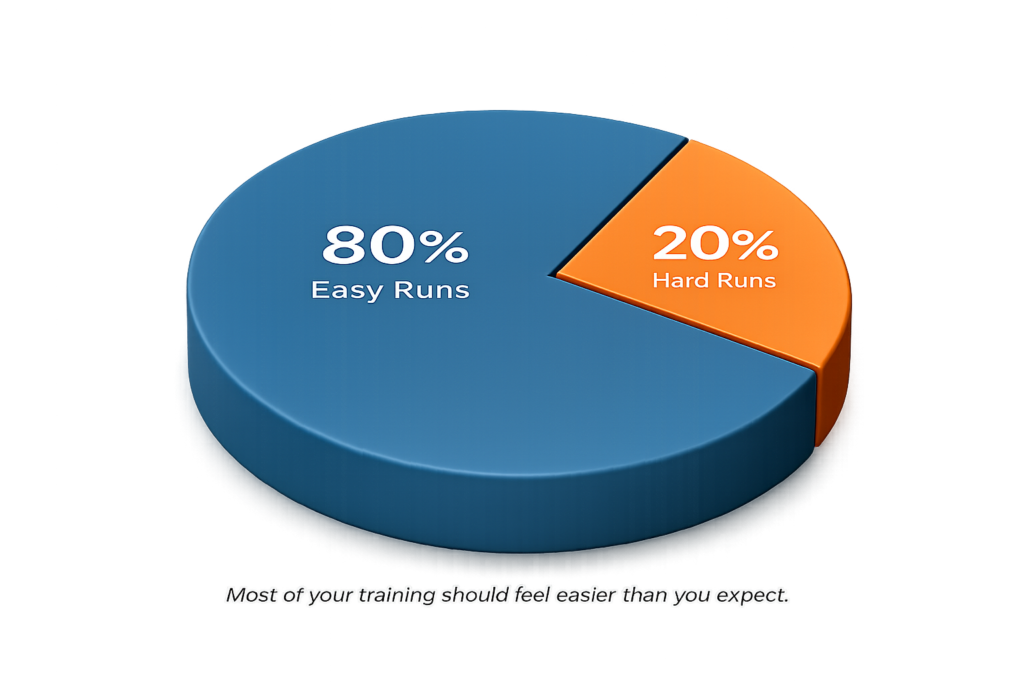
In most effective training structures, the majority of your running is easy. That is what allows everything else to work. Easy runs create the volume your body can handle, support recovery between harder sessions, and make it possible to train consistently over time.
Hard running still has a place, but it is a smaller part of the overall structure.
Typically, most runners progress best when the larger share of their training remains controlled and easy, with a smaller portion dedicated to higher-intensity work. That balance allows your aerobic system to develop, keeps fatigue manageable, and still provides enough stimulus to improve.
The key is not the exact percentage.
It is making sure that easy running stays easy, and hard running remains intentional and well-placed. When that balance is in place, your training becomes sustainable, and progress becomes much more predictable.
If you are unsure whether your current training paces match your actual fitness, the Running Pace Zone Calculator can help estimate more practical pace ranges for easy runs, tempo sessions, and interval work.
Why This Balance Works
Easy running gives you the foundation.
It allows you to accumulate volume without creating excessive fatigue, which is what makes consistent training possible in the first place. It is where most of your long-term development happens, even if it does not feel that way in the moment.
Hard running adds something different.
It introduces the stimulus your body needs in order to adapt. It challenges your system in a way easy running does not, helping to improve speed, strength, and overall capacity.
But the key is how these two interact.
When easy and hard running are combined correctly, they create a system that works. You can train consistently, recover properly between sessions, and continue improving over time without breaking the structure.
Remove either one, and that system starts to fall apart.
Without easy running, fatigue builds too quickly and consistency disappears. Without hard running, there is not enough stimulus to move forward. Both are necessary, but only when they are balanced within a structure your body can sustain.
When the Balance Is Off
If there is too much intensity, the structure begins to break down.
Fatigue builds up faster than your body can recover from it. Recovery becomes inconsistent, and performance starts to fluctuate from run to run. It can feel like you are doing a lot, but the results do not match the effort.
That is often where runners start to feel stuck.
They are working hard, but not moving forward. If that pattern sounds familiar, it is usually a sign that the balance has shifted too far toward intensity, as explained in How To Know If You Are Running Too Much?, where the early signs of excessive load are easier to recognize.
On the other side, too little intensity creates a different problem.
Your training becomes comfortable, but your body no longer has a reason to adapt. Progress slows down, improvements become harder to notice, and performance eventually plateaus.
Neither extreme works.
Balance is what keeps your training moving forward. It allows you to apply enough stress to improve, while still recovering well enough to repeat that process over time.
How To Know If Your Balance Is Right
You do not need complicated metrics to understand this.
You can feel it.
The signals are simple, if you know what to look for. Your easy runs should feel genuinely easy, without needing to hold the pace together. Your hard runs should feel structured and controlled, not random or forced. And between sessions, you should feel that recovery is actually happening.
That is the check.
If those pieces are in place, your balance is likely working. Your training has a rhythm, and each run supports the next.
If not, something is off.
It does not mean your plan is wrong. It usually means the distribution of effort has shifted. Easy runs may have drifted too hard, or hard sessions may not be properly supported by recovery.
That is where small adjustments make the biggest difference.
How To Adjust Your Training
If everything starts to feel too hard, it is usually a sign that your baseline effort has drifted up.
Bring it back down.
Slow your easy runs slightly, even if it feels unnecessary at first. Reduce overall intensity just enough to restore control, not to remove challenge completely. The goal is to create space for recovery again.
If everything feels too easy, the opposite adjustment applies.
Introduce structured intensity where it belongs. Not by pushing every run harder, but by adding focused sessions that create a clear stimulus while keeping the rest of your training stable.
That is the distinction.
You are not trying to increase effort everywhere. You are placing it where it actually matters.
And the key is not making big changes.
Balance is usually restored through small adjustments. A slightly slower easy run, a more controlled hard session, or a better separation between the two can shift the entire system back into place.
Frequently Asked Questions
What is the ideal balance of easy and hard running?
Most runners benefit from roughly 70–90% easy running.
Can I improve without hard runs?
Yes, especially in early stages — but long-term progress usually requires some intensity.
Should easy runs feel very easy?
Yes. That’s what makes consistent training possible.
How many hard runs should I do per week?
Typically 1–2, depending on your level and volume.
Balancing effort becomes much easier when you can actually see what your body is doing.
A reliable heart rate monitor helps you keep easy runs easy — and prevents hard runs from turning into uncontrolled effort — see Best Heart Rate Monitors for Running (2026).
Key Takeaway
Balance is not about equal effort.
It’s about doing most of your running easy — and your hard runs with purpose.