
Running more sounds simple at first.
You add a few kilometers, maybe an extra running day, and try to stay consistent. But for many runners, this is exactly the phase where training suddenly becomes less stable instead of more productive.
Small aches start appearing. Legs feel heavier more often. Recovery becomes less predictable. Progress slows down even though training volume continues increasing.
And eventually many runners reach the same frustrating conclusion:
running more seems to create more problems instead of more fitness.
But usually the problem is not the mileage itself.
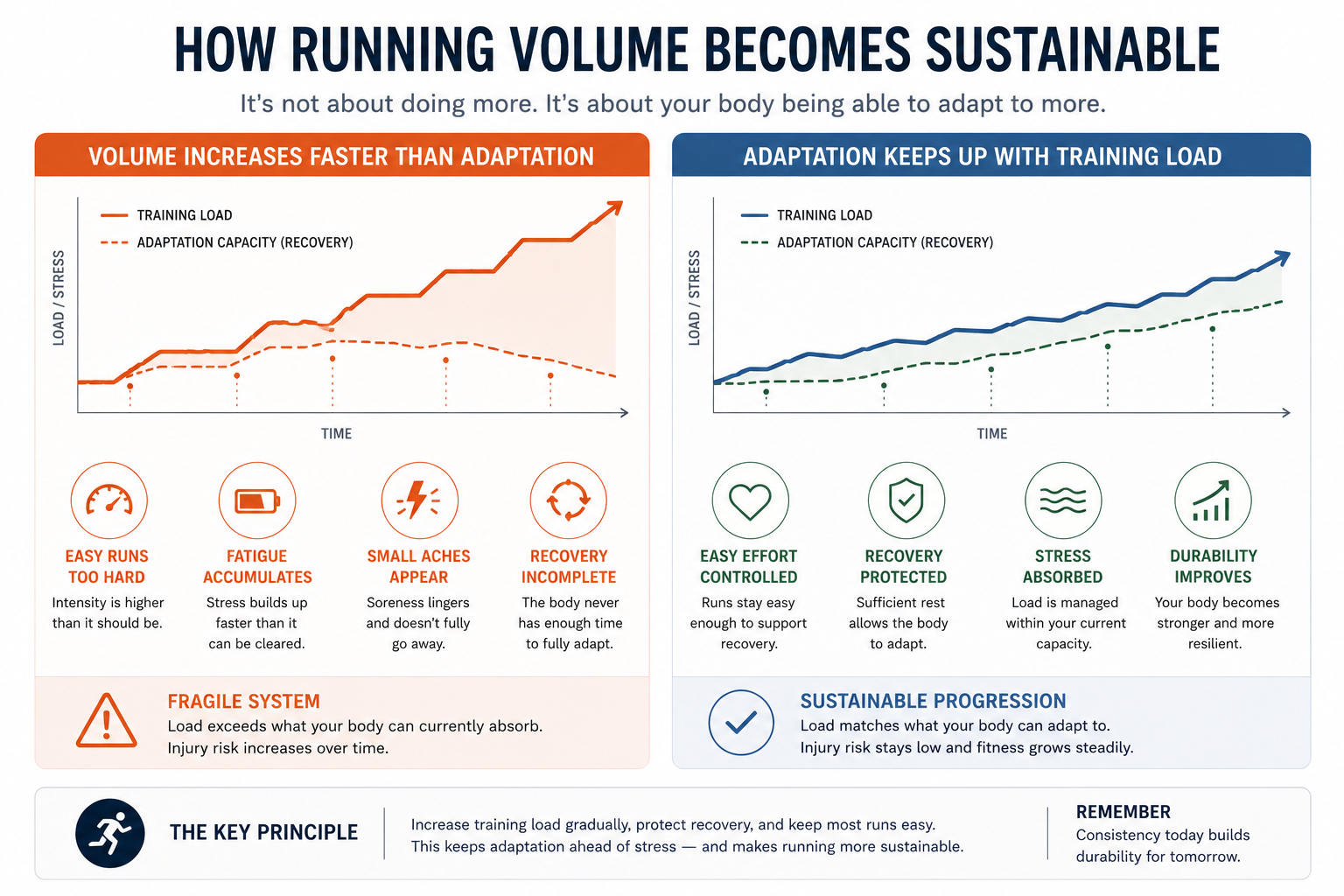
The real issue is that the body is being asked to absorb more stress than it is currently prepared to handle consistently.
That distinction matters enormously because sustainable endurance development is not built by forcing volume upward as quickly as possible.
It is built by increasing stress slowly enough that the body can actually adapt to it.
These decisions become much easier when you can see how your body is responding instead of guessing from pace alone.
If you want a clearer picture of effort, recovery, and day-to-day readiness, you can explore our guide to the Best Running Watches for Running (2026).
The Goal Is Not More Running — It Is Sustainable Running
Many runners quietly assume that more kilometers automatically mean more improvement.
But training only works when the body can successfully recover and adapt to the stress being applied.
That adaptation process takes time, especially for tendons, connective tissue, joints, and smaller stabilizing structures that usually develop much more slowly than cardiovascular fitness itself.
This is one reason runners often feel aerobically capable of more volume before the rest of the body is fully prepared to support it.
And that mismatch is where many injuries begin developing.
If the aerobic foundation itself still feels unstable, How to Build an Aerobic Base explains why endurance development needs to happen gradually before larger training loads become sustainable long term.
Because ultimately, progress is not defined by how much work you complete.
It is defined by how much work your body can consistently absorb and recover from productively.
Most Running Injuries Develop Gradually, Not Suddenly
One of the biggest misunderstandings about running injuries is the idea that they usually come from one dramatic mistake.
In reality, most overuse problems develop much more quietly than that.
Stress slowly accumulates over time:
volume increases slightly too quickly, recovery becomes less complete, and intensity quietly stays a little higher than the body can sustainably tolerate week after week.
And that last part is often the most overlooked.
Many runners trying to increase mileage also unintentionally keep their easy runs too demanding. Effort drifts upward, recovery quality decreases, and hidden fatigue begins accumulating underneath otherwise “normal” training.
If that pattern sounds familiar, What Happens If You Run Too Fast Too Often explains why slightly excessive intensity repeated consistently often becomes more damaging than obviously hard sessions themselves.
The difficult part is that none of this usually feels catastrophic immediately.
The body simply stops fully resetting between training stress.
And eventually, small issues stop resolving completely before new stress arrives again.
The Biggest Mistake Is Increasing Everything At Once
This is where motivation becomes dangerous.
When runners feel inspired, progress-oriented, or excited about improvement, multiple training variables often increase simultaneously without fully realizing it.
Mileage increases.
Frequency increases.
Intensity increases.
Long runs become longer.
Easy runs become slightly faster.
And psychologically, that feels productive.
But physiologically, it often overwhelms the body’s ability to adapt smoothly.
The body handles change much better when stress increases gradually and predictably. When multiple variables rise together, recovery becomes much harder to manage because the system loses stability before adaptation fully catches up.
This is exactly why structure matters so much in endurance training.
Build a Weekly Running Structure explains how organizing stress and recovery intentionally across the week helps create sustainable progression instead of constant overload.
One of the simplest long-term rules in endurance training is also one of the most effective:
change one major variable at a time.
Volume, Frequency, And Intensity All Interact Together
Running load is not just about distance.
It is the interaction between:
how far you run, how often you run, and how hard you run.
And these three variables constantly influence each other.
If frequency increases significantly, intensity usually needs to stay controlled.
If intensity rises, recovery capacity becomes more important.
If long-run volume grows, the rest of the week often needs better balance.
This is why runners sometimes become confused when “moderate” increases suddenly create disproportionate fatigue.
The problem is usually not one variable alone.
It is the combined stress of all variables interacting simultaneously.
If you are still unsure what sustainable weekly frequency should realistically look like for your current stage, How Many Times a Week Should You Run helps establish a more manageable baseline before volume starts increasing aggressively.
The body adapts best when training stress remains organized rather than chaotic.
Easy Running Is What Makes Higher Volume Possible
One of the biggest endurance misconceptions is the belief that running more requires becoming mentally tougher.
Most of the time, it actually requires becoming better at controlling effort.
Easy running is what allows larger volume to exist sustainably.
If easy runs remain genuinely aerobic and controlled, the body can continue accumulating work while still recovering productively between sessions.
But when easy runs slowly drift toward moderate intensity, everything changes.
Recovery becomes incomplete.
Fatigue accumulates faster.
The body loses the ability to fully absorb the growing workload.
And suddenly higher mileage starts feeling fragile instead of sustainable.
This is one reason Why Easy Runs Feel Too Hard becomes such an important concept. Many runners trying to increase volume are not failing because they lack discipline.
They are failing because too much of the training sits inside an intensity range that constantly interferes with recovery.
Running more successfully usually depends less on pushing harder and more on protecting aerobic sustainability.
If easy effort still feels difficult to judge consistently, the Heart Rate Zone Calculator for Running can help establish more realistic aerobic intensity ranges based on your current physiology rather than pace expectations alone.
And if pacing itself still feels unclear during easier runs, the Running Pace Zone Calculator can help estimate more sustainable training pace ranges from recent performances.
Your Body Usually Warns You Before Injury Happens
Most running injuries are preceded by warning signs long before actual breakdown occurs.
The problem is that runners often normalize those signals instead of interpreting them correctly.
The body usually starts communicating through patterns:
persistent heaviness in the legs, slower recovery between runs, rising heart rate at familiar effort, declining pace despite similar effort, or small aches that never fully disappear anymore.
None of those signs necessarily mean injury is already happening.
But they often mean the body is no longer fully adapting to current stress levels.
This is exactly where runners need to shift attention away from motivation and back toward interpretation.
If you are unsure whether training is still productive or simply accumulating fatigue, How to Tell If Your Running Is Improving explains the difference between positive adaptation and hidden overload much more clearly.
The goal is not avoiding all fatigue.
The goal is recognizing when fatigue stops resolving properly.
Durability Is Built Gradually, Not Forced
One of the most important mindset shifts in endurance training is understanding that durability develops slowly.
It cannot be rushed through motivation alone.
The body becomes more resilient by repeatedly experiencing manageable stress followed by sufficient recovery. That process gradually strengthens connective tissue, movement economy, muscular resilience, and overall tolerance for workload.
But when stress consistently exceeds recovery capacity, adaptation stops stabilizing properly.
And eventually the system becomes fragile instead of stronger.
This is why sustainable progression almost always feels calmer and less dramatic than runners initially expect.
Most durable runners are not constantly pushing limits.
They are consistently operating inside stress levels the body can continue absorbing week after week.
That stability is what allows larger volume to exist safely long term.
What Usually Works Better Instead
Running more successfully is usually much less complicated than runners fear.
The principles themselves are relatively simple:
keep most runs genuinely easy, increase workload gradually, protect recovery aggressively, and prioritize long-term consistency over short-term motivation.
The difficult part is accepting how patient that process often needs to be.
But sustainable endurance development almost always looks calmer than people expect from the outside.
If the training system remains stable, volume can grow naturally over time.
If the system becomes constantly overloaded, adding more only magnifies instability.
This is also why What a Balanced Running Week Looks Like becomes so important long term. Sustainable performance usually depends less on extreme workouts and more on how intelligently effort and recovery are distributed across the entire training structure.
Durability is rarely built through heroic effort.
It is usually built through repeatable sustainability.
Frequently Asked Questions
How quickly should weekly mileage increase?
Gradually enough that recovery quality stays stable. Many runners use roughly 5–10% as a loose guideline, but the body’s actual response matters far more than exact percentages.
Is it safer to run more often or make runs longer?
For most runners, spreading workload across multiple manageable runs is usually safer than dramatically extending single sessions.
Can volume and intensity increase together?
Technically yes, but it significantly increases injury risk for most runners. Usually it is safer to progress one major variable at a time.
What are the first signs of excessive training load?
Persistent heaviness, slower recovery, rising heart rate at familiar effort, declining pace consistency, and small aches that stop fully resolving between runs.
Does easy running really matter that much?
Yes. Easy aerobic running is what makes larger training volume sustainable. Without sufficient recovery-friendly running, fatigue accumulates faster than adaptation.
If you want your easy and recovery runs to feel smoother and reduce unnecessary strain, the shoes you use can make a difference.
You can explore options in our guide to the Best Running Shoes for Daily Training (2026).
Conclusion
Running more is not the real goal.
The real goal is building a body that can handle more running sustainably without constantly breaking down underneath the workload.
That process depends far less on motivation than most runners think.
And far more on:
controlled intensity, gradual progression, recovery quality, and long-term consistency.
Because durability is not built by forcing stress upward aggressively.