
There’s a point in training where things stop making sense.
You’re running regularly.
You’re putting in the effort.
And yet — your progress stalls, your legs feel heavy, and nothing feels as easy as it should.
The problem is rarely that you’re not doing enough.
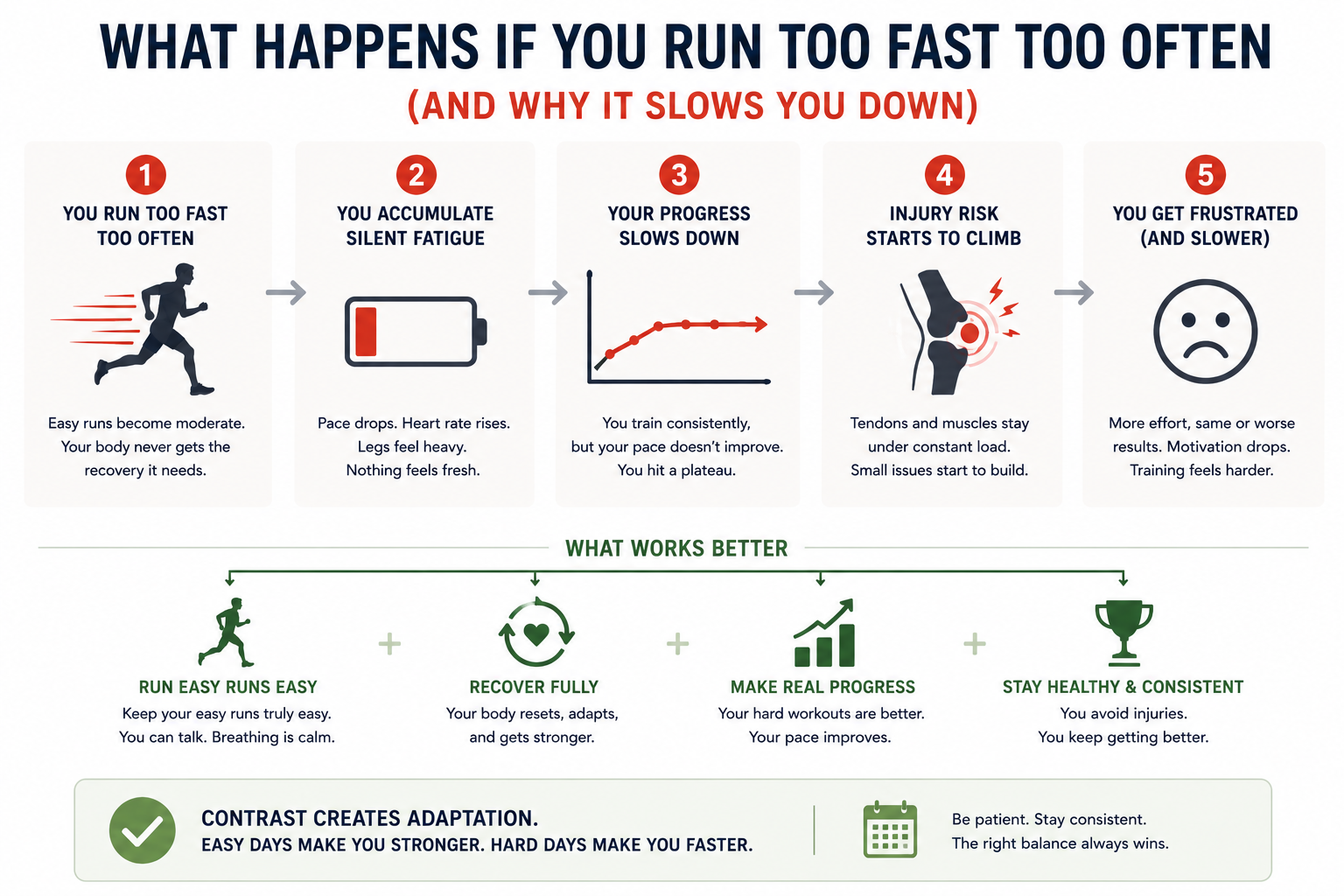
More often, it’s this: you’re running too fast, too often — without realizing it.
Your training works best when the basics are right.
Along with pacing and recovery, the right running shoes help you stay comfortable, consistent, and injury-free.
If you’re unsure what to choose, see our guide to the Best Running Shoes for Daily Training (2026).
The Hidden Problem: Most Runs Drift Too Fast
Very few runners deliberately go out and run too hard. Most of the time, the shift happens gradually and almost unnoticed.
The run starts comfortably. Breathing feels relaxed, pace feels natural, and everything seems under control. But little by little, the effort begins drifting upward. Your breathing becomes slightly more noticeable, your heart rate climbs higher than expected, and the run quietly moves away from true easy intensity.
The difficult part is that it still feels manageable.
That is exactly why so many runners spend too much time in the moderate-effort zone:
not easy enough to fully support recovery, but not hard enough to create high-quality performance adaptation either.
This is also where many runners misunderstand what easy running should actually feel like. Truly sustainable aerobic effort is usually calmer and more controlled than people initially expect.
If you are unsure what that effort should realistically feel like during a normal run, What Does an Easy Run Actually Feel Like explains where most runners unintentionally start drifting too hard.
You Lose the Purpose of Easy Runs
Easy runs are often misunderstood as “less important” training days, when in reality they are what make the entire system sustainable.
This is where aerobic development happens. It is where the body learns to produce energy more efficiently, where recovery stabilizes between harder sessions, and where weekly mileage becomes manageable without constantly accumulating excessive fatigue.
But when easy runs slowly drift into moderate effort, that balance starts disappearing.
Recovery becomes less complete. Fatigue begins carrying from one session into the next. The body never fully settles before new stress arrives again.
And over time, that quietly changes how every run feels.
This is also why many runners struggle with intensity distribution without fully realizing it. Understanding the difference between truly easy effort and recovery-focused running becomes extremely important once training volume starts increasing.
If that distinction still feels unclear, What Is the Difference Between Easy Runs and Recovery Runs? explains why those two types of runs serve different purposes even when both feel relatively comfortable.
Your Hard Workouts Stop Working
This is usually where the problem finally becomes visible.
Workouts that should feel controlled suddenly feel unusually demanding. Tempo runs become unstable earlier than expected, interval sessions feel heavier from the beginning, and holding planned pace requires more effort than it should.
Not necessarily because fitness disappeared.
But because the body never fully returned to a stable recovery state between sessions.
When easy runs consistently become too demanding, harder workouts gradually lose their quality as well. Fatigue starts replacing adaptation, and training becomes increasingly difficult to absorb productively.
Over time, that affects progression far more than most runners realize.
This is exactly why weekly structure matters so much. Sustainable improvement usually depends less on individual hard sessions and more on how well effort and recovery are balanced across the entire week.
If you want a clearer framework for organizing that balance, How to Build a Weekly Running Structure That Actually Works explains how different run types support each other inside a sustainable training system.
You Start Accumulating Fatigue Without Fully Noticing It
This is usually the phase where the problem becomes hardest to recognize clearly.
Nothing feels dramatically wrong at first.
You are still training consistently. You are still completing runs. Motivation is still relatively normal. But underneath that surface, the body slowly stops fully absorbing the workload.
The signs are subtle:
pace begins dropping slightly at the same heart rate, heart rate rises earlier at familiar paces, and the legs start feeling mildly heavy more often than not.
Not exhausted.
Just never completely fresh.
That is what makes this type of fatigue so deceptive.
It rarely stops training completely. Instead, it quietly limits adaptation while the runner continues accumulating stress week after week.
The difficult part is that most runners interpret this as needing more effort rather than less.
But very often, the body is not asking for harder training.
It is asking for more recovery space between the stress.
Progress Starts Slowing Even Though Training Continues
This is usually the point where frustration begins building.
You are consistent. You are disciplined. You continue putting in the work. Yet despite all of that, progress starts feeling strangely flat.
Pace no longer improves the way it once did. Runs stop feeling smoother. Performance stabilizes instead of developing forward.
In many cases, the issue is not lack of effort.
It is lack of contrast.
The body adapts best when easy days remain truly easy and harder sessions remain clearly purposeful. But once most runs drift into the same moderate intensity range, that separation disappears.
Everything becomes slightly stressful.
Nothing becomes fully recoverable.
And nothing becomes high-quality enough to create stronger adaptation either.
That is one reason many runners eventually feel stuck despite increasing training consistency.
If this pattern sounds familiar, Why Your Pace Is Not Improving (Even If You Train Regularly) explains why progress often slows when overall intensity distribution becomes too blurred across the training week.
Average effort repeated constantly usually creates average adaptation.
Injury Risk Quietly Starts Increasing
One of the most overlooked consequences of constantly running slightly too hard is not immediate exhaustion.
It is accumulated mechanical stress.
When recovery becomes incomplete for long periods, muscles stay under low-grade fatigue, tendons remain under repeated loading, and small weaknesses stop resolving fully between sessions.
This is rarely caused by one dramatic mistake.
Much more often, it develops through small amounts of excessive stress repeated consistently over time.
That is where:
Achilles irritation, lower-leg tightness, knee discomfort, and persistent stiffness often begin appearing.
Not because training suddenly became extreme.
But because the body stopped fully resetting between efforts.
This is also why injury prevention depends so heavily on proper intensity balance rather than simply lowering mileage alone.
Why This Pattern Feels So Normal
Very few runners intentionally train too hard.
In fact, this pattern usually develops from good intentions.
Running slowly often feels psychologically uncomfortable at first. Easy pace can feel almost “too easy,” especially for runners who associate improvement with constant effort.
So gradually, pace becomes something you start chasing without fully noticing it.
Moderate effort begins feeling normal.
Slightly elevated breathing starts feeling acceptable.
And over time, the entire effort baseline quietly shifts upward.
That is how excessive easy-run intensity becomes invisible.
This is one reason many runners struggle understanding what sustainable easy effort should actually feel like. Truly aerobic running is often calmer, smoother, and more controlled than most people initially expect.
What Usually Works Better Instead
The solution is usually much simpler than runners want it to be.
Easy runs need to stay genuinely easy.
That means breathing remains relaxed, conversation stays comfortable, and effort feels sustainable enough that the body can recover while still accumulating aerobic work.
The goal of easy running is not proving fitness.
It is supporting adaptation.
Hard sessions should create the primary stress. Easy sessions should create the recovery space that allows the body to absorb that stress productively.
That balance is where sustainable progress actually comes from.
If easy effort still feels confusing or difficult to judge consistently, What Does Easy Pace Actually Mean? explains why sustainable aerobic running often feels much slower and calmer than runners initially expect.
Frequently Asked Questions
Is it bad to run fast every day?
Not immediately — but over time, it reduces recovery and limits progress.
How slow should easy runs be?
Slower than you think. Effort matters more than pace.
Can I improve without slow running?
Short-term, maybe. Long-term, no.
Why do easy runs feel too hard sometimes?
Because accumulated fatigue is already there.
One of the simplest ways to control this is by tracking effort more objectively.
A reliable heart rate monitor can help you stay within the right intensity — especially on easy days when pace can be misleading.
If you’re choosing one, here’s a clear comparison of the best options → Best Heart Rate Monitors for Running (2026)
Key Takeaway
The problem is not that you’re training too much.
It’s that you’re training at the wrong intensity too often.
Run your easy runs easy — so your hard runs can actually work.