
It usually does not feel obviously fast.
You go out for what should be a normal run, settle into a pace that feels reasonably comfortable, and everything initially seems under control.
Then gradually something changes.
Your breathing becomes slightly more noticeable. Your heart rate climbs faster than expected. Your legs begin feeling heavier earlier in the run. And by the end, the effort feels strangely high for what was supposed to be an ordinary session.
That is where many runners start wondering:
Am I running too fast?
The confusing part is that running slightly too hard rarely feels dramatic.
Most runners are not sprinting through easy days. They are simply operating at an effort level that is just a little too high for sustainable aerobic running.
And over time, that small difference changes everything.
These decisions become much easier when you can see how your body is responding instead of guessing from pace alone.
If you want a clearer picture of effort, recovery, and day-to-day readiness, you can explore our guide to the Best Running Watches for Running (2026).
Running Too Fast Usually Feels Surprisingly Normal
One of the biggest misconceptions in endurance training is assuming excessive effort should feel obvious.
But the problem is rarely extreme intensity.
Most runners who struggle with fatigue, stalled progress, or constantly difficult runs are not training far too hard. They are training slightly above the intensity their aerobic system can comfortably support day after day.
That moderate effort zone often feels:
controlled, productive, and manageable at first.
Which is exactly why it becomes so easy to repeat.
The issue is physiological, not psychological.
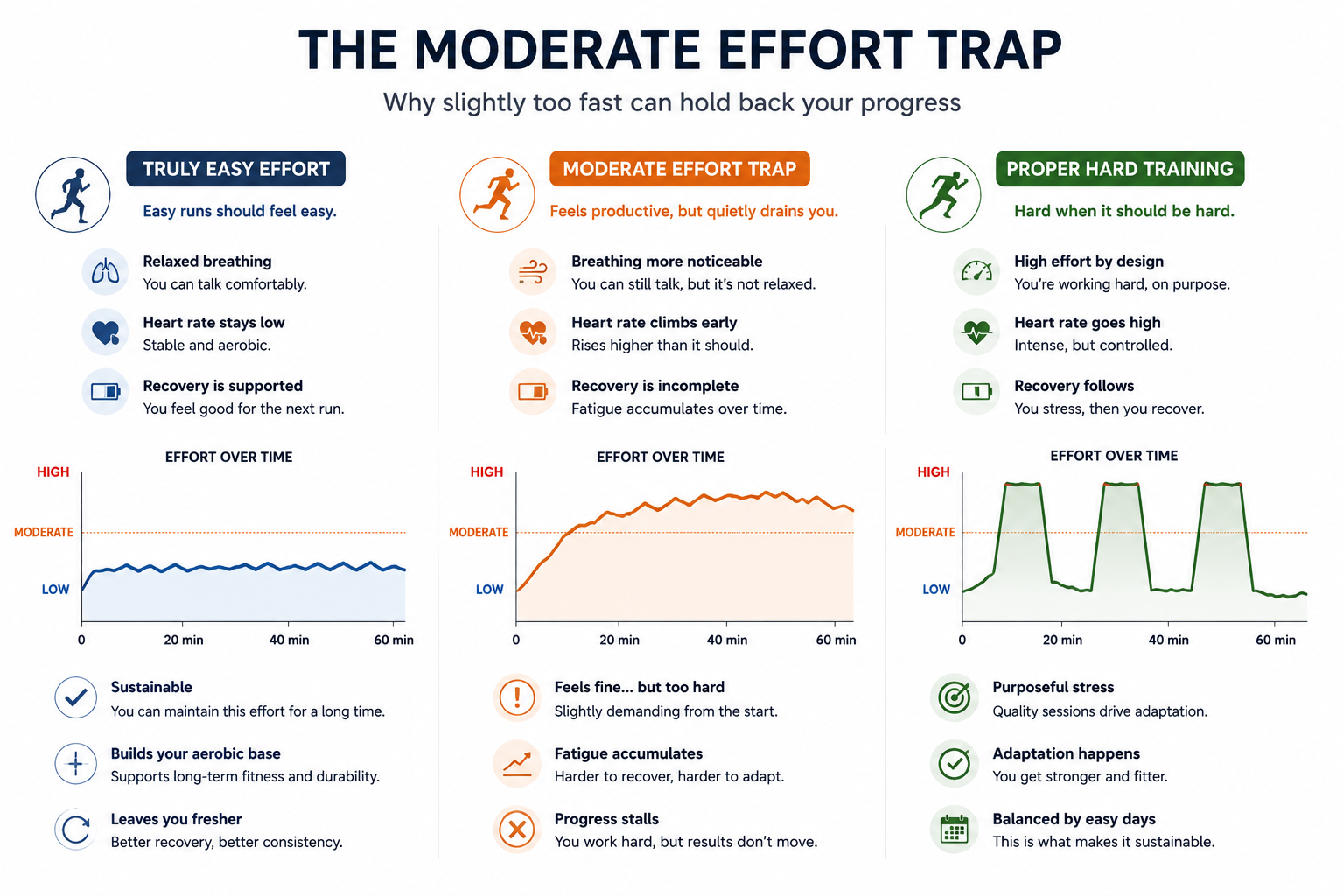
Once effort drifts slightly above true easy intensity, recovery becomes less complete, fatigue accumulates more quietly, and the body starts carrying more stress across the entire training week.
This is where many runners unknowingly get stuck:
not easy enough to recover properly, but not hard enough to maximize quality adaptation either.
Over time, the result is often:
constant fatigue, inconsistent recovery, and runs that feel harder than they should.
This is also why What Is a Good Heart Rate for Running becomes so important. Sustainable training effort usually feels calmer and less dramatic than many runners initially expect.
Running too fast rarely feels reckless.
It usually feels only slightly harder than necessary.
Your Breathing Often Reveals The Problem First
One of the earliest signs of excessive pace is not your legs.
It is your breathing.
Not heavy breathing in the obvious sense. Most runners are not gasping for air during these runs. The signal is much subtler than that.
Breathing simply stops feeling fully relaxed.
At truly sustainable easy effort, breathing settles naturally into the background. Conversation feels smooth. Rhythm stays stable. You are not consciously monitoring your breathing pattern at all.
But when pace drifts slightly too high, breathing becomes more mentally noticeable. You start controlling it instead of ignoring it. Speaking comfortably becomes less natural. The run still feels manageable, but no longer truly relaxed.
That small shift matters much more than most runners realize.
Because once breathing becomes slightly strained early in the run, effort usually continues building gradually underneath the surface.
If you constantly feel aware of your breathing during supposedly easy runs, there is a good chance your pace is already slightly too high.
Heart Rate Usually Rises Before Effort Feels Hard
Another reason runners miss excessive pace is because perceived effort often reacts slower than physiology itself.
The pace still feels manageable, but internally the body has already shifted into higher stress.
Pace alone does not always reveal how demanding a run was. The Run Effort Check Calculator combines subjective and objective signals to estimate overall effort.
This is where heart rate becomes extremely useful.
One of the clearest signs of excessive easy-run pace is heart rate climbing unusually quickly during the opening phase of the session. The body is working harder before the runner consciously feels the consequences yet.
That happens because slightly excessive pace forces the cardiovascular system to respond earlier and more aggressively in order to support the demand.
The difficult part is that runners often wait until the run feels hard before adjusting.
Usually that is already too late.
If you have noticed your heart rate climbing unusually early during easy runs, Why Your Heart Rate Is High on Easy Runs explains the most common causes behind that pattern.
And if you are unsure what sustainable aerobic intensity should realistically look like, the Heart Rate Zone Calculator for Running can help estimate more practical training zones based on recent running effort rather than generic formulas alone.
The Real Problem Usually Appears Later In The Run
The strongest clue that you started too fast often does not appear during the first kilometers.
It appears later.
The pace initially feels smooth and controlled. But gradually the effort begins drifting upward even though the pace itself remains unchanged.
Breathing becomes heavier. Legs lose freshness. Maintaining rhythm requires more concentration.
Eventually the run feels much harder than it logically should.
This is one reason many runners misunderstand pacing entirely.
They assume the problem started when the fatigue appeared.
In reality, the mistake usually happened much earlier.
The body simply spent energy too aggressively during the opening phase, and the cost only became visible later in the run once fatigue accumulated enough to expose it.
This is also why easy pacing matters so much for long-term consistency.
If easy runs repeatedly become moderate-effort sessions, recovery quality starts declining even when training volume itself appears reasonable.
Easy Runs Should Not Constantly Feel Difficult
One of the clearest long-term signs of excessive pacing is when easy days stop feeling genuinely easy.
Not occasionally. Consistently.
You begin noticing that:
breathing is always slightly elevated, effort never fully settles, and recovery runs somehow still feel tiring despite the pace appearing reasonable on paper.
This is where many runners enter a difficult cycle.
Runs feel harder than expected, so they push slightly more to maintain pace. That added stress increases fatigue further, which then makes future runs feel even harder again.
Over time, effort baseline slowly rises across the entire training week.
That is why Running Feels Hard? Here’s Why becomes such an important concept. Difficulty during running is often less connected to fitness itself and more connected to accumulated stress and pacing habits across multiple sessions.
If easy running no longer feels genuinely sustainable, overall training intensity is probably drifting too high.
Sometimes Lack Of Progress Is Actually A Pacing Problem
Many runners assume stalled progress automatically means they need more intensity.
Very often the opposite is true.
When easy effort remains slightly too high for long periods, the body spends too much time under moderate stress and too little time fully recovering. Adaptation quality gradually starts declining even though training effort remains high.
This creates one of the most frustrating situations in running:
you continue training consistently, but runs do not feel easier and performance improvements slow down unexpectedly.
The issue is usually not lack of discipline.
It is accumulated fatigue without enough stabilization.
Paradoxically, many runners start improving again only after lowering intensity and allowing more truly aerobic running back into the system.
That is also why How to Lower Your Heart Rate While Running often becomes less about forcing lower numbers and more about learning how sustainable effort actually feels.
Progress usually returns once effort becomes more balanced again.
Running Slightly Slower Often Creates Better Training
One of the hardest things for runners to accept is that slower running is not wasted running.
In reality, sustainable endurance development depends heavily on keeping most training controlled enough for the body to absorb consistently.
When pace becomes more manageable:
recovery improves, aerobic development becomes more stable, harder workouts become more effective, and overall consistency becomes easier to maintain across months instead of days.
This is where structure matters far more than isolated hard efforts.
Not every run needs to feel impressive.
Each run simply needs to serve a purpose inside the overall system.
That is why Build a Weekly Running Structure becomes so important long term. Good training usually depends less on maximizing individual runs and more on balancing stress and recovery across the entire week.
Running slower is not moving backward.
It is often what finally allows runners to move forward sustainably.
What To Do If You Think You’re Running Too Fast
The solution is usually simpler than runners expect.
Slow down more than feels necessary initially.
Allow breathing to settle naturally instead of forcing pace early. Stop treating pace as the primary goal of every run. Learn to evaluate effort through breathing, rhythm, recovery quality, and overall sustainability rather than speed alone.
Most importantly, be patient.
If you have spent months or years operating slightly above sustainable easy intensity, truly controlled running may initially feel awkward or unusually slow.
That is normal.
But over time, the body adapts.
Easy effort becomes more natural, recovery improves, and running starts feeling smoother instead of constantly demanding.
For runners struggling to understand what sustainable pacing should realistically look like, the Running Pace Zone Calculator can help estimate more practical training ranges based on current fitness and recent running performance.
Frequently Asked Questions
How do I know if I’m running too fast?
The clearest signs are usually subtle:
breathing feels controlled but not fully relaxed, heart rate rises unusually early, effort gradually increases during the run, and recovery becomes less complete afterward.
Should easy runs feel very slow?
Often yes. Truly aerobic running usually feels calmer and more controlled than many runners initially expect.
Is it bad to run slightly too hard every day?
Over time, yes. Constant moderate effort often leads to accumulated fatigue, incomplete recovery, and slower long-term progress.
Should I always slow down if a run feels hard?
Usually adjusting slightly earlier is better than forcing pace unnecessarily. Sustainable effort almost always produces better long-term consistency.
Can slower running actually improve performance?
Absolutely. Aerobic development, recovery quality, and overall training consistency often improve significantly once effort becomes more controlled.
If you want your training to feel more stable and reduce unnecessary strain during runs, supportive gear can help as well.
You can explore options in our guide to the Best Running Shoes for Daily Training (2026).
Conclusion
Running too fast rarely feels dramatic.
That is exactly why it becomes such a common problem.
Most runners who struggle with fatigue, inconsistent recovery, or stalled progress are not training recklessly hard. They are simply operating slightly above sustainable effort more often than they realize.
Over time, that small difference quietly changes recovery, aerobic development, and overall training quality.
The solution is usually not pushing harder.
It is learning how sustainable effort actually feels.
Once runners develop better pacing awareness, easier breathing, and more controlled aerobic effort, training often becomes smoother, more repeatable, and much more effective over the long term.