
Running more often feels like progress.
More kilometers. More consistency. More discipline.
But there’s a point where “more” quietly turns into too much.
Not in a dramatic way. Nothing breaks overnight.
Instead, things just start to feel… off.
The challenge is that running too much rarely looks like a clear mistake.
Modern running watches allow you to track pace, distance, heart rate, cadence, VO2 max and much more during workouts.
If you’re choosing one for training, see our guide to the Best Running Watches for Running (2026).
The Problem: There’s No Clear Line
There is no single point where training suddenly becomes too much.
What feels manageable for one runner can feel overwhelming for another, even at the same volume. The difference comes from context. Your training history, your current level of fitness, and how well you are recovering all shape how your body responds to the workload.
That is why copying someone else’s training rarely works in practice. The numbers may look reasonable, but they are not built around your capacity.
Training only works when it aligns with where you are right now, not where someone else is. If you want to understand how to build that alignment more safely, it helps to revisit How To Run More Without Getting Injured.
Too Much Isn’t About One Run — It’s About Accumulation
Running too much is rarely the result of one hard session.
It builds more quietly than that.
Most of the time, it comes from a series of small imbalances. The volume is just slightly higher than what your body can comfortably absorb. The intensity creeps up more often than it should. Recovery is just a bit shorter or less effective than needed.
None of these things feel extreme on their own.
But over time, they accumulate.
What makes this especially difficult to recognize is that the training still feels manageable in the moment. There is no clear breaking point, no single session that stands out. The strain builds gradually, often in the background.
This pattern is closely linked to the tendency to run just a bit too hard, a bit too often, something explored in What Happens If You Run Too Fast Too Often.
And because everything still feels “reasonable,” it is easy to miss until the effects start to show.
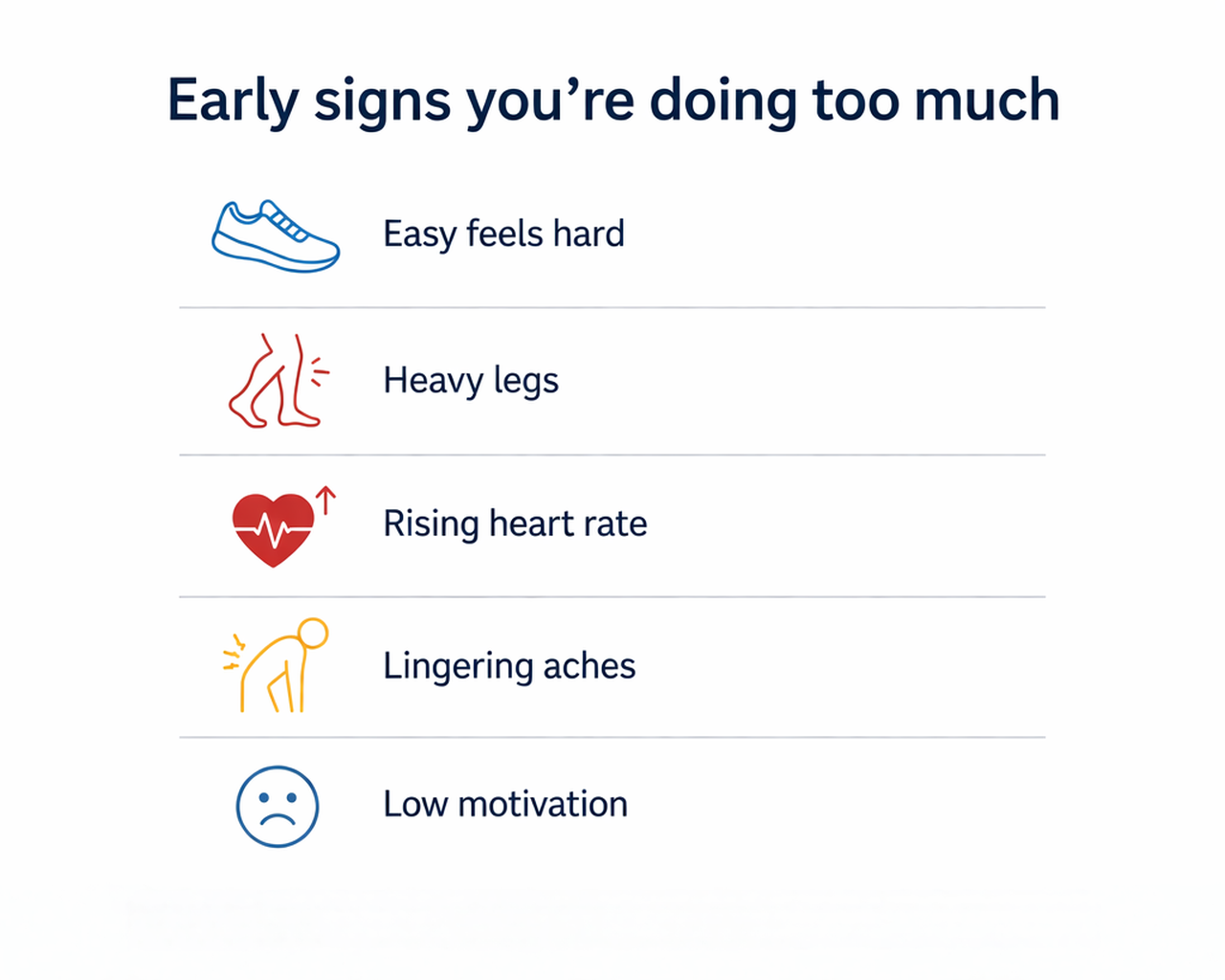
Early Signs You’re Doing Too Much
Your body usually gives signals before anything actually breaks down.
The challenge is not whether those signals exist, but whether you notice the pattern.
It rarely shows up as a single bad run. Instead, small changes begin to repeat. Easy runs stop feeling truly easy. Your legs feel heavier than expected, even on days that should feel fresh. Motivation becomes harder to find, not because you do not want to run, but because the effort feels less inviting.
You may also notice that your heart rate behaves differently, sitting slightly higher than usual at the same effort.
None of these signs are dramatic on their own.
But together, they point in the same direction.
Often, the first clear signal appears in your easy runs. When something that should feel relaxed starts to feel demanding, it is usually an early indication that the overall load is drifting too high. If that feels familiar, it helps to revisit Why Easy Runs Feel Too Hard, because that shift in effort is rarely random.
These are not random bad days.
They’re signals.
Performance Starts to Plateau (or Drop)
At first, everything can still feel productive.
You are training regularly, the sessions are getting done, and there is a sense that you are doing the right work. Nothing feels obviously wrong.
But over time, small changes begin to appear.
Your pace stops improving in the way you expected. Workouts that used to feel manageable start to feel more demanding. Consistency becomes harder to maintain, not because of one bad day, but because the overall load becomes more difficult to absorb.
This is where things become confusing.
You are putting in more effort, but the return on that effort starts to fade.
It feels like you should be progressing, yet the results do not reflect it.
That disconnect is often a sign that the balance between training and recovery has shifted slightly out of alignment. If that pattern sounds familiar, it is closely related to what is explained in Why Your Pace Is Not Improving.
Fatigue Becomes Your Baseline
This is the most subtle phase, and often the hardest to recognize.
Nothing feels dramatically wrong. There is no clear breaking point, no single run that stands out as a problem. Training continues, sessions get completed, and everything appears to be moving forward.
But something has shifted.
Your legs are never fully fresh. Runs feel acceptable, but rarely good. Recovery happens, but it never feels complete. The baseline has quietly moved from “ready” to “just managing.”
That is what makes this phase difficult.
There is no obvious signal to react to, only a gradual loss of clarity. You are no longer sure whether you are building fitness or simply carrying fatigue from one run to the next.
If that uncertainty feels familiar, it helps to revisit How to Tell If Your Running Is Improving, because the difference between progress and accumulated fatigue is not always visible from the outside.
This is where too much training tends to hide.
Small Issues Start to Stick Around
Instead of a clear injury, the signs are much more subtle.
You begin to notice small areas of tension. Your calves feel tighter than usual. There is a slight discomfort around the knee that comes and goes. Your Achilles feels a bit stiff, especially at the start of a run.
Nothing is sharp or alarming.
At first, it is easy to ignore. The sensations fade as you warm up, and the run continues without major issues. It feels manageable, even normal.
But they never fully disappear.
They return the next day, and then again after the next run. Not worse, but not better either. Over time, these small signals stop being random and start forming a pattern.
That is usually the point where the body is no longer fully keeping up with the training load.
That’s the key signal.
If something never fully resets, your load is too high.
The Real Cause: Imbalance, Not Effort
Running too much is rarely about a single hard effort.
It is usually about how the different parts of training fit together.
When load, recovery, and intensity are not in balance, even reasonable training can become too much. The volume might look moderate, the sessions might not feel extreme, but the overall structure does not allow the body to absorb the work.
That is when fatigue begins to accumulate instead of resolve.
The issue is not how hard you are training on any given day. It is whether your week creates enough space for that training to be processed.
If that structure is missing, even well-intended training can become counterproductive. To see how that balance should look in practice, it helps to revisit Build a Weekly Running Structure.
A Simple Self-Check
Instead of asking whether you are running too much, it helps to shift the question slightly.
Do your runs still feel sustainable?
That is usually where the answer becomes clearer. Not in a single session, but across the entire week. Can you move from one run to the next without forcing it? Do your easy runs still feel controlled and relaxed, or do they require more effort than they should? When a session ends, does recovery happen naturally, or does it feel incomplete before the next one begins?
These are not dramatic signals, but they are reliable ones.
When training is balanced, there is a sense of continuity. Each run connects to the next without resistance. When the load becomes too high, that connection starts to break. You begin to manage the training instead of flowing through it.
If that shift is already present, it is usually a sign that the current load is exceeding what your body can comfortably absorb.
What To Do If You Are Running Too Much
You usually do not need to stop.
What matters more is making a small adjustment before the imbalance grows.
That often means stepping back just enough to let your body catch up. The overall volume can come down slightly, not dramatically, just enough to reduce the constant pressure. Easy runs return to what they are meant to be, truly controlled and relaxed, instead of drifting into something more demanding.
At the same time, recovery is given space to work again.
When that balance returns, training starts to feel connected rather than forced. The goal is not to remove effort, but to restore the conditions where that effort can actually be absorbed.
If your training feels unstable, the solution is not more effort.
It’s better balance.
Frequently Asked Questions
How many runs per week is too much?
It depends on your level and recovery, not just the number.
Is it better to run less and feel good?
Yes — consistency beats overload.
Can you recover while still running?
Yes, if intensity and volume are controlled.
What’s the biggest mistake?
Ignoring early signs and continuing to add load.
One of the easiest ways to detect when your training is drifting too high is by tracking your effort.
A reliable heart rate monitor helps you see rising fatigue before it becomes a problem — see Best Heart Rate Monitors for Running (2026).
Key Takeaway
Running too much doesn’t feel like a big mistake.
It feels like slow accumulation.
If your training no longer feels sustainable, it’s time to adjust — not push harder.