
Most runners assume improvement comes from training harder.
Faster intervals, tougher sessions, pushing closer to the limit. And while intensity does have its place, it is rarely the main thing driving long-term progress.
What usually separates runners who improve from those who stay stuck is not how hard they train on any one day.
It is how consistently they are able to show up, train, recover, and repeat the process over time.
Modern running watches allow you to track pace, distance, heart rate, cadence, VO2 max and much more during workouts.
If you’re choosing one for training, see our guide to the Best Running Watches for Running (2026).
Consistency Builds What Intensity Cannot
Every run creates a small stimulus. On its own, it does not change much.
But when those runs are repeated over time, something starts to build.
The body begins to adapt in quiet, gradual ways. Your aerobic system becomes stronger, your movement becomes more efficient, and your ability to handle training improves.
That is how real progress happens.
Not from one hard session, but from many controlled efforts layered consistently over weeks and months. This is the foundation behind everything, and it is explained more clearly in How to Build an Aerobic Base, where the long-term adaptation process becomes easier to understand.
Intensity can accelerate progress.
But without consistency, it has nothing to build on.
Why Intensity Feels More Effective
Hard runs often feel productive.
You finish tired, your watch shows higher numbers, and it creates a clear sense that something meaningful just happened. That immediate feedback is powerful, and it is easy to associate it with progress.
But that feeling can be misleading.
Intensity creates short-term signals. It makes the effort visible, but it does not always translate into long-term improvement. When used too often, it starts to work against the process rather than supporting it.
This is where many runners get stuck. They begin to chase that feeling instead of building something more stable underneath. Over time, easy runs become harder than they should be, fatigue starts to accumulate, and consistency begins to break. This pattern is explained more clearly in What Happens If You Run Too Fast Too Often, where the long-term impact of too much intensity becomes easier to see.
The problem is not intensity itself.
It is relying on it as the main driver of progress, instead of using it as a controlled part of a consistent structure.
The Hidden Cost of Too Much Intensity
Running hard too often creates instability.
At first, it may not feel obvious. You are still training, still pushing, still getting through your sessions. But underneath, things begin to shift. Recovery becomes less consistent, fatigue starts to accumulate, and small issues begin to appear where everything previously felt stable.
Over time, that instability becomes more noticeable.
Sessions begin to feel harder than they should, even at familiar paces. Progress slows down, despite the effort you are putting in. Motivation can start to drop, not because you are doing less, but because the work is no longer producing the same return.
If this pattern feels familiar, it often shows up as a plateau rather than a clear breakdown. What seems like a lack of progress is often the result of accumulated fatigue and inconsistent recovery. This is explained more clearly in Why Your Pace Is Not Improving, where the connection between effort, fatigue, and stalled performance becomes easier to understand.
Intensity without consistency doesn’t create progress.
It disrupts it.
Consistency Is What Compounds
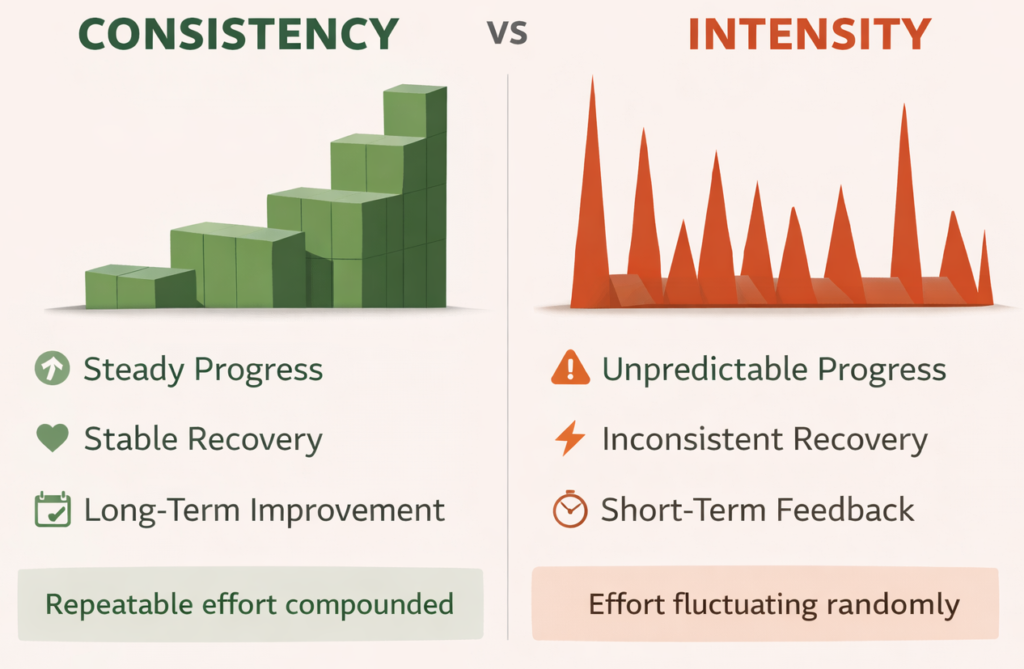
Progress in running is not linear.
It builds gradually, through accumulation rather than sudden breakthroughs. A single week of training does not change much on its own, but weeks stacked together begin to create a meaningful shift. That is where consistency becomes powerful.
It allows your training load to increase in a controlled way, your recovery to stay stable, and your body to adapt over time instead of being constantly disrupted. This is also why progress can sometimes feel slow or uneven in the moment. The changes are happening underneath, even when they are not immediately visible, as explained in Why Your Progress Is Not Linear, where this process is described in a more practical context.
When those weeks connect without interruption, small gains begin to compound into something much more significant.
If your training is stable, improvement becomes predictable.
The Real Goal: Sustainable Training
The best training plan is not the hardest one.
It’s the one you can repeat. Week after week. Month after month.
If your training is not sustainable, it doesn’t matter how “good” it looks on paper.
Your weekly structure should support consistency, not fight against it — see Build a Weekly Running Structure.
What Consistency Actually Looks Like
Consistency is not perfection.
It is not about getting every run exactly right or feeling good every time you step out the door. It is about showing up regularly, keeping your effort controlled, and avoiding unnecessary extremes that disrupt your training.
Some runs will feel smooth and controlled. Others will feel off, even when nothing obvious has changed. That variation is part of the process, not a sign that something is wrong. If you have ever wondered why that difference shows up from day to day, it helps to revisit Why Some Runs Feel Easy and Others Feel Hard, where those shifts are explained in a more practical way.
What matters is not how any single run feels, but whether you are able to keep the overall pattern stable from one week to the next.
Consistency means continuing anyway — within a stable structure.
Why Most Runners Get This Wrong
The most common mistake is simple.
On good days, you do too much. On more difficult days, you do too little.
At the time, both decisions feel justified. When you feel strong, it is tempting to push further. When the run feels harder than expected, it is easy to back off completely. But together, those choices create an unstable pattern.
Instead of steady progression, you get peaks of effort followed by gaps in training. The overall load becomes inconsistent, and the rhythm that supports improvement never fully settles.
One of the first signs of this pattern is when easy runs begin to feel harder than they should. The effort drifts up, recovery becomes less predictable, and the balance between sessions starts to shift. This is explained more clearly in Why Easy Runs Feel Too Hard, where the connection between control and effort is easier to see in practice.
Consistency does not come from motivation. It comes from keeping the effort stable, even when the day itself does not feel perfect
A Smarter Way to Improve
Instead of asking how hard you should train, shift the question slightly.
Ask whether the way you are training right now is something you can sustain for the next four to six weeks.
That small change in perspective makes a big difference. It moves the focus away from a single session and toward the pattern your training is creating over time. If the answer is no, then the approach is not sustainable, no matter how productive it feels in the moment.
This is where consistency is built.
Most of your runs need to stay controlled, with intensity added carefully and recovery protected as part of the process rather than something that happens by accident. If you are unsure how to balance those elements in practice, it helps to revisit How To Balance Easy Runs and Hard Runs, where the structure behind sustainable training is explained more clearly.
If your system is stable, progress follows.
Frequently Asked Questions
Is intensity not important?
It is — but only on top of consistency.
Can you improve without hard workouts?
Yes, especially early on. Consistency matters more.
What matters more: weekly mileage or intensity?
For most runners, consistent volume matters more.
How do I become more consistent?
Lower intensity, simplify structure, and focus on repeatability.
Consistency becomes easier when your effort is controlled.
A reliable heart rate monitor helps you keep your training balanced and avoid drifting into unnecessary intensity — see Best Heart Rate Monitors for Running (2026).
Key Takeaway
Intensity feels productive. Consistency actually is.
Show up regularly. Keep your effort controlled. Let progress compound.