
Running more is one of the most reliable ways to improve.
But it’s also where many runners get stuck — or injured. You add distance, feel good for a while, and then something starts to feel off.
Not a big injury. Just enough to slow you down. The problem isn’t increasing volume.
It’s increasing it faster than your body can adapt.
Modern running watches allow you to track pace, distance, heart rate, cadence, VO2 max and much more during workouts.
If you’re choosing one for training, see our guide to the Best Running Watches for Running (2026).
Progress Comes From Adaptation, Not Just Volume
More running only works when your body is able to absorb it.
Every increase in volume creates additional stress, and different parts of the body respond to that stress at different speeds. Muscles tend to adapt relatively quickly, which can give the impression that everything is progressing well. But tendons and connective tissue adjust more slowly, and that is where imbalance often begins.
You may feel capable of doing more, but your structure is not fully ready to support it yet.
That is why increasing mileage too early can feel fine at first, and then gradually start to create issues that were not there before.
Before adding more volume, the foundation needs to be in place. Your aerobic base should be stable enough to carry that additional load without forcing the effort or compromising recovery. If that foundation is not clear yet, it helps to revisit How to Build an Aerobic Base, because that is where sustainable progress begins.
Because if adaptation lags behind load, problems start quietly.
Why Weekly Volume Is the Most Sensitive Variable
You can adjust many variables in training, but volume is the one that builds the fastest.
It rarely changes in a single, obvious step. More often, it grows through small additions. One extra run during the week. A few minutes added to a familiar route. A rest day that quietly turns into an easy run.
Each change feels reasonable on its own.
But together, they reshape the entire week.
That is why volume can become too high without ever feeling like a clear decision. There is no single moment where things shift. It happens gradually, through a series of small increases that begin to overlap.
If that pattern sounds familiar, it is closely related to what is explained in How To Run More Without Getting Injured.
It is not one choice that creates the problem.
It is how those choices accumulate over time.
The 5–10% Rule (And Its Limits)
You have probably heard the guideline to increase your weekly mileage by five to ten percent.
It can be useful, but it is not something that works the same way for everyone.
That number does not exist in isolation. What matters more is where you are starting from, how well you are recovering, and how demanding your current training already is. A small increase can feel manageable in one context and excessive in another.
If your week already feels slightly strained, even a modest addition can push the overall load beyond what your body can absorb. The change itself may look small, but its effect depends on everything around it.
This is why fixed rules often fall short in practice.
If you are not sure whether your current training is actually leading to progress or just adding fatigue, it helps to revisit How to Tell If Your Running Is Improving, because the difference is not always obvious from the numbers alone.
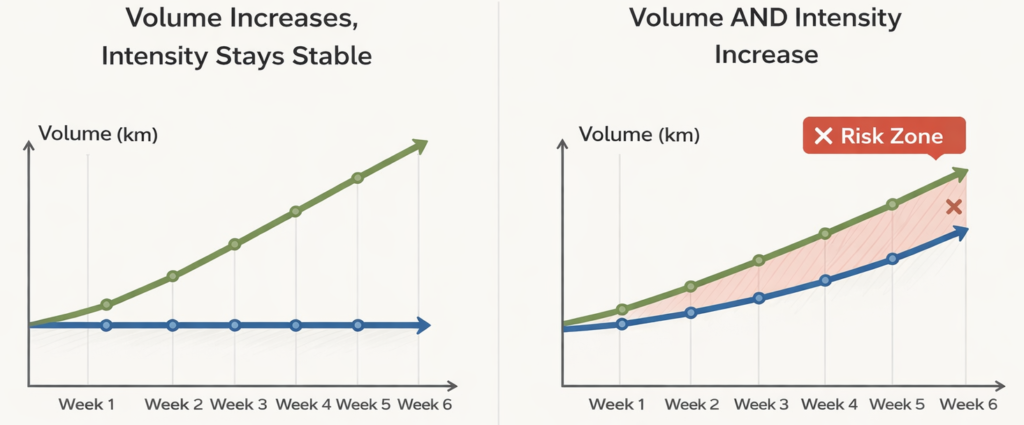
Don’t Increase Volume and Intensity at the Same Time
This is where many runners make a critical mistake.
They begin to do more, and at the same time, they begin to push harder.
The volume increases, the pace creeps up, and the overall effort becomes more demanding. None of these changes feel extreme on their own, but together they create something unstable.
Training stops being something you can absorb and becomes something you are constantly trying to manage.
If volume is going up, effort needs to stay controlled. Otherwise, the balance shifts too quickly, and the body does not have the space it needs to adapt.
That is where many runners drift into a middle zone where the effort is too high to recover from properly, but not structured enough to create clear progress. If that sounds familiar, it is closely related to what is explained in What Happens If You Run Too Fast Too Often.
One variable up. The others stay stable.
Use Frequency Before Distance
There are two main ways to increase your overall running volume.
You can make your existing runs longer, or you can run more often.
Both approaches raise the total load, but they do it in very different ways.
Extending individual runs concentrates stress into fewer sessions. The effort within each run becomes more demanding, and recovery between runs needs to be more complete. Increasing frequency, on the other hand, spreads that same load more evenly across the week. Each run can remain more controlled, and the overall structure becomes easier to sustain.
For most runners, that distribution makes a difference.
It allows the body to adapt gradually, without placing too much strain on any single session. The training becomes more consistent, and consistency is what ultimately drives progress.
If you are not sure how often you should be running in the first place, it helps to revisit How Many Times a Week Should You Run, because that baseline shapes how safely you can build volume over time.
Easy Runs Make Volume Sustainable
You do not build volume through hard running.
You build it through easy running.
That is what makes higher mileage sustainable. Easy runs create space in your training. They allow you to accumulate time on your feet without constantly increasing stress.
When those runs drift into a higher effort, that balance starts to break.
Recovery becomes less complete. Fatigue begins to carry over from one session to the next. What should feel manageable turns into something you have to work through, and the volume that once seemed reasonable starts to feel too much.
It is rarely obvious in a single run. But over time, the pattern becomes clear.
If that feels familiar, it is usually the first place to look. Revisiting Why Easy Runs Feel Too Hard often explains why the overall load is becoming difficult to sustain.
You don’t earn more volume by pushing harder.
You earn it by staying controlled.
Plan Cutback Weeks (Before You Need Them)
Progress in running is rarely linear.
Even when training is consistent, your body does not adapt in a straight line. It needs moments where the overall load comes down, so that the work you have already done can be absorbed.
Without those periods, training continues, but adaptation begins to fall behind.
That is why reducing the load slightly every few weeks is not a step backward. It is part of the process. Volume comes down just enough to release accumulated fatigue, intensity stays controlled, and recovery is allowed to fully catch up.
When that space is missing, fatigue does not always show itself immediately.
It builds quietly.
And over time, that hidden accumulation begins to slow progress, even if the training itself looks consistent.
Signs You’re Increasing Too Fast
Your body usually signals a shift before anything serious develops.
The challenge is noticing the pattern rather than reacting to a single symptom.
Fatigue that does not fully resolve, a slightly higher heart rate at a familiar pace, small aches that linger longer than expected, or a gradual drop in performance can all point in the same direction. None of these feel urgent on their own, but together they suggest that the current load is no longer being absorbed as it should.
What matters is not the presence of one signal, but the consistency of them.
If you are unsure how to interpret that pattern, it helps to revisit Why Your Pace Is Not Improving, because those early changes are often the first indication that progress has started to stall.
Ignoring them does not make them disappear.
It simply allows a manageable imbalance to develop into something more difficult to correct.
A Smarter Way to Progress
Instead of chasing numbers, it helps to focus on something more stable.
Not how much you can add, but whether your training holds together from one week to the next.
Progress works best when it builds gradually. Most runs remain easy, recovery is protected, and consistency is something you can rely on rather than force. When that structure is in place, the training begins to support itself.
If it is not, every addition starts to create friction.
That is why the weekly structure matters more than any single number. It determines whether the work you are doing can actually turn into progress. If you want to see how that balance should look in practice, it helps to revisit Build a Weekly Running Structure.
When the system is stable, volume tends to grow on its own.
When it is not, adding more usually makes the imbalance more visible.
Frequently Asked Questions
How much should I increase weekly mileage?
Typically 5–10%, but your body’s response matters more than the number.
Is it okay to increase mileage every week?
Not always. Planned cutback weeks are essential.
What’s safer: longer runs or more runs?
For most runners, more frequent shorter runs are safer.
How do I know if I increased too much?
Fatigue, rising heart rate, and persistent discomfort are early signs.
As your weekly volume increases, managing effort becomes more important.
A reliable heart rate monitor helps you keep easy runs truly easy and avoid accumulating hidden fatigue — see Best Heart Rate Monitors for Running (2026).
Key Takeaway
Increasing volume is one of the most powerful ways to improve.
But only if your body can keep up.
Build gradually. Control your effort. Let adaptation lead the process.