
Some runs leave you tired in a satisfying way.
Your legs feel worked, your breathing settles normally afterward, and even though you are fatigued, the effort still feels connected to progress. Other runs feel different. Your body feels heavy in a way that seems disconnected from the training itself. Recovery feels unusually slow, your rhythm never quite settles, and even easy effort starts to feel strangely forced.
Most runners eventually notice this difference, but many struggle to describe it clearly.
Not all fatigue means the same thing.
Learning to recognize the difference between productive fatigue and harmful fatigue is one of the most important long-term running skills, because training adaptation always includes stress, but too much unresolved stress gradually stops helping.
If you want your easy and recovery runs to feel smoother and reduce unnecessary strain, the shoes you use can make a difference.
You can explore options in our guide to Best Shoes for Long Runs, where different models are explained based on how they actually feel during real training.
Why Running Improvement Always Includes Fatigue
One reason runners become confused about fatigue is that improvement itself requires stress.
Every meaningful training stimulus creates some level of disruption in the body. Harder sessions challenge muscle fibers, long runs reduce energy availability, and higher weekly volume increases overall recovery demand. Without some level of fatigue, adaptation usually does not happen.
This is why completely fresh legs every day are not necessarily a sign of ideal training.
A runner building endurance consistently will often carry mild background fatigue through parts of the week. The body is balancing stress and recovery at the same time, not separately.
This is closely connected to What Actually Improves Your Running Over Time, because progress rarely comes from isolated workouts. It comes from repeated manageable stress that your body successfully absorbs.
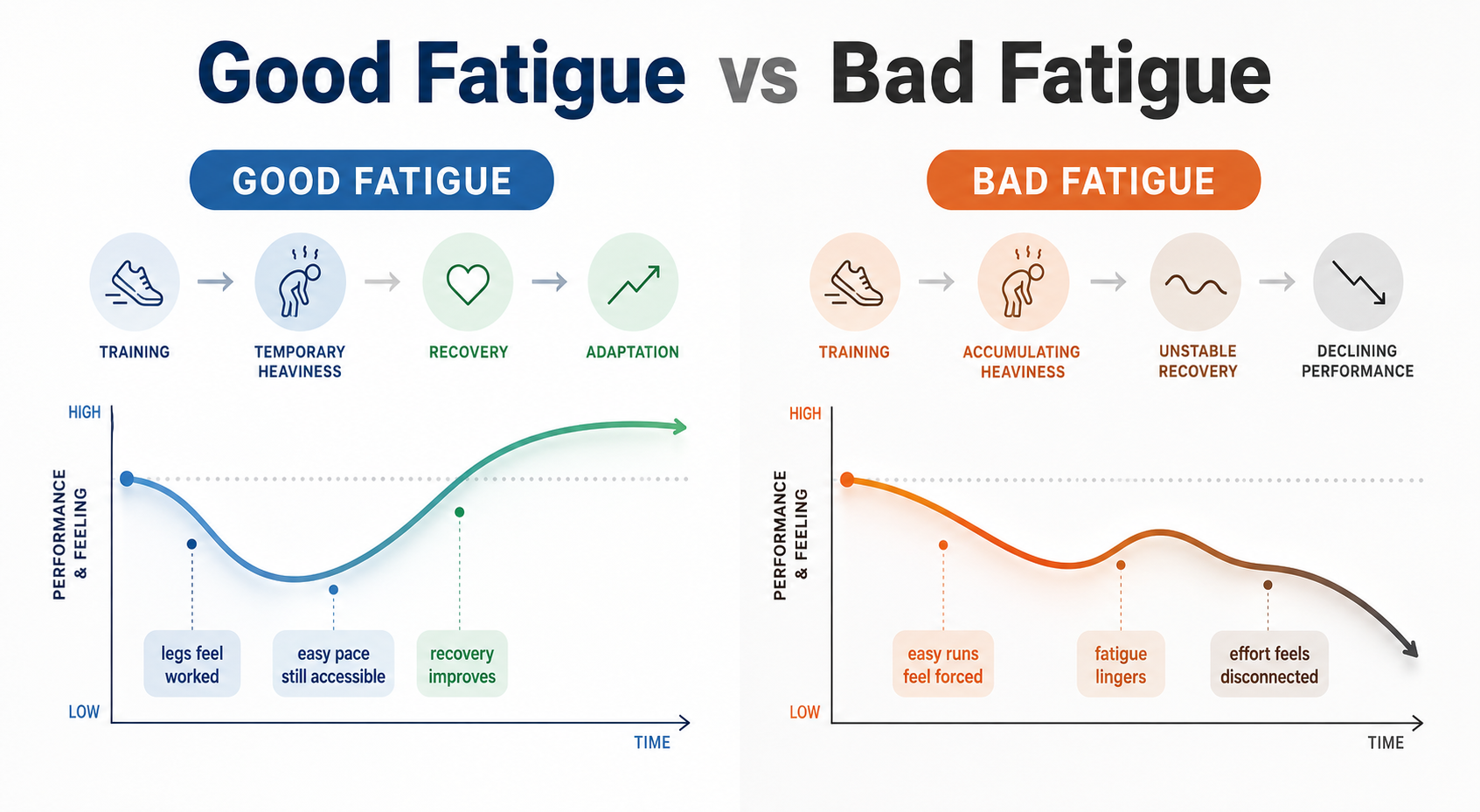
Good fatigue usually appears after training that was appropriate for your current fitness level. The body feels worked, but still responsive. You may feel slower temporarily, but movement still feels coordinated and stable.
Bad fatigue feels different. Instead of feeling challenged, the body starts feeling resistant. Recovery takes longer than expected, easy effort becomes harder to access, and the feeling of freshness becomes increasingly difficult to regain.
That distinction is often where productive training ends and accumulating fatigue begins.
What Good Fatigue Usually Feels Like
Good fatigue is surprisingly calm.
Your legs may feel slightly heavy, but not unstable. Easy pace still feels accessible even if it feels less energetic than usual. Your breathing settles normally, and your overall movement still feels mechanically smooth.
Most importantly, recovery still moves in the right direction.
The next day may feel slightly flat at first, but once you begin running, your body gradually opens up instead of deteriorating further. This is often what runners experience after a productive long run or controlled workout block.
The fatigue feels explainable.
You understand why it is there.
This is also why many runners misinterpret normal training stress as a problem, especially after increasing mileage or adding workouts. In reality, mild temporary heaviness is often part of the adaptation process itself.
If you already understand what heavy legs really mean, it becomes much easier to recognize when fatigue is simply accumulated training load rather than something more serious.
What Bad Fatigue Usually Feels Like
Bad fatigue usually feels less connected to a specific session.
Instead of feeling worked, the body starts feeling unusually resistant from the beginning of runs. Easy effort becomes harder to access, coordination feels slightly off, and recovery no longer follows a predictable pattern.
One of the clearest signs is that fatigue stops resolving as the week progresses.
Instead of gradually absorbing training stress, the body continues accumulating it. Easy runs begin feeling harder instead of easier. Motivation drops. Small discomforts become more noticeable. Pace and effort drift apart.
This is often where runners mistakenly push harder in an attempt to “train through it,” which usually makes the problem worse.
The body is no longer adapting efficiently. It is simply trying to keep up.
This is closely related to how to tell if you’re close to overtraining, because early overreaching rarely appears as dramatic exhaustion at first. It usually begins as subtle recovery instability.
Why Context Matters More Than a Single Run
One difficult run does not automatically mean bad fatigue.
Even very fit runners experience occasional off days caused by sleep disruption, stress, weather, nutrition, or accumulated life stress outside training. The mistake is assuming every difficult feeling requires immediate interpretation.
I think many runners have experienced the temptation to diagnose an entire training cycle based on a single bad run.
The problem is that the body is rarely that simple. Patterns matter more than isolated sessions.
Good fatigue fluctuates but trends toward recovery. Bad fatigue becomes increasingly persistent and less predictable over time.
This is why experienced runners often evaluate fatigue across entire weeks rather than individual runs. They look for overall direction instead of reacting emotionally to one difficult session.
Understanding this also helps explain Why Some Weeks Feel Harder Even When Training Is the Same, because recovery capacity constantly changes even if the schedule itself does not.
Good fatigue feels temporary and explainable.
Bad fatigue feels persistent and increasingly disconnected from the training itself.
Conclusion
Fatigue is not automatically a problem in running.
In fact, some level of fatigue is necessary for progress to happen at all. The important difference is whether the body continues adapting positively or gradually loses the ability to recover between sessions.
Good fatigue usually feels controlled, understandable, and temporary.
Bad fatigue feels increasingly unstable, harder to explain, and less responsive to normal recovery.
The goal is not avoiding fatigue completely.
The goal is learning how to recognize when fatigue still belongs to productive training — and when it no longer does.
Frequently Asked Questions
Is it normal to feel tired during a training block?
Yes. Mild background fatigue is common during consistent training, especially when building mileage or adding harder sessions.
How do I know if fatigue is becoming a problem?
A warning sign is when recovery stops improving over multiple days and easy runs consistently start feeling forced or unusually difficult.
Should I stop training completely if I feel fatigued?
Not always. Sometimes reducing intensity or adjusting volume is enough. The important part is recognizing whether the body is still recovering normally.
Can good fatigue still include heavy legs?
Yes. Productive fatigue often includes temporary heaviness, especially after long runs or workouts. The difference is that movement still feels coordinated and recovery gradually improves.
Does bad fatigue always mean overtraining?
No. Early problematic fatigue usually appears long before true overtraining. Most runners experience smaller periods of accumulated fatigue that improve once recovery and training balance return.
Seeing patterns over time makes this much easier to understand.
Modern running watches allow you to track pace, distance, heart rate, cadence, VO2 max and much more during workouts.
If you’re choosing one for training, see our guide to the Best Running Watches for Running (2026).