
Most runners are looking for one thing that will unlock progress.
A better workout. A faster session. A more optimal plan. Something that feels like the key.
But improvement in running rarely comes from one thing.
It usually comes from doing the right things repeatedly, with enough consistency for those small inputs to begin adding up. That is what makes progress hard to notice in the moment. Most of the things that truly improve your running do not feel dramatic while you are doing them. They feel controlled, ordinary, and almost too simple to matter.
And yet those are often the things that matter most.
Better endurance rarely comes from constant optimization. It usually comes from consistency, pacing control, recovery awareness, and sustainable structure — which is also why many elite runners quietly prefer simpler running watches focused on training rather than lifestyle features.
Best Running Watches Used by Elite Runners (And Why Simpler Often Wins)
Improvement Is Built, Not Triggered
There is no single run that changes your fitness, not even your hardest session.
Progress in running is not triggered by intensity. It is built through accumulation.
Each run adds something small. A little more aerobic strength, a little more efficiency, a little more durability. None of these changes stand out on their own, and most of them are almost invisible in the moment.
But over time, they begin to add up.
Weeks connect to each other, small adaptations layer together, and what once felt difficult starts to feel more stable. That is where progress actually comes from. Not from one standout effort, but from many consistent ones.
This is also why chasing individual hard workouts rarely leads to lasting improvement. The real driver is the pattern behind them, as explained in Why Consistency Matters More Than Intensity, where the role of repetition and structure becomes clearer.
The Foundation Is Aerobic
If there is one system that drives most of your running performance, it is your aerobic base.
It shapes how efficiently you use oxygen, how long you can sustain effort, and how well you recover between sessions. Almost everything you experience as “fitness” is connected to how well this system is developed.
The challenge is that aerobic development is slow.
It does not create immediate feedback. It does not feel like progress from one run to the next. Most days, it feels like you are simply repeating the same kind of effort without anything changing.
But that is exactly how it works.
While it may not feel dramatic, it is quietly building the foundation that everything else depends on. As this system improves, your effort becomes more stable, your runs feel more controlled, and your ability to handle training increases without needing to force it.
That is why controlled, repeatable effort matters more than occasional intensity. The long-term effect comes from what you can sustain, not from what you can do once, as explained in How to Build an Aerobic Base, where this process is described in more detail.
Volume Expands Your Capacity
Running more, when done correctly, increases what your body can handle.
Not just in distance, but in total load across your training week.
As volume increases in a controlled way, you spend more time in aerobic development, your movement becomes more efficient, and your body gets more opportunities to adapt. These are not dramatic changes from one run to the next, but they add up over time.
That is where the benefit of higher volume comes from.
But only if it is sustainable.
If you increase volume too quickly, the effect reverses. What should support progress turns into accumulated stress. Recovery becomes inconsistent, fatigue builds faster than your body can adapt, and the quality of your training begins to drop.
This is why volume is not just about doing more. It is about doing more in a way your body can absorb. If you are unsure how to increase your running safely, it helps to revisit How To Run More Without Getting Injured, where this balance is explained more clearly.
Most of the Work Happens at Easy Effort
This is where many runners get it wrong. They assume improvement comes from pushing harder.
In reality, most progress comes from running at an effort that can feel almost too easy.
That is where aerobic development actually takes place. It is where fatigue stays manageable, and where consistency becomes possible without constantly needing to recover from previous sessions.
The challenge is that this kind of effort does not feel impressive. It does not create the same immediate feedback as harder running, which makes it easy to drift slightly faster without noticing. Over time, that small shift changes the purpose of the run.
If your easy runs become too fast, they stop supporting the system they are meant to build. Effort rises, recovery becomes less predictable, and the overall structure begins to lose stability. This is explained more clearly in Why Easy Runs Feel Too Hard, where that drift and its impact are broken down in a practical way.
Without a stable easy-running foundation, everything built on top of it becomes harder to sustain.
Adaptation Happens During Recovery
Training creates the signal. Recovery creates the change.
Every run places a demand on your body, but the actual adaptation does not happen during the effort itself. It happens afterwards, when your system has the time and capacity to respond to that signal.
If recovery is incomplete, that process never fully finishes.
Fatigue begins to accumulate, performance becomes less consistent, and the overall direction of your training starts to slow down. It may still feel like you are doing everything right, because you are training regularly, but the results do not reflect that effort.
This is why more training is not always better.
If your system never resets, it never has the chance to adapt. Instead of building fitness, you end up maintaining a constant level of fatigue. That is often the point where runners feel stuck, even though their effort has not decreased.
If this situation feels familiar, it is often a sign that the balance between training and recovery has shifted too far. This is explained more clearly in How To Know If You Are Running Too Much?, where the early signs of excessive load are easier to recognize.
Consistency Connects Everything
Each of these elements matters. But none of them work in isolation.
Consistency is what connects them.
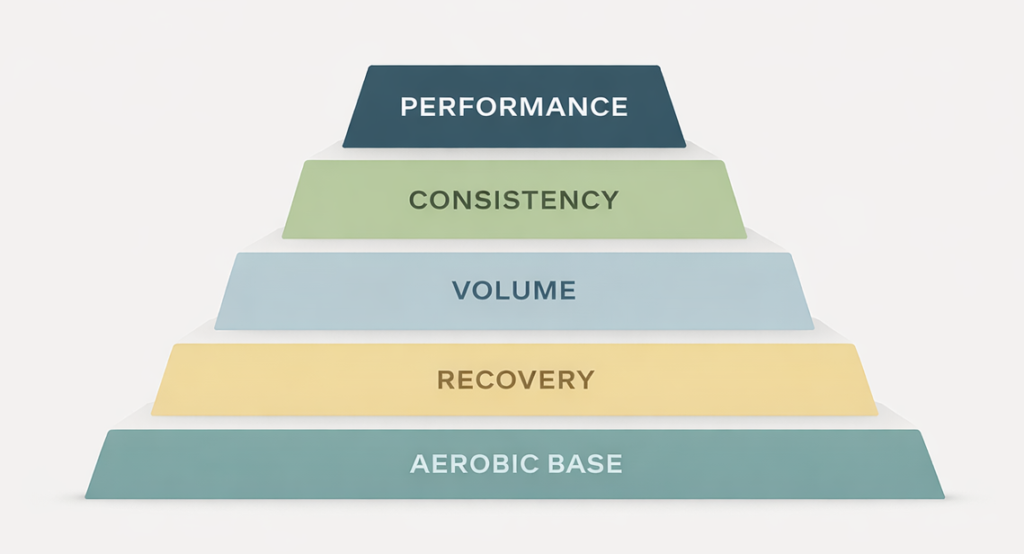
It links your volume to something your body can actually absorb. It keeps your effort controlled enough to be repeatable. It allows recovery to happen often enough for adaptation to take place. Without that connection, each piece exists on its own, but they never combine into something that moves you forward.
That is why even a well-designed plan can fall apart.
If the pattern is not stable, if the effort is not repeatable, or if recovery is constantly disrupted, the system never fully settles. You may still be training, but the direction becomes inconsistent, and progress becomes harder to see.
When consistency is in place, those same elements begin to support each other. Volume becomes sustainable, effort becomes controlled, and adaptation starts to build in a predictable way.
What Doesn’t Improve Your Running (On Its Own)
There are things that feel productive, but do not create lasting progress on their own.
A single hard workout can feel meaningful in the moment. A sudden increase in intensity can create a strong sense of effort. Even a perfectly executed training week can give the impression that everything is coming together.
But none of these things matter in isolation.
They can support progress, but only when they are part of a stable system that you can repeat. Without that structure, they remain one-off efforts that do not connect to anything before or after.
This is where many runners get misled.
The feeling of a strong session is easy to remember, but progress depends on what happens around it. If that session is not supported by consistent training and recovery, it does not build forward. It simply stands alone.
That is why structure matters. Not because it makes training more complex, but because it allows each piece to connect and contribute to something bigger.
What Actually Drives Progress
Over time, running improvement comes from a simple combination.
Consistent training, controlled volume, mostly easy effort, and sufficient recovery. None of these elements stand out on their own, and none of them feel extreme while you are doing them.
That is exactly why they work.
They allow your training to remain stable. They give your body the space to adapt. And they make it possible to repeat the same pattern week after week without breaking it.
What feels ordinary in the moment becomes powerful through repetition.
And that is where real progress is built.
Frequently Asked Questions
What improves running the most?
A combination of consistent volume, aerobic development, and proper recovery.
Do hard workouts make you faster?
Yes — but only when supported by consistent training.
Is mileage or intensity more important?
For most runners, consistent mileage matters more.
How long does it take to improve?
Long enough that you stop looking for quick results.
Understanding what actually drives progress becomes much easier when you can track your effort over time.
A reliable heart rate monitor helps you stay within the right effort range and avoid unnecessary intensity — see Best Heart Rate Monitors for Running (2026).
Key Takeaway
Running improvement is not about one thing.
It’s about doing the right things consistently over time.