
Most runners know the feeling immediately. You start the run and the legs just feel… heavy.
Not injured. Not sharply painful. Just strangely flat and resistant. The stride feels less responsive. Easy pace requires more effort than expected. The body moves, but without its normal rhythm underneath.
And almost automatically, the mind starts searching for explanations.
Did I lose fitness? Am I overtrained? Should I skip the workout? Am I getting sick?
But heavy legs are usually much more ordinary than runners initially fear.
In most cases, they are not a sign that something is broken. They are a sign that the body is still processing stress from somewhere — training, recovery, life load, or accumulated fatigue that has not fully settled yet.
Learning how to interpret heavy legs correctly matters because many runners either:
ignore the feeling completely, or panic far too early.
And both reactions can quietly make training less effective over time.
Heavy Legs Usually Mean The System Is Carrying Residual Fatigue
One reason the sensation feels confusing is that heavy legs rarely arrive with dramatic warning signs. The body still functions. You can still run. Breathing may even feel relatively normal.
But movement itself feels less elastic than usual.
That sensation often reflects residual fatigue still sitting somewhere inside the system.
Muscles may still be recovering from previous load. The nervous system may not be fully reset. The body may simply be carrying more accumulated stress than it can currently clear completely between sessions. And importantly, that does not automatically mean recovery is failing.
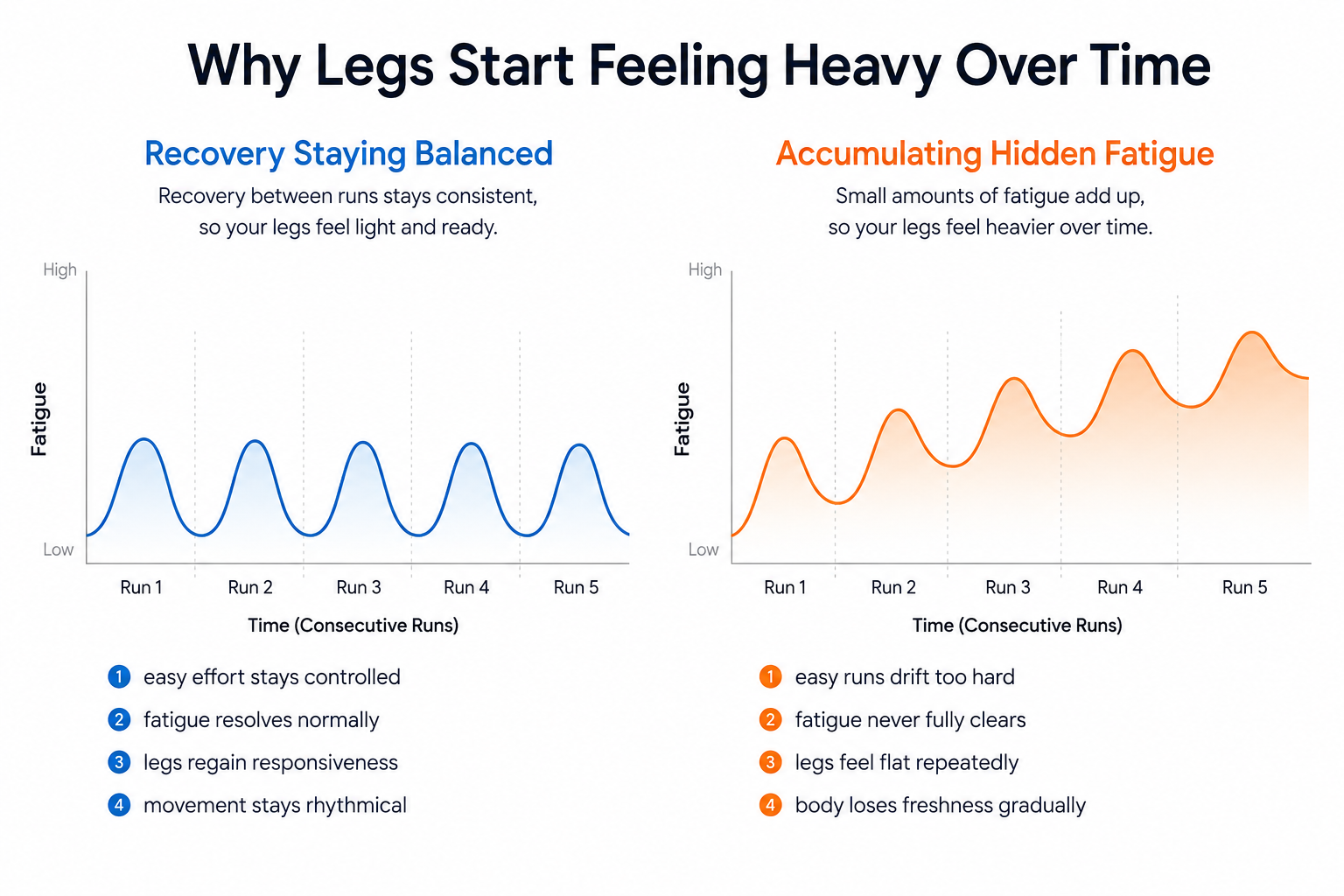
Consistent endurance training almost always includes some level of residual fatigue. The important question is whether the body continues stabilizing overall between runs.
This is closely connected to How to Know If You’re Recovering Properly Between Runs, because sustainable recovery rarely means feeling perfectly fresh all the time. More often, it means the body keeps returning toward manageable, stable effort even while carrying moderate fatigue underneath.
Heavy legs often mean the body is still processing load — not necessarily that something is wrong.
The Feeling Usually Becomes Clearer Once The Run Develops
One of the biggest mistakes runners make is judging heavy legs too quickly.
Because many runs naturally begin stiff or flat before the body settles properly into movement. Muscles warm gradually. Coordination improves progressively. Rhythm develops step by step instead of instantly.
This is why experienced runners often wait calmly before deciding what the feeling actually means. Do the legs gradually loosen after fifteen or twenty minutes? Does movement become smoother once breathing stabilizes? Or does the heaviness keep increasing even at controlled effort?
That distinction matters enormously.
Temporary heaviness that improves during the run is usually very different from systemic fatigue that continues worsening regardless of pace adjustments.
This is one reason How to Read Your Body Before a Run (Simple Daily Check) matters so much. The body often reveals whether fatigue is manageable or accumulating through how effort changes once movement continues.
Good interpretation usually comes from watching what the body does next — not from reacting emotionally during the opening minutes.
Heavy Legs Do Not Always Mean You Need Rest
This is where runners often become too reactive. The moment the legs feel flat, they immediately assume: “I must need complete rest.”
Sometimes that is true. But often the body simply needs: lower intensity, more aerobic effort, slightly reduced pace, or a calmer session than originally planned.
In fact, controlled easy movement frequently helps the body feel better once circulation, rhythm, and breathing stabilize properly.
This becomes especially important because endurance training is not really built on isolated perfect sessions. It is built through sustainable continuity across weeks and months.
That means learning how to distinguish between: manageable fatigue, and fatigue the body is no longer absorbing productively.
This is exactly why Signs You Should Stop a Run Early (And When Not To) becomes such an important skill. Not every difficult-feeling run needs to be abandoned completely. Sometimes the smartest adjustment is simply reducing the cost of the session before unnecessary fatigue accumulates further.
Heavy legs are information. They are not automatically a stop sign.
Sometimes Heavy Legs Come From Running Slightly Too Hard Too Often
One surprisingly common reason heavy legs never fully disappear is that easy effort quietly stopped being easy.
The body never fully resets between sessions because recovery itself keeps getting interrupted by moderate hidden strain.
This pattern becomes very common when runners drift slightly above sustainable aerobic effort day after day without realizing it. Nothing feels catastrophic. Training still happens normally. But the body slowly stops feeling truly light or responsive between runs. The legs remain slightly flat almost constantly.
This is one reason What Happens If You Run Too Fast Too Often (And Why It Slows You Down) matters so much. Endurance fatigue often accumulates quietly long before obvious breakdown appears.
And if easy effort itself has recently started feeling difficult to interpret consistently, What Does an Easy Run Actually Feel Like? explains how sustainable aerobic running usually feels much calmer than many runners initially expect.
Sometimes heavy legs are not coming from one hard workout.
They are coming from weeks of slightly unresolved fatigue underneath otherwise normal training.
Recovery Problems Usually Feel Different From Normal Heavy Legs
One useful distinction is paying attention to what else changes alongside the heaviness. Normal training fatigue usually still feels relatively stable.
The body may feel flat, but: breathing settles normally, movement gradually improves, and effort remains manageable once the run develops.
Problematic fatigue often feels different. Easy pace becomes unusually expensive. Breathing stays strained. Heart rate rises earlier than expected. The body never really settles into sustainable rhythm.
That difference matters because heavy legs themselves are not necessarily the problem. The larger question is whether the overall system still feels absorbable underneath them.
This is one reason experienced runners pay close attention to: stability, rhythm, and recoverability instead of only focusing on soreness or pace.
Because healthy endurance systems can still function very well while carrying moderate fatigue. Unstable systems usually cannot.
Heavy legs do not always mean poor fitness. Sometimes the body simply needs to work harder to maintain the same output. One clue can be unusually high heart rate drift during easy runs, which you can estimate using our Easy Run Drift Calculator.
Sometimes The Smartest Solution Is Simpler Than You Think
One interesting thing about heavy legs is that runners often search for complicated explanations first. But many cases improve through surprisingly basic adjustments.
More sleep. Lower intensity for a few days. Slightly reduced volume. Better fueling. Less emotional pressure during runs. And often, simply allowing easy effort to remain truly easy again.
This is also why runners who improve consistently long term usually become less obsessed with forcing perfect training every single day. They understand that adaptation depends heavily on allowing the body enough space to actually absorb the work afterwards.
The body usually does not need panic. More often, it needs slightly less accumulated stress.
Frequently Asked Questions
What do heavy legs during running usually mean?
Usually residual fatigue. The body is still processing accumulated stress from training, recovery demands, or overall life load.
Are heavy legs always a bad sign?
No. Moderate heaviness is common during consistent endurance training. The important question is whether the body still stabilizes and recovers normally overall.
Should I stop a run if my legs feel heavy?
Not automatically. Many runs improve once movement and breathing settle properly. The body’s response over time matters more than the initial sensation itself.
Why do my legs feel heavy even during easy runs?
Often because recovery is slightly incomplete, aerobic effort is drifting too high, or accumulated fatigue has quietly built over multiple days.
How do I know if heavy legs are becoming a problem?
Usually when heaviness comes together with unstable breathing, rising heart rate, worsening effort, or recovery that no longer fully resolves between sessions.
If You Want Better Control Over Effort And Recovery
Reliable heart rate and recovery tracking can help identify when easy effort is remaining sustainable versus quietly drifting into excessive fatigue accumulation.
The goal is not obsessing over numbers.
It is understanding whether the body is continuing to absorb training productively over time.
If you want a practical comparison of the best tools available, Best Running Watches for Running (2026) breaks down the most useful options for aerobic pacing, recovery tracking, and endurance-focused training.
Conclusion
Heavy legs usually do not mean the body is failing. More often, they mean the system is still carrying stress that has not fully settled yet.
And learning how to interpret that feeling calmly is part of becoming a stronger endurance runner long term.
Because sustainable training is rarely about feeling perfectly fresh every day.
It is about recognizing when fatigue is: manageable, temporary, and recoverable… and when the body quietly needs slightly less stress before adaptation can continue normally again.