
It is one of the most confusing feelings in running.
You have been training consistently, following a structure, and doing what should be helping. On paper, everything looks fine.
And yet you feel slower.
Your pace feels harder to hold, your legs feel heavier than expected, and the run does not feel as smooth or natural as it used to. That is usually the moment where the same question appears.
Am I getting worse?
In most cases, you are not.
You’re actually improving — it just doesn’t feel like it.
Your training works best when the basics are right.
Along with pacing and recovery, the right running shoes help you stay comfortable, consistent, and injury-free.
If you’re unsure what to choose, see our guide to the Best Running Shoes for Daily Training (2026).
Progress Doesn’t Feel the Way You Expect
Most runners expect progress to feel obvious.
They look for clear signals. A faster pace, an easier effort, better runs that confirm something is working.
But real improvement rarely shows up like that in the short term.
Instead, it often feels different. The effort can feel higher, fatigue becomes more noticeable, and the sense of lightness in your running may temporarily disappear. On the surface, it feels like things are moving in the wrong direction.
But that is often part of the process.
Progress in running is not something you feel instantly. It builds over time, usually in ways that are not obvious from one run to the next. What you experience day to day is often influenced more by fatigue, load, and external conditions than by your actual fitness level. This is explained more clearly in How to Tell If Your Running Is Improving, where the difference between short-term feeling and long-term progress becomes easier to understand.
Fatigue Can Hide Fitness
When your training becomes more consistent, your overall load begins to increase.
You are running more often, your structure becomes more stable, and the total amount of stress your body has to handle goes up. That is a normal part of improvement.
And with that comes fatigue.
Not the kind that stops you from running, but the kind that subtly changes how your runs feel. Effort becomes slightly higher, your usual pace feels less comfortable, and your legs carry a bit more weight than you expect.
Nothing is clearly wrong, but everything feels just a little off.
What makes this confusing is that these sensations often appear at the same time your fitness is actually improving. Underneath that layer of fatigue, your system is adapting, but the day-to-day experience does not always reflect it.
That is why this phase often creates doubt.
It feels like something has stopped working, when in reality your body is simply carrying more load than before. If this situation feels familiar, it helps to understand how accumulated stress affects your perception of effort. This is explained more clearly in How To Know If You Are Running Too Much?, where the difference between productive load and excessive fatigue becomes easier to recognize.
You’re Operating at a Higher Level Now
As your fitness improves, your baseline begins to shift.
Without really noticing it, you start to move a little differently. Your natural pace drifts slightly higher, your effort creeps up, and you become more comfortable operating at a level that previously felt demanding.
What once felt like a good day gradually becomes your new normal.
And that is where the confusion starts.
Because even though your fitness is improving, your runs can begin to feel harder. Not because something is wrong, but because your system is now working at a higher level more often.
This is why effort matters more than pace.
If you judge your runs only by speed, it can feel like you are struggling more than before. But when you shift your focus to how the effort feels, the picture becomes clearer. This is explained in more detail in What Does Easy Pace Actually Mean, where the relationship between pace and effort is easier to understand in practice.
Easy Runs Quietly Drift Up
One of the most common hidden causes is simple.
Your easy runs are no longer truly easy.
As your fitness improves, it becomes very easy to let pace drift without noticing it. A little faster on one day, a bit more effort on another. Nothing feels extreme in the moment, but the pattern slowly changes.
And over time, that removes the contrast your training depends on.
Easy days stop feeling easy. Hard days no longer stand out clearly. Everything begins to sit somewhere in the middle.
That is when running starts to feel harder overall.
Not because your fitness has dropped, but because your structure has become less defined. Without clear separation between effort levels, your body never fully settles into either recovery or quality work. This is explained more clearly in Why Easy Runs Feel Too Hard, where that gradual drift and its impact are easier to recognize.
You’re Comparing Against Your Best Days
Memory can distort reality.
You tend to remember your smoothest runs, your fastest sessions, and the days when everything felt light and effortless. Those moments stand out, so they become your reference point.
But they were never your baseline. They were peaks.
When you compare your current state to those moments, it can feel like something has been lost. In reality, you are comparing a normal training day to an unusually good one.
That is why the perception can be misleading.
Real progress is not measured by isolated runs. It shows up across consistent weeks, in efforts you can repeat, and in a training pattern that remains stable over time. If you step back and look at that bigger picture, the direction becomes much clearer, even when individual runs feel less impressive.
Higher Load Feels Harder (And That’s Normal)
If your training is working, your total load is higher than before.
You are running more, your frequency has increased, and the amount of work your body is handling across the week is greater. That is what progress requires.
And that naturally changes how running feels.
When your body is doing more overall, even controlled runs can feel slightly harder. Effort feels a bit higher, and the sense of ease you might expect is not always there.
But that does not mean something is wrong.
It usually means your system is under a higher, but still productive, level of load. This is part of how improvement happens. Your body is adapting to doing more, even if the day-to-day feeling does not always reflect that clearly. This process is explained in more detail in What Actually Improves Your Running Over Time, where the relationship between load and adaptation becomes easier to understand.
Feeling Comes After Adaptation
This is the key shift to understand.
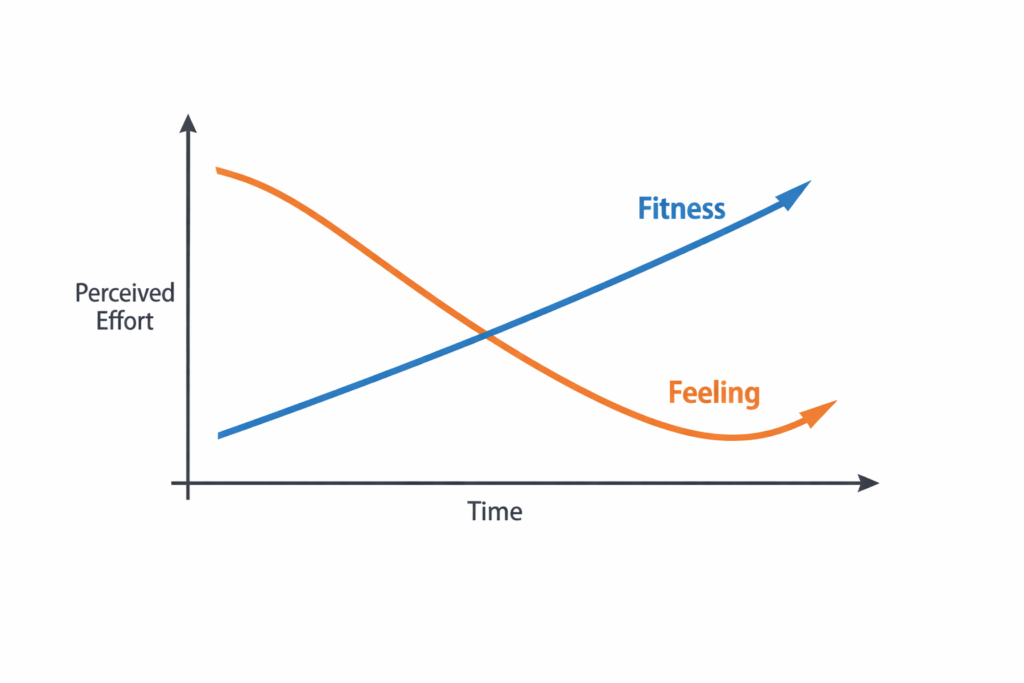
Feeling follows progress, not the other way around.
There are phases where your runs feel slower, heavier, and less controlled, even though your body is actually improving underneath. Those periods can be difficult to interpret, because the feedback you feel does not match what is happening.
Then, often without a clear turning point, things begin to change.
Your effort starts to feel more manageable again. Pace improves without forcing it. Confidence returns, not because you pushed harder, but because the system has adapted.
That is how this process works.
Not in a straight line, and not on a timeline you can feel from one run to the next. It builds quietly, then shows up when your body is ready for it.
What To Do When You Feel Slower
The worst thing you can do in this situation is react emotionally.
When a run feels off, the instinct is to fix it immediately. You push a little harder, increase intensity, or try to force the run back into what you expect it to feel like. In the moment, that feels like the right response.
But it usually makes the situation worse.
By reacting to the feeling, you disrupt the balance your training depends on. Effort rises, recovery becomes less predictable, and the overall structure begins to shift away from what was working.
A better approach is to stay steady.
Keep your structure intact. Let your easy runs remain controlled, even if they feel slightly heavier than usual. Allow the process to continue without trying to correct every fluctuation.
If your training is consistent, this phase will pass. The feeling will catch up to the progress you have already built.
Frequently Asked Questions
Why do I feel slower even though I’m training more?
Because fatigue and increased load can mask your fitness.
Does feeling slow mean I’m getting worse?
Usually not. It often means your body is adapting.
Should I push harder when I feel slow?
No — that often makes things worse.
How do I know if I’m improving?
Look at long-term consistency, not daily feeling.
Understanding what’s really happening becomes much easier when you track effort instead of just pace.
A reliable heart rate monitor helps you see whether your effort is actually higher — or just feels that way — see Best Heart Rate Monitors for Running (2026).
Key Takeaway
Feeling slower doesn’t mean you are regressing.
It often means your body is adapting to a higher level of training.