
Most runners do not suddenly wake up overtrained.
The process is usually quieter than that.
Your training still looks normal from the outside. You are still completing workouts. Your mileage has not exploded overnight. Nothing feels dramatically wrong.
But something slowly starts changing underneath the surface.
Easy runs stop settling naturally. Recovery becomes less predictable. Some days your body feels strangely disconnected from the effort you are trying to produce.
And the difficult part is that these early signs rarely look dramatic enough to feel alarming.
I honestly believe this is why so many runners miss them at first.
Because overtraining does not usually begin with collapse. It usually begins with subtle instability.
As your volume increases, managing effort becomes more important.
A reliable heart rate monitor helps you keep easy runs controlled and avoid building hidden fatigue over time — see Best Heart Rate Monitors for Running (2026).
Overtraining Rarely Starts With Extreme Fatigue
Most people imagine overtraining as complete exhaustion.
But early overtraining usually feels much less obvious than that.
You are still capable of running. You are still capable of finishing workouts. In fact, some runners continue training reasonably well for quite a while before realizing the system is gradually becoming unstable.
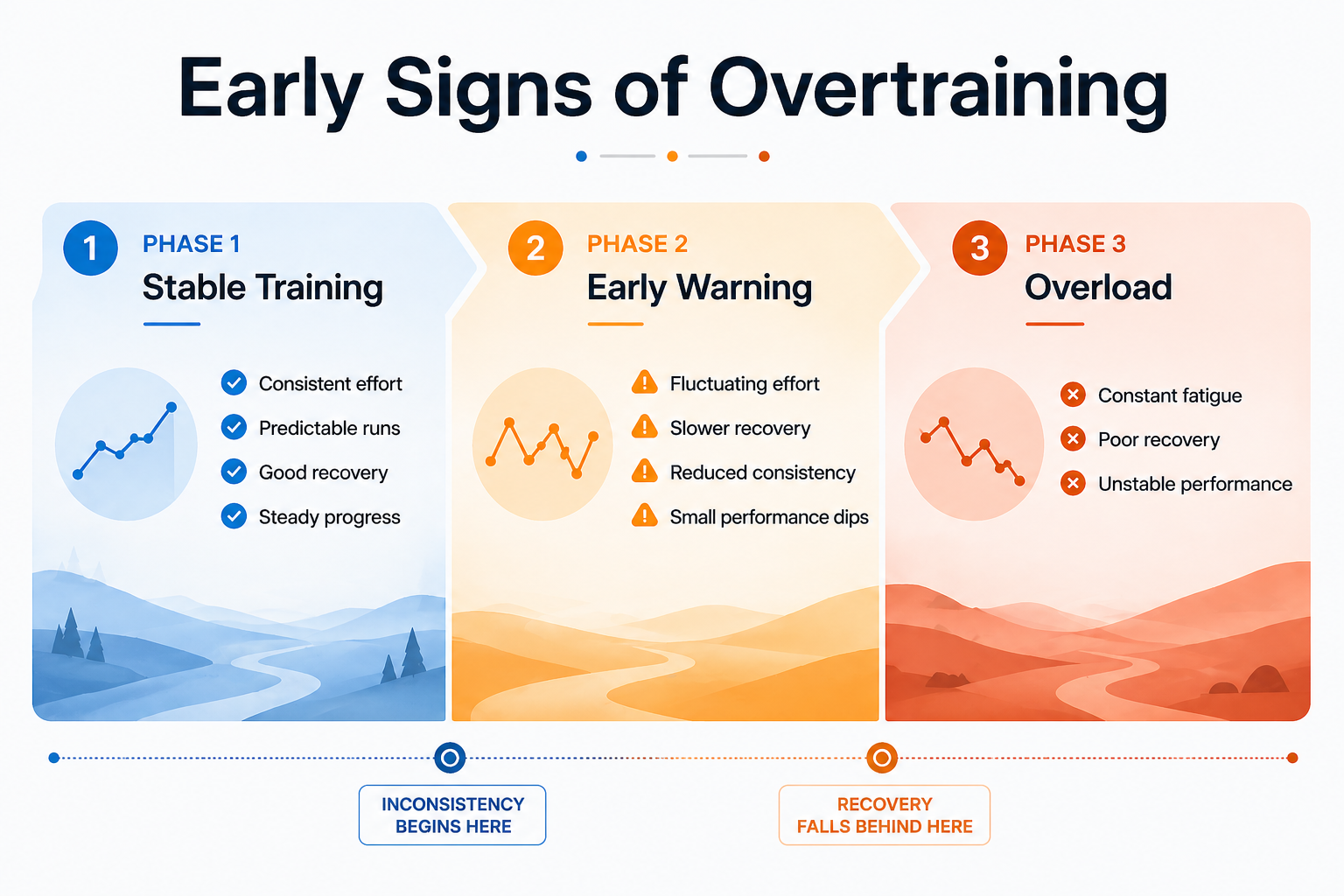
I’ve started noticing that the first signs are often not physical intensity itself, but inconsistency.
Your body stops behaving predictably.
One day feels manageable.
The next day feels strangely difficult.
Then a workout feels good again.
Then suddenly your recovery disappears for several days.
That unpredictability matters.
Because healthy training stress usually behaves relatively consistently. Fatigue comes and goes, but the overall rhythm remains understandable.
When the system begins drifting toward overtraining, the rhythm often starts breaking apart first.
Easy Runs Start Feeling More Expensive
One of the clearest early signals is that easy effort slowly becomes harder to access.
Not dramatically. Just persistently.
You start needing more concentration to hold relaxed pace. Breathing settles later than normal. Your legs feel slightly loaded before the run has even properly started.
This is closely connected to How to Know If a Run Was Actually Easy, because many runners unintentionally normalize rising effort over time instead of recognizing it as accumulated stress.
To me, this is where training interpretation becomes more important than training motivation.
Because pushing through occasional fatigue is normal.
But needing to push through almost every run is different.
That distinction is subtle, but extremely important.
Recovery Stops Feeling Predictable
Healthy recovery is not perfect, but it is usually understandable.
You complete a harder session. You feel tired. Then your body gradually settles again.
When overtraining starts approaching, that pattern becomes less reliable.
Recovery begins feeling incomplete more often than expected. Fatigue lingers longer. One difficult session affects several days instead of one.
And sometimes the body simply feels flat for no obvious reason at all.
I think this is one of the hardest parts psychologically because runners often respond by trying to solve the problem with more effort.
More intensity. More discipline. More pushing.
But the system is usually already struggling to absorb what is there.
This is deeply connected to Why You Feel Tired Even When You’re Training Correctly, because productive fatigue and accumulating dysfunction can initially feel surprisingly similar.
Motivation Often Starts Fluctuating
Another early sign is surprisingly emotional. Your motivation becomes unstable.
Not because you suddenly hate running.
But because the body quietly stops associating training with manageable stress.
Every session begins carrying slightly more resistance.
I suspect many runners interpret this as laziness or lack of discipline, when in reality the nervous system may simply be accumulating more fatigue than it can currently resolve.
That does not mean every low-motivation day is dangerous. But persistent emotional heaviness around training often deserves attention.
Especially when combined with rising effort and slower recovery.
Performance Does Not Always Collapse Immediately
This part confuses many runners.
You can still perform reasonably well while moving toward overtraining. Sometimes fitness even continues improving temporarily because the accumulated training load is still creating adaptation.
But underneath that adaptation, recovery capacity may already be shrinking. That is why performance alone is not always a reliable safety signal.
I think many runners assume:
If I can still hit the workout, everything must be fine.
But overtraining is often less about whether the body can produce effort once and more about whether the system can sustainably repeat that effort week after week.
This is also why What Makes a Training Week Actually Effective matters so much. Effective training is not just about completing work. It is about absorbing work.
Sleep And Stress Start Affecting You More
One thing that often changes surprisingly early is resilience.
Small disruptions begin affecting you more than they used to.
One poor night of sleep suddenly impacts several runs. A stressful work week feels heavier physically. Recovery feels more fragile.
To me, this is one of the clearest signs that the body’s buffer capacity is shrinking. Healthy systems usually tolerate moderate life stress relatively well. Overloaded systems stop adapting smoothly to additional strain.
And honestly, I think this is where many runners accidentally keep adding training stress instead of temporarily reducing it.
Because they are still thinking: more effort will fix the problem.
But the problem is usually insufficient recovery capacity, not insufficient discipline.
Small Adjustments Matter More Than Big Corrections
The good news is that early overtraining signs are often reversible surprisingly quickly.
Usually the solution is not stopping training completely.
It is restoring balance before deeper exhaustion develops.
Reducing intensity slightly.
Protecting easy days.
Allowing recovery to normalize.
Improving sleep consistency.
Removing unnecessary strain.
These adjustments often stabilize the system much faster than runners expect.
This is closely related to How to Structure a Week When You’re Tired, because sustainable training depends on adjusting load before the system fully breaks down.
And honestly, I think many runners wait far too long because they assume real overtraining must look catastrophic before it deserves attention.
Usually it does not. It starts quietly.
Why Learning These Signs Matters
One of the most valuable endurance skills is learning to recognize instability early.
Not emotionally. Not fearfully. Just honestly.
Because the strongest long-term runners are rarely the people who can suffer the most.
They are usually the runners who protect consistency the best.
That means understanding when training stress is still productive and when recovery is beginning to fall behind.
Over time, I think many runners realize that longevity in running depends less on heroic intensity and more on staying physiologically sustainable long enough for adaptation to accumulate.
The goal is not to avoid fatigue completely.
The goal is avoiding fatigue that the body can no longer successfully absorb.
Modern running watches allow you to track pace, distance, heart rate, cadence, VO2 max and much more during workouts.
If you’re choosing one for training, see our guide to the Best Running Watches for Running (2026).
Conclusion
Overtraining rarely arrives suddenly.
Most of the time, the body starts signaling instability long before full exhaustion appears.
Easy effort becomes harder to access.
Recovery loses predictability.
Motivation fluctuates more than usual.
The system starts feeling increasingly fragile instead of adaptable.
None of these signs alone automatically mean something is wrong.
But together, they often reveal that recovery is no longer fully keeping up with stress.
And honestly, I think learning to recognize these patterns early is one of the most important long-term endurance skills a runner can develop.
Because sustainable progress depends less on how hard you can push and more on how consistently your body can continue adapting over time.
Frequently Asked Questions
What are the first signs of overtraining?
Early signs often include unstable recovery, rising effort during easy runs, persistent fatigue, fluctuating motivation, and reduced resilience to stress or poor sleep.
Can you still train well while becoming overtrained?
Yes. Performance sometimes remains stable temporarily even while recovery capacity is gradually declining underneath the surface.
Does feeling tired automatically mean overtraining?
No. Normal training fatigue is expected. The important difference is whether recovery remains predictable and manageable over time.
Should I stop running completely if I notice early signs?
Usually not. In many cases, small adjustments to intensity, recovery, and training balance are enough to restore stability.
How long does recovery from early overtraining take?
If recognized early, recovery often improves relatively quickly once overall training stress becomes manageable again.