
You are training consistently. You are showing up, putting in the work, and trying to trust the process.
But at some point, almost every runner starts asking the same question:
Am I actually improving?
Because progress in running is rarely as obvious as people expect.
Your pace does not improve every week. Some runs still feel difficult. Certain days feel surprisingly flat even after good training blocks. And when improvement does happen, it often happens slowly enough that it becomes hard to notice in real time.
That uncertainty creates doubt.
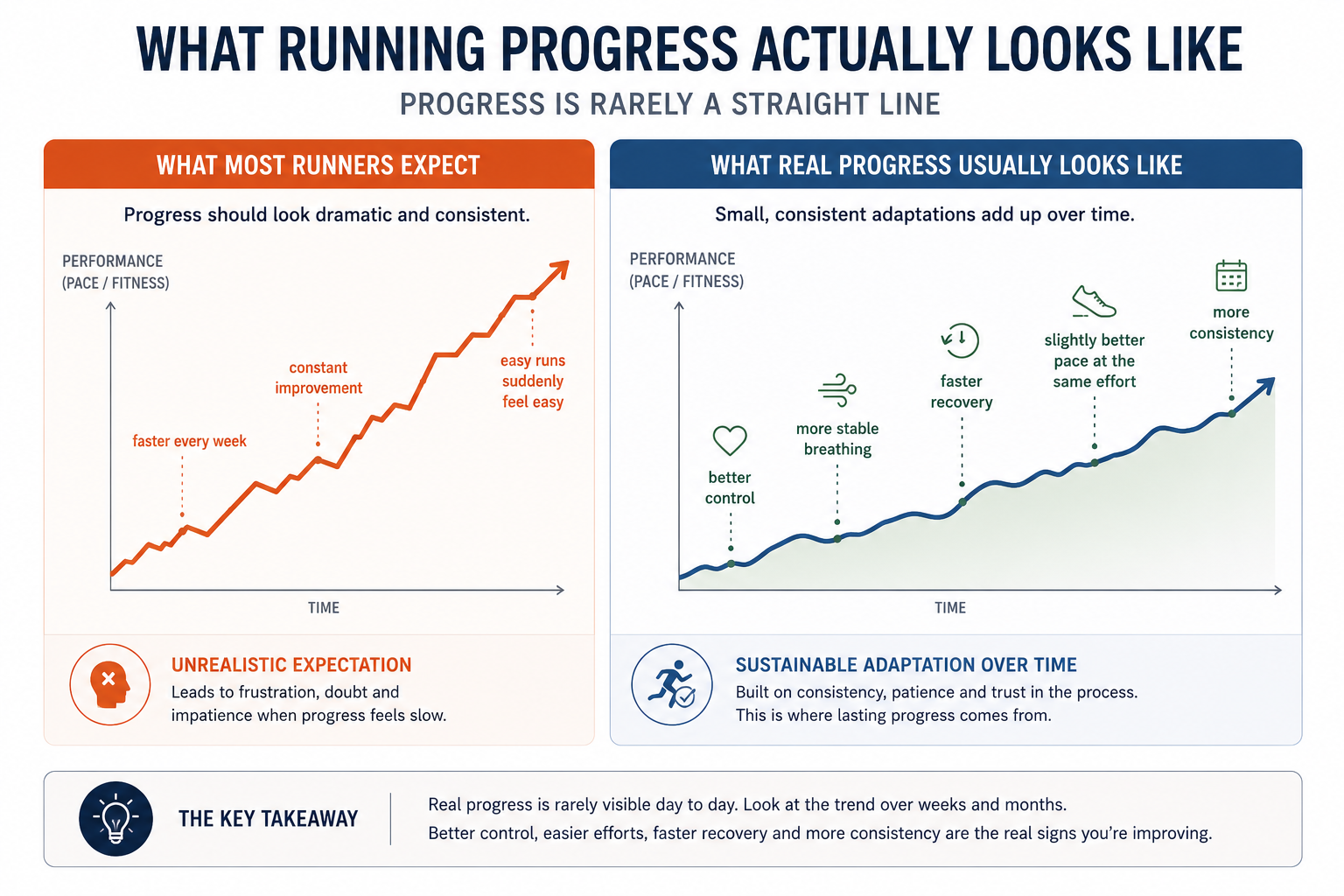
Many runners assume progress should always feel dramatic: faster pace, easier breathing, obvious performance breakthroughs. But endurance development usually works much more quietly than that.
Real progress often appears first in:
control, recovery, consistency, pacing stability, and how sustainably the body handles effort over time.
And once runners understand what to actually look for, improvement becomes much easier to recognize correctly.
These decisions become much easier when you can see how your body is responding instead of guessing from pace alone.
If you want a clearer picture of effort, recovery, and day-to-day readiness, you can explore our guide to the Best Running Watches for Running (2026).
Progress Usually Feels Smaller Than Expected
One of the biggest frustrations in endurance training is that progress rarely announces itself clearly.
Most runners expect improvement to feel obvious. They look for faster times, immediate pace changes, or runs suddenly becoming easy.
But real adaptation is usually far more gradual than that.
Week to week, progress can feel almost invisible. Some runs feel strong, others feel heavy, and the overall direction becomes difficult to judge emotionally from individual sessions alone.
That is completely normal.
The body adapts slowly through accumulated consistency rather than dramatic breakthroughs.
And psychologically, that creates a strange effect:
improvement quietly becomes your new normal before you fully recognize it as progress.
This is one reason many runners underestimate themselves. They constantly compare current fitness against future expectations instead of comparing current fitness against where they were months earlier.
If you often feel unsure whether training is actually working, Why Running Doesn’t Get Easier (And What That Actually Means) explains why endurance progress frequently feels much subtler than runners initially expect.
Progress in running is usually quieter than people think.
Your Pace Improves At The Same Effort
One of the clearest long-term signs of improvement is not running harder.
It is running faster while effort stays similar.
This is one of the most important concepts in endurance development because many runners accidentally look for the wrong type of progress. They assume improvement should feel easier, when in reality it often means producing more output at roughly the same perceived effort.
That might look like:
slightly faster easy pace, more stable breathing at familiar pace, or better control during longer runs without forcing additional intensity.
The important detail is that the effort itself remains sustainable.
You are not pushing harder to create those changes.
The body is simply becoming more efficient.
This is also where objective feedback tools become useful. If heart rate stays relatively similar while pace gradually improves, that is often a very strong sign that aerobic adaptation is happening successfully.
If you want a clearer estimate of sustainable training intensities based on current fitness, the Running Pace Zone Calculator can help translate recent race performance into realistic training pace ranges.
And if you want to better understand how aerobic effort should feel during easier runs, What Does an Easy Run Actually Feel Like? explains the key signals most runners eventually learn to recognize naturally.
Real progress often means: more output at the same effort.
Not more suffering at the same pace.
Your Runs Feel More Controlled
Another very important sign of progress is stability.
Early in a runner’s development, runs often feel unpredictable. Breathing fluctuates quickly, effort spikes unexpectedly, pacing becomes difficult to manage, and fatigue arrives inconsistently.
But over time, something subtle begins changing.
Runs start feeling smoother.
Breathing settles faster. Pace becomes easier to regulate. Effort remains more stable across the run instead of constantly drifting upward.
That increased control matters enormously because endurance performance is not just about raw speed.
It is also about repeatability and sustainability.
A controlled run is often a sign that:
aerobic efficiency is improving, movement economy is stabilizing, and pacing awareness is becoming more refined.
This is one reason Running Feels Hard? Here’s Why (Even When You’re Fit) becomes such an important concept. Experienced runners still feel effort, but they usually handle it with much greater control and consistency than before.
Progress is not always dramatic. Sometimes it simply feels steadier.
You Recover Faster Between Runs
Improvement does not only appear during the run itself.
Very often, it appears afterward.
As aerobic fitness develops, the body becomes more efficient at recovering from stress. Muscular fatigue resolves faster, energy stabilizes more quickly, and training sessions stop interfering with each other as heavily as before.
That recovery improvement is one of the clearest signs the body is adapting productively.
Many runners focus so heavily on pace that they completely miss this side of development. But recovery quality strongly influences whether sustainable progression is even possible long term.
If your legs feel fresher more consistently, harder sessions stop affecting the next several days as heavily, and your overall training week feels more manageable than before, those are extremely meaningful signs of progress.
The body is becoming more resilient.
And resilience is one of the most important forms of endurance adaptation.
Easy Runs Start Feeling More Sustainable
This is one of the most psychologically important signs of progress.
Not because easy runs suddenly become effortless, but because they stop feeling unstable.
Breathing stays calmer. Effort drifts upward more slowly. Pace becomes easier to sustain without tension building quickly.
The difference is subtle, but important.
Before adaptation: easy runs often feel slightly awkward, surprisingly demanding, or difficult to settle into.
After adaptation: the same type of run feels calmer, more repeatable, and easier to regulate overall.
That is direct aerobic progress.
This is also why easy running matters so much in the first place. Sustainable aerobic development depends heavily on the body spending enough time inside controlled intensity instead of constantly drifting into moderate effort.
If easy pace still feels confusing or inconsistent, How Slow Should Easy Runs Be? (And How to Know You’re Doing It Right) explains why sustainable aerobic effort often feels calmer and slower than runners initially expect.
When easy runs start feeling more stable, endurance development is usually moving in the right direction.
Your Consistency Improves
One of the strongest indicators of long-term progress is not pace.
It is consistency.
You recover well enough to continue training regularly. Missed sessions become less frequent. Weekly structure feels more manageable instead of constantly disrupted by fatigue or soreness.
That reliability matters enormously because consistency is what allows adaptation to accumulate over time.
Without consistency, fitness constantly resets itself before development fully stabilizes.
This is also why runners often underestimate how important recovery, pacing, and intensity control really are. Those things do not just affect individual runs. They affect whether sustainable training is even possible week after week.
If you can consistently handle your planned training without constantly feeling overwhelmed, that alone is already a major sign the system is adapting positively.
This is exactly why How to Build a Weekly Running Structure That Actually Works becomes so important long term. Progress usually depends less on perfect workouts and much more on how sustainably effort is organized across the entire week.
Consistency itself is a form of progress.
Progress Is Easier To See In Trends Than Individual Runs
One of the biggest mistakes runners make is trying to judge progress from isolated workouts.
One run can feel incredible. Another can feel terrible.
Neither one necessarily means very much alone.
Endurance development becomes much easier to understand when runners stop obsessing over individual sessions and start looking at broader patterns instead.
Over time, important questions become:
Are runs feeling more stable?
Is recovery improving?
Is breathing settling faster?
Is pace becoming more sustainable at similar effort?
Is training consistency improving?
Those trends matter far more than whether one specific run felt amazing or disappointing.
This is also why overanalyzing metrics can sometimes create more confusion than clarity. Too many isolated data points often disconnect runners from the bigger picture of actual adaptation.
The goal is not perfect data.
The goal is recognizing sustainable long-term direction.
What Not To Rely On Too Much
Not every sign that looks like progress actually is progress.
And not every difficult period means training has stopped working.
Pace fluctuates constantly depending on fatigue, weather, recovery, terrain, and stress. One difficult week does not erase months of adaptation. One great workout does not guarantee massive improvement either.
This is also why comparison becomes dangerous so quickly in running.
Different runners have different training history, recovery capacity, injury background, genetics, and life stress. Comparing isolated numbers without context usually creates unrealistic expectations instead of useful perspective.
The better approach is focusing on:
your own consistency, your own trends, and your own adaptation over time.
That perspective is much more reliable psychologically and physiologically.
How To Track Progress Without Overcomplicating Everything
Most runners do not actually need complicated systems to recognize improvement.
Simple patterns are often enough.
Pay attention to:
how stable your effort feels, how quickly breathing settles, how sustainable your pacing becomes, how well you recover, and how manageable training feels across multiple weeks.
Those signals already reveal a tremendous amount.
Repeatable routes can help too. Running similar sessions under similar conditions often makes subtle aerobic changes easier to notice over time.
And most importantly:
judge progress across months, not days.
Endurance adaptation is slow enough that trying to evaluate it emotionally run by run usually creates unnecessary doubt.
If your training is becoming:
more sustainable, more stable, and more repeatable over time, you are almost certainly improving.
Frequently Asked Questions
How do I know if my running is improving?
Look for long-term patterns:
better control, more stable breathing, improved recovery, more sustainable pacing, and greater consistency across training weeks.
Why is my pace not improving even though I train regularly?
Sometimes aerobic development appears first through recovery, efficiency, and control before obvious pace improvements fully appear.
How long does running progress usually take?
Most runners begin noticing subtle changes within weeks, but more meaningful endurance adaptations usually develop gradually across months of consistent training.
Should running feel easier when fitness improves?
Usually more controlled rather than dramatically easier. Better fitness often means producing more output at similar effort instead of removing effort completely.
Is recovery improvement a sign of progress?
Absolutely. Faster recovery between runs is one of the clearest signs the body is adapting positively to training stress.
If you want your easy and recovery runs to feel smoother and reduce unnecessary strain, the shoes you use can make a difference.
You can explore options in our guide to the Best Running Shoes for Daily Training (2026).
Conclusion
Running progress is rarely as dramatic as runners initially expect.
Most improvement happens quietly through:
better control, stronger recovery, more sustainable pacing, and greater consistency across time.
And because those changes happen gradually, many runners fail to recognize them while they are actively happening.
But that does not mean progress is absent.
Very often, it simply means adaptation has already started becoming your new normal.