
You are training consistently. You are showing up, putting in the effort, and trying to stay disciplined.
But your pace is not really changing.
The same runs still feel challenging. Race times stay similar. Easy pace does not move the way you expected it to. And eventually the question starts appearing almost automatically:
Why am I not getting faster?
This is one of the most frustrating phases in endurance training because the work feels real, but the visible reward feels delayed.
And very often, runners respond the wrong way:
they push harder, add more intensity, or start doubting the entire process.
But pace is not always the first thing that improves.
In many cases, the body is adapting in important ways long before speed becomes obviously visible.
And sometimes, pace progression slows not because training is failing, but because the body is no longer fully absorbing the work being done.
That distinction changes everything.
These decisions become much easier when you can see how your body is responding instead of guessing from pace alone.
If you want a clearer picture of effort, recovery, and day-to-day readiness, you can explore our guide to the Best Running Watches for Running (2026).
Pace Is Usually The Last Thing To Improve
One of the biggest misunderstandings in running is the idea that progress should immediately appear as faster pace.
Most runners expect visible improvement to look like:
better splits, easier speed, and obvious performance jumps.
But endurance adaptation rarely works that cleanly.
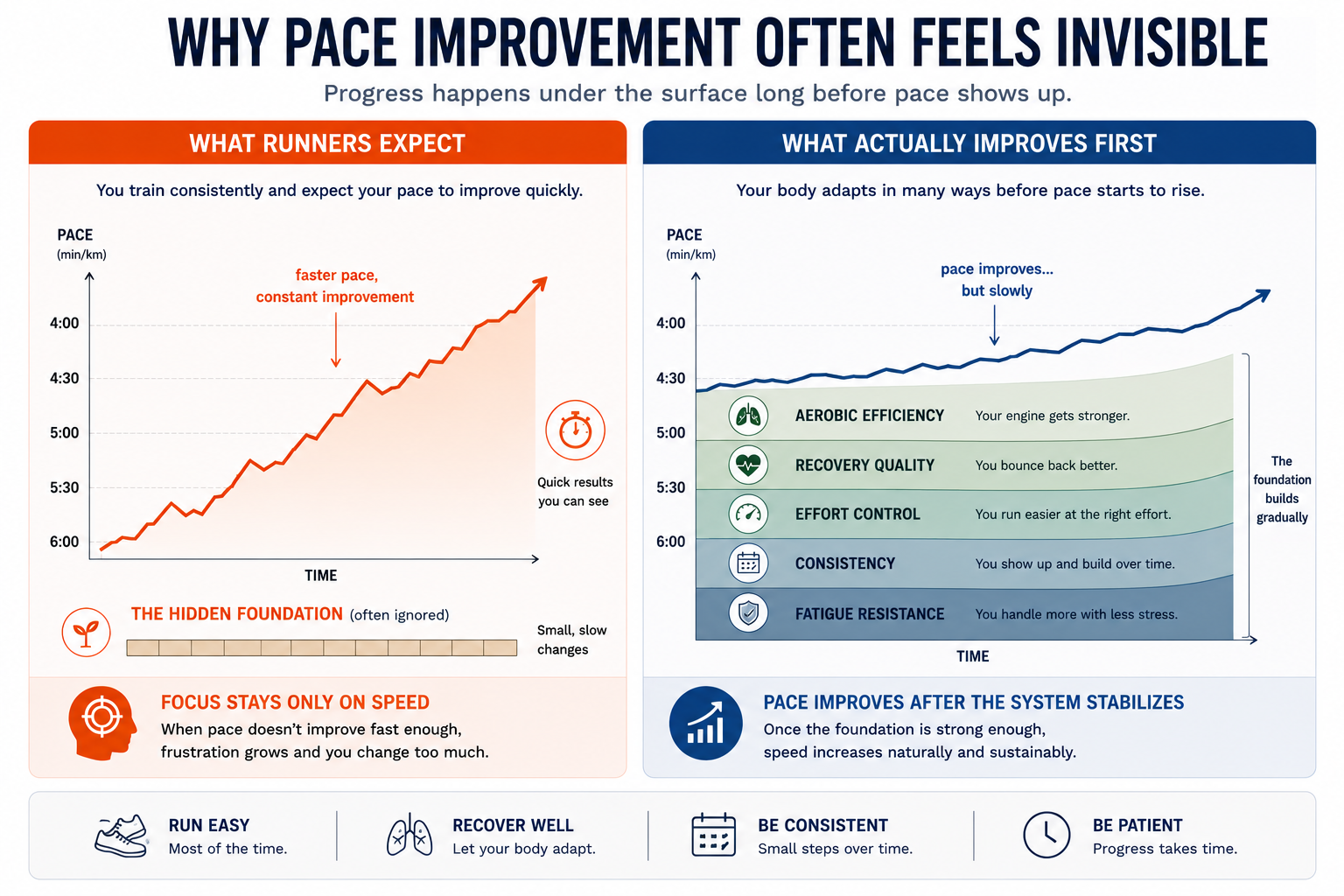
Before pace changes significantly, the body usually improves in less visible ways first: aerobic efficiency, recovery quality, pacing stability, movement economy, fatigue resistance, and overall workload tolerance.
Those systems quietly build underneath the surface long before speed fully reflects them.
That is one reason runners often become discouraged too early. They are looking for performance output before the underlying systems have finished stabilizing.
This is also why How to Tell If Your Running Is Improving becomes such an important concept. Progress frequently appears first through better control, consistency, and recovery long before dramatic pace changes become obvious.
Real adaptation often starts invisibly.
Many Runners Are Training Consistently — But Not Absorbably
This is one of the most important ideas in endurance training.
A runner can train regularly and still fail to progress if the body never fully absorbs the training stress productively.
And very often, the reason is hidden fatigue.
The training itself may look structured. Mileage may be consistent. Workouts may be completed correctly. But underneath the surface, recovery quality slowly deteriorates because the overall stress never fully resolves between sessions.
This usually happens quietly.
Easy runs drift slightly too hard. Recovery days stop feeling truly restorative. Heart rate rises earlier than expected. Legs stay mildly heavy more often than not.
Nothing feels catastrophic.
But the body slowly stops adapting efficiently.
This is exactly why What Happens If You Run Too Fast Too Often (And Why It Slows You Down) becomes such an important concept. Constant moderate-intensity stress often creates the illusion of productive training while quietly limiting long-term adaptation.
Progress slows when fatigue becomes constant instead of productive.
Easy Runs Are Often The Real Problem
Many runners assume pace improvement depends mostly on harder workouts.
But in reality, pace development often depends more on how sustainable the easier running actually is.
Easy runs are supposed to support: aerobic development, recovery quality, and sustainable weekly training load.
But when those runs slowly drift into moderate effort, the entire system becomes less stable.
Recovery becomes incomplete. Hard sessions lose quality.
Fatigue accumulates faster than adaptation.
And eventually pace stops improving even though training volume continues.
The difficult part is that slightly-too-hard running rarely feels dramatically difficult. It usually feels controlled enough that runners continue doing it for weeks or months without fully noticing the long-term cost.
If easy pace still feels difficult to judge consistently, How Slow Should Easy Runs Be? (And How to Know You’re Doing It Right) explains why sustainable aerobic running often feels calmer and slower than runners initially expect.
And if you want clearer effort guidance based on current physiology, the Heart Rate Zone Calculator for Running can help establish more realistic aerobic intensity ranges instead of relying purely on pace feel.
Many runners are not undertraining.
They are under-recovering.
Your Body May Still Be Improving In Ways You Cannot See Yet
One of the most frustrating parts of endurance training is that adaptation often becomes invisible while it is happening.
Because runners usually focus heavily on pace, they overlook quieter signs of improvement happening underneath the surface.
But progress may already be visible through:
better recovery between runs, more stable breathing, smoother pacing, lower perceived effort at similar workload, or greater consistency across the training week.
Those changes matter enormously because they are often the foundation that eventually allows pace to improve later.
This is one reason Running Doesn’t Get Easier (And What That Actually Means) becomes such an important mindset shift. Better fitness usually means producing more output at similar effort, not removing effort completely.
Progress frequently becomes difficult to notice because adaptation slowly becomes your new normal.
Pace Improvement Depends On System Stability
This is where many runners unintentionally sabotage themselves.
They become impatient with progress, so they continuously change something:
more intensity, different workouts, higher mileage, more aggressive pacing.
But aerobic development depends heavily on stability.
The body adapts best when:
stress remains organized, recovery remains sufficient, and training remains sustainable long enough for adaptation to fully accumulate.
Constantly forcing additional stress often interrupts that process instead of accelerating it.
This is also why structure matters so much.
How to Build a Weekly Running Structure That Actually Works explains why sustainable progression usually depends less on individual hard sessions and more on how intelligently stress and recovery are balanced across the entire week.
The goal is not maximum effort.
The goal is maximum absorbable training.
Expectations Often Move Faster Than Adaptation
Another major reason pace feels disappointing is that expectations quietly accelerate faster than physiology itself.
Runners naturally expect improvement quickly once consistency begins.
A few good weeks create optimism. Slight progress creates bigger goals. And eventually runners begin evaluating themselves against future expectations rather than current reality.
But endurance adaptation is relatively slow by nature.
Aerobic development happens through accumulated exposure repeated over months, not dramatic short-term breakthroughs.
And psychologically, that delay often feels frustrating because effort feels immediate while adaptation feels delayed.
This is one reason many runners start doubting effective training systems too early. They assume lack of rapid pace improvement means something is wrong.
Very often, the process simply has not had enough uninterrupted time yet.
If you are still unsure how long meaningful running improvement realistically takes, How Long Does It Take to Improve Running? explains why adaptation usually develops much slower — and much more sustainably — than runners initially expect.
What Actually Drives Pace Improvement Long Term
Pace improves when the systems underneath it improve.
That means:
aerobic capacity, efficiency, recovery quality, movement economy, workload tolerance, and consistency.
Not just motivation.
This is why trying to force pace directly usually fails long term. Speed is often the outcome of a stable system rather than something runners can successfully chase aggressively every day.
The runners who improve most sustainably are usually the ones who:
keep easy runs genuinely easy, recover consistently, avoid constant hidden fatigue, and train steadily long enough for adaptation to fully accumulate.
If pacing itself still feels difficult to structure practically, the Running Pace Zone Calculator can help estimate more realistic training intensities based on current race fitness rather than emotional expectations.
Better pace usually appears as a result of sustainable adaptation.
Not as a result of constantly trying to run harder.
What To Focus On Instead
If pace is not improving yet, shifting attention toward the right signals becomes extremely important psychologically.
Instead of obsessing over speed alone, start evaluating:
recovery quality, effort stability, consistency, aerobic control, and how sustainable training feels across multiple weeks.
Those things reveal much more about long-term trajectory than isolated pace numbers.
Ask:
Are runs becoming more controlled?
Is recovery becoming more predictable?
Can the body handle training more sustainably?
Does breathing settle more naturally?
Is fatigue resolving more completely between sessions?
Those are often the real indicators that adaptation is still moving forward.
Because ultimately, pace is usually not built directly.
It is built indirectly through improving the entire system behind it.
Frequently Asked Questions
Why is my running pace not improving even though I train regularly?
Because pace is often the final visible result of deeper adaptations like aerobic efficiency, recovery quality, and workload tolerance.
Can running too hard slow progress?
Yes. Constant moderate-intensity fatigue often interferes with recovery and limits the body’s ability to fully absorb training stress productively.
Are easy runs really that important for improving pace?
Absolutely. Easy runs support aerobic development and recovery, which are both essential for sustainable pace improvement long term.
How long does pace improvement usually take?
Meaningful pace development usually happens gradually across months of consistent, sustainable training rather than dramatic short-term jumps.
What are signs that progress is still happening even if pace is not changing?
Better recovery, more stable breathing, improved consistency, smoother pacing, and greater workload tolerance are all strong signs of positive adaptation.
If you want your easy and recovery runs to feel smoother and reduce unnecessary strain, the shoes you use can make a difference.
You can explore options in our guide to the Best Running Shoes for Daily Training (2026).
Conclusion
If your pace is not improving yet, it does not automatically mean your training is failing.
Very often, it means the deeper systems underneath performance are still developing: efficiency, recovery, aerobic stability, and workload tolerance.
And sometimes it means the body is no longer fully absorbing the amount of stress being applied consistently.
That is why sustainable progress depends less on constantly pushing harder and more on building a system the body can repeatedly recover from and adapt to over time.
Because long-term pace improvement is rarely forced directly.
It is usually the outcome of sustainable adaptation accumulated patiently across months of controlled training.