
Recovery is one of the strangest parts of running because most of it is invisible.
You finish a run, shower, eat something, continue your day — and somewhere in the background, your body either starts adapting to the training…or quietly falls behind it.
The difficult part is that runners often expect recovery problems to feel dramatic.
They imagine overtraining looking obvious. Extreme fatigue. Complete exhaustion.
A body that simply refuses to run. But most recovery problems do not begin that way.
Usually it is much quieter.
Easy pace starts feeling slightly more expensive. The legs stop feeling truly fresh between runs. Breathing becomes more noticeable during sessions that normally feel manageable.
And because nothing feels catastrophic yet, many runners continue training exactly the same way without realizing the system is no longer fully resetting underneath the surface.
Learning how to recognize proper recovery is important because endurance progress does not happen during the run itself.
It happens during the body’s ability to absorb what the run created afterwards.
Good Recovery Usually Feels Quiet
One reason recovery becomes difficult to interpret is that proper recovery rarely feels dramatic either.
You usually do not wake up feeling superhuman after a productive training block. Most of the time, good recovery simply feels… stable.
The body responds normally when running begins. Breathing settles relatively naturally. Easy effort feels manageable instead of strangely expensive. The legs may feel slightly worked, but movement still feels fluid underneath the fatigue.
That distinction matters.
Because runners often expect recovery to mean: completely fresh, fully energized, perfectly rested.
But endurance training does not really work like that. When training consistently, there is almost always some level of fatigue present somewhere in the system. The important thing is whether that fatigue continues resolving predictably between sessions.
This is one reason What a Good Training Day Actually Feels Like matters so much. Productive endurance training usually feels more stable and sustainable than spectacular.
Good recovery does not remove all fatigue. It allows fatigue to remain manageable enough that the body keeps adapting normally.
One Of The Clearest Signs Is How Easy Running Feels
Easy runs reveal recovery quality surprisingly honestly.
Hard workouts can temporarily hide fatigue through adrenaline and intensity. Easy aerobic effort usually cannot.
When recovery is functioning well, easy pace tends to settle naturally after the body warms up. Breathing becomes rhythmical. Movement starts feeling smoother instead of heavier as the run develops.
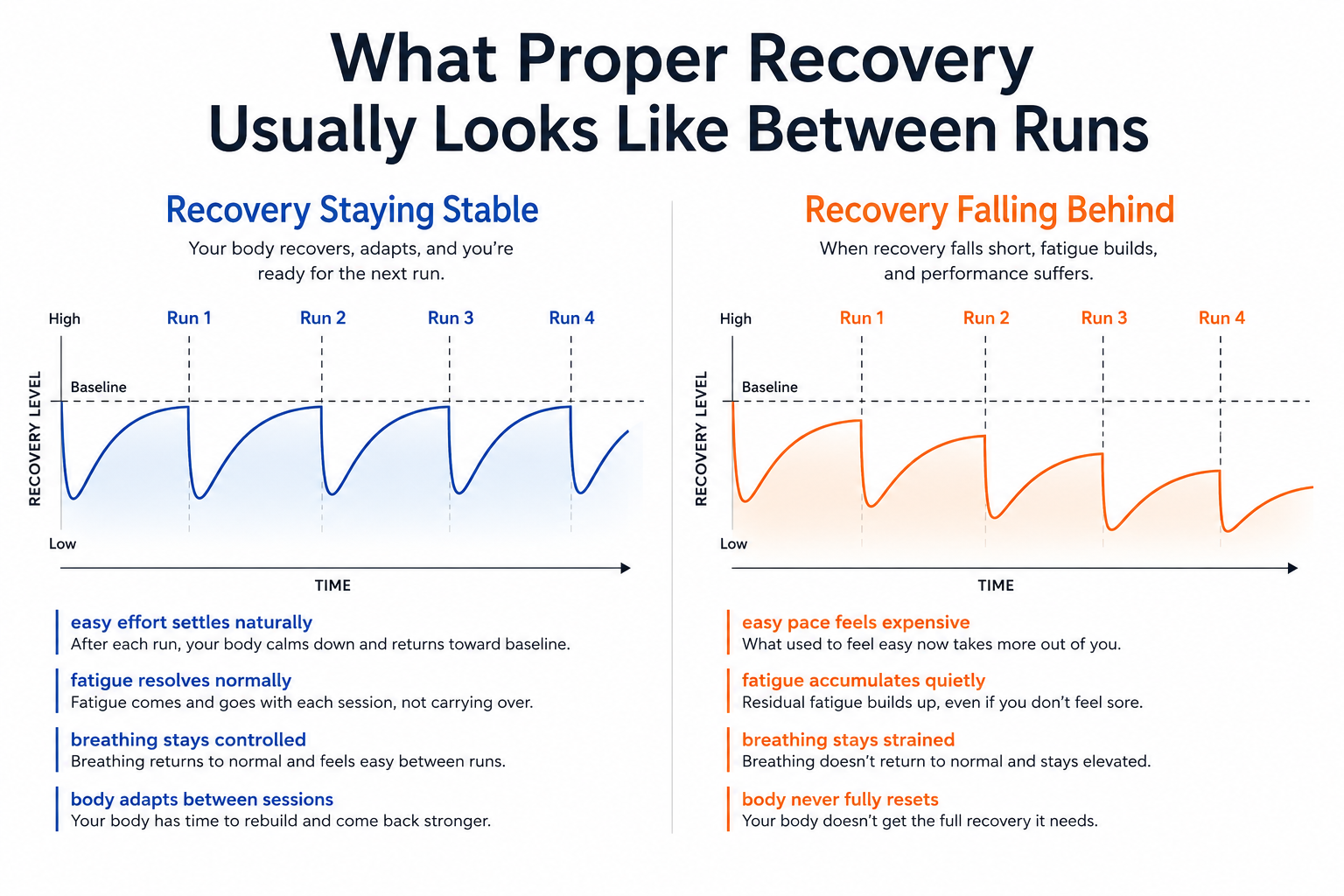
But when recovery quietly falls behind, easy effort often changes first. Breathing stays slightly strained. Heart rate rises earlier than expected. The body feels flat instead of simply tired. Easy pace starts feeling more expensive than it should.
And importantly, this often appears before obvious performance decline becomes visible elsewhere.
This is closely connected to What Does an Easy Run Actually Feel Like?, because many runners accidentally normalize subtle hidden fatigue after spending too much time slightly above sustainable aerobic effort.
And if you want a more objective way to monitor whether easy effort is remaining truly aerobic, the Heart Rate Zone Calculator for Running can help establish more realistic recovery-friendly training ranges.
Easy running often tells the truth about recovery earlier than hard running does.
Recovery Problems Usually Build Gradually
Another reason runners miss recovery issues is that the process is rarely sudden.
The body usually gives smaller signals first. A run that never fully settles. Slightly heavier legs across multiple days. Pace dropping at the same effort. A strange feeling that easy running requires more concentration than normal.
None of those alone automatically mean something is seriously wrong.
But together, they often reveal that the body is absorbing stress less effectively than before.
This becomes especially common when runners unintentionally remove the contrast between hard days and easy days. Easy runs drift too hard, recovery becomes incomplete, and moderate fatigue quietly accumulates underneath otherwise normal-looking training.
What Happens If You Run Too Fast Too Often (And Why It Slows You Down) explains why this pattern becomes so common once runners lose clear separation between aerobic running and harder effort.
Recovery problems usually do not announce themselves loudly. More often, they slowly change how sustainable running feels from day to day.
Recovery quality often influences how stable your heart rate remains during easy runs. If drift suddenly becomes much larger than normal, it can sometimes indicate accumulating fatigue. Our Easy Run Drift Calculator can help identify these patterns.
Recovery Is About Returning To Stability
One misunderstanding about recovery is the idea that recovery simply means “not feeling tired.”
But physiologically, recovery is really about the body regaining stability between stress exposures. Breathing stabilizes normally again. Movement quality returns. The nervous system settles. Easy effort becomes manageable instead of strained.
That is why runners who are recovering well can still train consistently even while carrying moderate fatigue. The body still responds proportionally.
This is also why recovery cannot really be judged from one isolated run alone. Endurance training works in patterns, not moments.
One difficult run means very little by itself.
A repeated pattern of unstable effort means much more.
This is one reason experienced runners become surprisingly observant about trends instead of isolated sessions. They understand that the body constantly fluctuates slightly — but healthy systems still return toward stability afterwards.
If recovery itself has recently felt difficult to interpret consistently, How to Read Your Body Before a Run (Simple Daily Check) explains how smaller physiological signals often reveal recovery quality before performance numbers change dramatically.
Good recovery usually looks less like perfect freshness and more like reliable stability returning repeatedly.
The Goal Is Not To Eliminate Fatigue Completely
This is where many runners accidentally become too reactive. Not every tired day means recovery is failing. Training itself creates fatigue intentionally.
That is part of adaptation.
The important distinction is whether the fatigue continues resolving predictably over time — or whether it starts accumulating faster than the body can absorb.
Healthy training fatigue usually still feels: manageable, understandable, and recoverable.
Problematic fatigue feels different. The body stops fully resetting. Easy effort stays expensive. Breathing remains strained unusually early. Recovery between sessions becomes less complete week after week.
This is one reason sustainable runners become less emotionally reactive to individual difficult runs.
They stop asking: “Do I feel perfectly fresh today?”
And start asking: “Is the body still returning toward stability overall?”
That question is usually much more useful long term.
Recovery Often Improves Before Performance Does
One interesting thing about endurance adaptation is that recovery quality frequently improves before obvious speed improvements appear.
Runners sometimes notice: easy effort stabilizing faster, breathing settling earlier, legs recovering more predictably, or consistent training becoming easier to sustain before pace itself changes dramatically.
That matters because many important endurance adaptations happen quietly underneath the surface before they become visible through performance metrics.
This is closely connected to How to Tell If Your Running Is Improving (7 Clear Signs), because some of the earliest signs of progress are actually:
more stable effort, more predictable recovery, and more sustainable training continuity.
Good recovery is not separate from progress. Very often, it is one of the clearest signs that progress is already happening.
Frequently Asked Questions
How do I know if I’m recovering properly between runs?
Usually through stability. Easy effort feels manageable, breathing settles normally, movement feels coordinated, and fatigue continues resolving between sessions instead of constantly accumulating.
Is it normal to feel slightly tired while training consistently?
Yes. Consistent endurance training almost always includes some level of fatigue. The important thing is whether the body still responds and recovers predictably overall.
What are early signs of poor recovery?
Easy runs feeling unusually hard, elevated heart rate at normal pace, lingering heaviness, unstable breathing, and fatigue that no longer fully resolves between runs.
Can I still improve if I never feel completely fresh?
Yes. Good endurance adaptation usually happens while carrying manageable fatigue, not while feeling perfectly rested all the time.
Why do easy runs reveal recovery problems so clearly?
Because aerobic effort exposes how sustainably the body is functioning underneath accumulated stress without adrenaline or high intensity masking fatigue.
If You Want Better Insight Into Recovery And Effort
Reliable heart rate and recovery tracking can help identify when easy effort is remaining sustainable versus quietly becoming more expensive underneath accumulated fatigue.
The goal is not obsessing over numbers.
It is understanding whether the body is continuing to absorb training productively over time.
If you want a practical comparison of the best tools available, Best Running Watches for Running (2026) breaks down the most useful options for aerobic pacing, recovery tracking, and endurance-focused training.
Conclusion
Recovering properly between runs usually does not feel dramatic.
More often, it feels stable.
The body keeps returning toward manageable effort. Easy pace continues feeling sustainable. Breathing settles normally. Fatigue resolves enough that training remains absorbable instead of constantly accumulating underneath the surface.
And over time, that quiet stability is often what allows the strongest endurance systems to develop consistently without breaking down.
Because long-term progress in running depends less on how hard individual sessions feel…
and much more on how well the body continues recovering from them afterwards.