
Some mornings feel strange before the run even starts.
You are not injured. You are not sick. But something feels slightly off in a way that is difficult to explain clearly.
The legs feel flatter than usual. The idea of running already feels mentally expensive. Even easy pace somehow feels tiring before you have taken the first real steps. And often, the hardest part is not the run itself.
It is deciding what the feeling actually means.
Because sometimes the body simply needs time to warm up. Other times, recovery has quietly fallen behind and the system is carrying more fatigue than you realized.
Learning how to recognize the difference is one of the most useful endurance skills a runner can develop.
Not because every difficult-feeling day should stop training. But because not every difficult-feeling day should be ignored either.
The Body Usually Gives Small Signals First
One of the biggest misconceptions in endurance training is the idea that fatigue suddenly appears all at once.
Usually it does not.
Most of the time, the body starts communicating much earlier through smaller, quieter signals that are easy to dismiss individually.
Easy pace feels slightly more expensive than normal. Breathing feels more noticeable during warm-up. The legs do not really loosen after the first minutes. Movement itself feels less fluid without obvious pain or injury.
None of those automatically mean: “You should not run today.”
But together, they often reveal whether the body is adapting well or simply carrying unresolved fatigue from previous stress.
This is why experienced runners become surprisingly observant about small changes in effort perception. They understand that endurance training is not only about completing sessions. It is also about recognizing how sustainably the body is handling them underneath the surface.
If runs have recently started feeling unusually heavy without obvious explanation, Running Feels Hard? Here’s Why (Even When You’re Fit) breaks down why recovery, stress, and accumulated fatigue often influence effort more than runners initially realize.
The First Ten Minutes Often Tell The Truth
One difficult part about reading the body correctly is that many runs feel awkward at first.
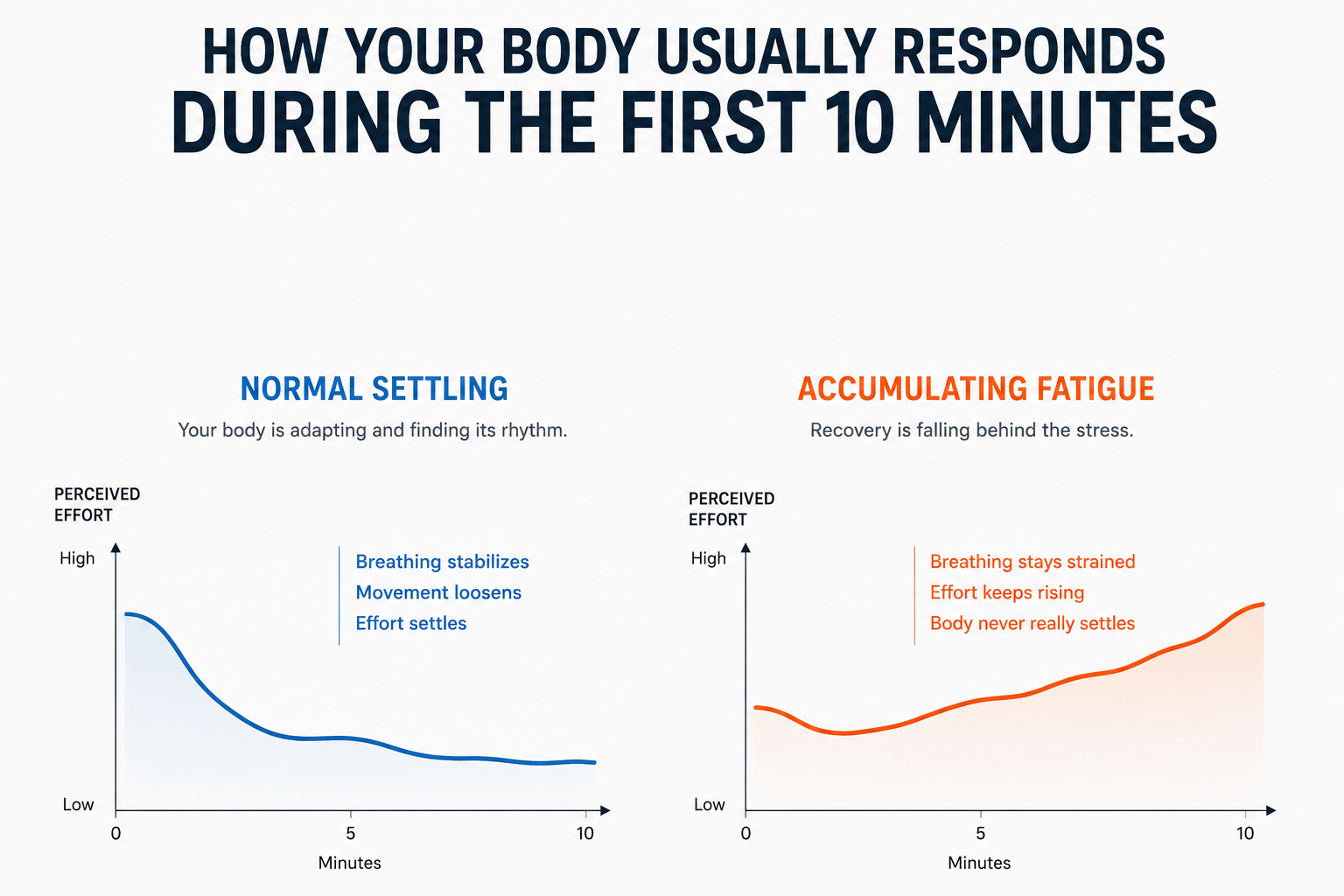
That is normal. The body is transitioning from rest into movement. Breathing is stabilizing. Muscles are warming up. Coordination is settling into rhythm again. This is why experienced runners rarely judge a run too quickly. Instead, they quietly watch what happens as the body starts moving.
Do the legs gradually loosen? Does breathing settle naturally? Does easy effort begin feeling more sustainable? Or does the strain stay unusually high despite low intensity?
That distinction matters enormously.
Because many difficult-feeling mornings are temporary. The body simply needs time to settle into movement before effort starts feeling normal again.
But sometimes the opposite happens: the run never really settles. Easy pace continues feeling strangely demanding. Breathing stays disconnected. Effort keeps rising earlier than it should. That is usually the body telling you something important about current recovery state.
This is closely connected to What It Means When a Run Feels Hard From the Start, because early heaviness can reflect either temporary stiffness or deeper accumulated fatigue depending on how the body responds as the run continues.
The important question is rarely: “Do I feel amazing immediately?”
It is: “Does the body gradually become more stable once movement begins?”
Easy Effort Reveals Recovery Better Than Hard Effort
Hard workouts can temporarily hide fatigue surprisingly well.
Adrenaline, focus, and intensity often mask what the body is actually carrying underneath.
Easy running does the opposite. Easy effort exposes recovery quality very honestly.
When the body is absorbing training well, easy pace usually feels calm enough that breathing settles naturally and movement becomes rhythmical without much internal resistance.
But when fatigue has accumulated too far, even controlled aerobic running starts feeling unusually expensive. Breathing becomes slightly strained earlier than normal. Heart rate drifts upward faster. The body feels flat instead of simply tired. Easy pace stops feeling truly easy.
And importantly, this often appears before obvious performance decline becomes visible elsewhere.
This is one reason runners who constantly train “slightly too hard” often struggle to recognize hidden fatigue early enough. Easy effort gradually stops feeling sustainable, but because nothing feels catastrophic yet, they continue accumulating stress anyway.
If easy running itself has started feeling difficult to interpret consistently, What Does an Easy Run Actually Feel Like? explains the difference between sustainable aerobic effort and subtle hidden strain much more clearly.
And if you want a more objective way to keep aerobic effort controlled during uncertain days, the Heart Rate Zone Calculator for Running can help establish more realistic recovery-friendly intensity ranges based on your current physiology.
Easy effort is often where the body tells the truth first.
Sometimes The Smartest Decision Is Adjusting The Run
Many runners treat training decisions as completely binary.
Either complete the session normally, or skip the run entirely.
But real endurance training usually lives somewhere between those extremes. Sometimes the body does not need complete rest. It simply needs less stress than originally planned.
That might mean: running shorter, slowing the pace, removing intensity, or allowing the session to stay purely aerobic instead of trying to “salvage” performance from a tired system.
This is one of the most important long-term endurance skills: adjusting training before overload becomes visible enough to force bigger recovery later. Because sustainable consistency is rarely built through stubbornness alone.
It is built through recognizing when the body is: absorbing stress well, struggling slightly, or quietly asking for less load before deeper fatigue develops.
This is also why What a Balanced Running Week Looks Like matters so much. Strong endurance systems are usually built through stable stress distribution rather than constant high effort.
Sometimes the smartest run is not the hardest one.
It is the one that leaves the body stable enough to continue training tomorrow.
Your Body Is Not A Machine
One difficult psychological part of running is accepting that the body will never feel exactly the same every day.
Some mornings feel smooth immediately. Others feel mentally heavy for no obvious reason. Certain weeks feel powerful. Others feel strangely flat despite similar training. That variability is normal.
Sleep, work stress, accumulated fatigue, nutrition, weather, life load, and recovery quality all influence how effort feels before a run even begins.
The problem starts when runners interpret every difficult-feeling day emotionally instead of contextually. A slightly heavy morning does not mean fitness disappeared. One low-energy day does not erase months of adaptation. And adjusting a run does not mean training is failing.
Very often, it simply means the body is behaving like a living system instead of a machine.
And learning how to interpret those fluctuations calmly is part of becoming a more durable runner long term.
A Simple Daily Check Before Running
Before a run, try simplifying the process.
Instead of asking: “Do I feel fully fresh today?”
Ask quieter questions instead.
Does movement improve after warming up? Does breathing settle naturally? Does easy effort feel manageable? Does the body feel stable rather than strained?
Those answers usually reveal far more than motivation alone. And if the body continues feeling unusually stressed even at low effort, the smarter decision is often: reduce intensity, shorten the run, or prioritize recovery instead of forcing unnecessary fatigue into an already overloaded system.
Long-term endurance progress is rarely built through isolated heroic sessions.
It is built through sustainable adaptation repeated consistently over time.
Frequently Asked Questions
How do I know if I should still run when I feel tired?
Pay attention to how the body responds once movement begins. Many runners feel slightly heavy initially but settle naturally after warming up. If effort continues feeling unusually strained even at easy pace, recovery may be falling behind.
Is it normal for easy runs to feel harder sometimes?
Yes. Sleep, stress, accumulated fatigue, weather, and previous training all influence how sustainable effort feels from day to day.
Should I skip a run if motivation is low?
Not automatically. Motivation and recovery are not the same thing. Often the body is capable of training even when motivation feels temporarily flat.
What are early signs of accumulating fatigue?
Easy pace feeling unusually difficult, breathing staying strained, elevated heart rate at low effort, persistent heaviness, and recovery that no longer fully resolves between runs.
Is adjusting a run better than forcing the planned workout?
Very often, yes. Reducing intensity or duration before overload fully develops is usually smarter than forcing fatigue into an already stressed system.
If You Want Better Feedback About Recovery And Effort
Reliable heart rate and pacing data can make it easier to recognize when easy effort is drifting higher than current recovery supports.
The goal is not obsessing over numbers.
It is understanding how sustainably the body is responding to training over time.
If you want a practical comparison of the best options available, Best Running Watches for Running (2026) breaks down the most useful tools for aerobic pacing, recovery tracking, and long-term endurance training.
Conclusion
Learning how to read your body before a run is not about becoming fragile or overanalyzing every feeling.
It is about recognizing the difference between: normal training fatigue and accumulating systemic stress.
Because the runners who stay healthy and consistent long term are usually not the ones who ignore fatigue completely.
They are the ones who gradually learn how to interpret it calmly before small problems quietly become larger ones.