
A good training day rarely feels spectacular while it is happening.
That surprises many runners.
Because most people unconsciously expect progress to feel obvious. They expect the body to feel powerful, pace to feel effortless, and the run itself to somehow confirm that training is working.
But real endurance development usually feels much quieter than that. In fact, many genuinely productive training days feel almost… ordinary.
The breathing settles naturally. The pace feels sustainable. The body feels stable instead of explosive. Nothing dramatic happens. And strangely, that calm feeling often creates doubt.
Was this good enough? Should it have felt harder? Am I improving if the run just felt controlled?
Understanding what a good training day actually feels like is important because many runners accidentally chase sensations that have very little to do with sustainable progress.
And over time, that misunderstanding quietly changes how they train.
Good Training Usually Feels Controlled, Not Heroic
One of the biggest misconceptions in running is the idea that productive training should feel impressive while it is happening.
But most strong endurance systems are not built through constant breakthrough sessions. They are built through repeatable controlled work that the body can continue absorbing week after week.
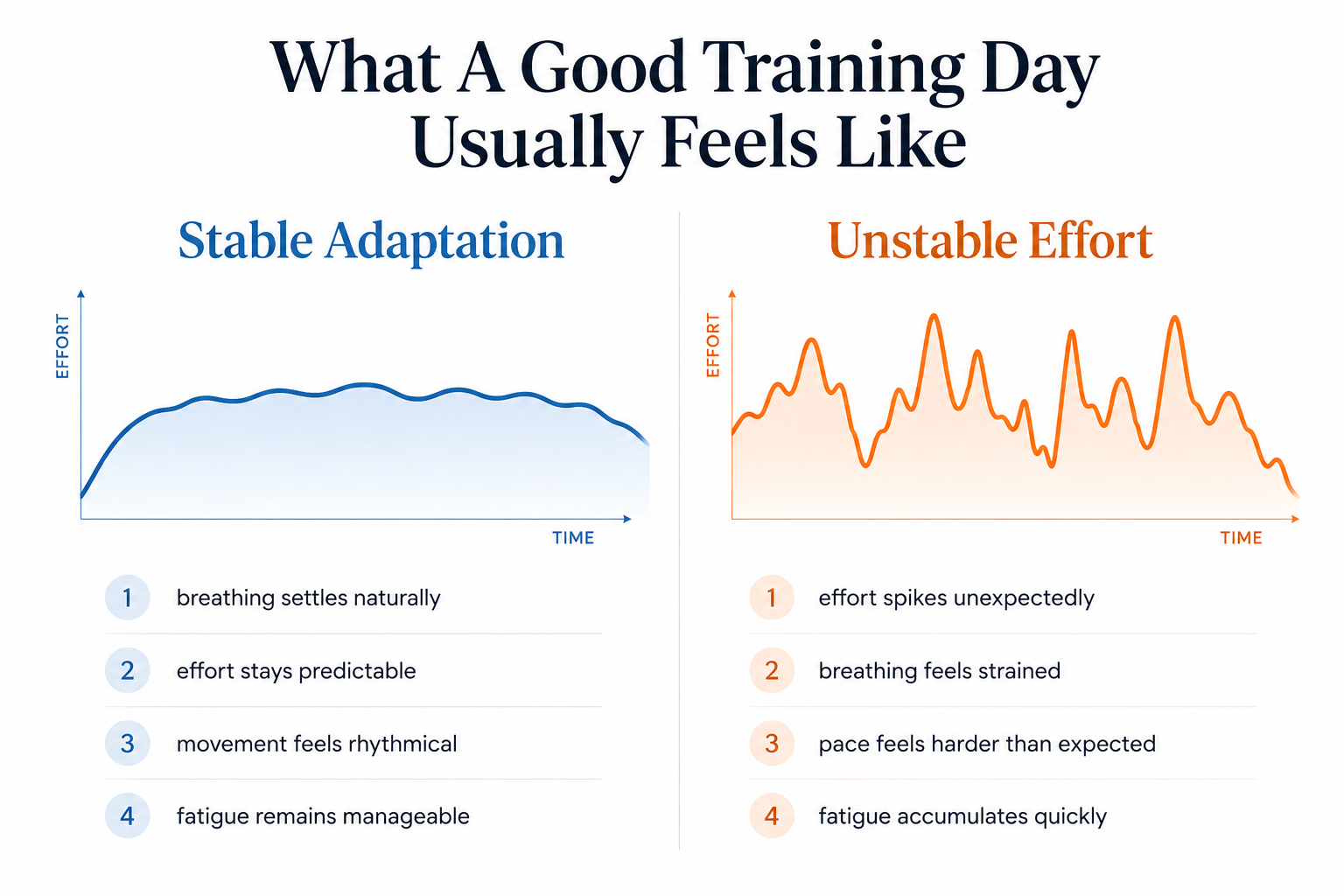
That usually means a good training day feels surprisingly manageable. Breathing stays relatively calm. Movement feels rhythmical instead of forced. Effort remains stable instead of constantly rising.
The body feels like it is working with you rather than fighting against you. This is especially true during aerobic runs, where the goal is not creating maximum fatigue but creating sustainable adaptation underneath the surface.
That is why What Actually Happens in Your Body During Easy Runs matters so much. Many important endurance adaptations happen during sessions that feel almost deceptively simple while they are happening. And psychologically, that can feel strangely unsatisfying at first.
Because runners often associate suffering with effectiveness.
But endurance development usually rewards stability much more than drama.
A Good Run Often Starts Calmly
Another thing runners misunderstand is how good training days usually begin.
Many people expect a strong run to feel amazing immediately. But often, even very productive runs begin quietly.
The body needs time to transition into movement. Breathing settles gradually. Muscles loosen progressively. Rhythm develops step by step instead of appearing instantly.
This is why experienced runners rarely panic during the opening minutes of a run. They understand that good sessions often reveal themselves slowly. The important thing is not whether the body feels incredible immediately. It is whether the body gradually becomes more stable as the run continues. Breathing settles. Movement smooths out. Effort stops fluctuating.
This is closely connected to How to Read Your Body Before a Run (Simple Daily Check), because one of the most useful endurance skills is learning the difference between temporary stiffness and deeper unresolved fatigue.
Good training days rarely announce themselves dramatically. Usually, they quietly become better as the run develops.
The Body Feels Stable Instead Of Unpredictable
One of the clearest signs of a productive training day is not speed.
It is stability.
The effort feels predictable. Breathing stays relatively consistent. The body responds proportionally instead of erratically.
Even when the run becomes harder, the system still feels manageable underneath the strain. That feeling matters enormously. Because sustainable endurance progress depends heavily on how repeatable your effort becomes over time.
This is one reason runners often mistake emotionally exciting runs for productive ones. Fast starts, aggressive pacing, and adrenaline can create temporary excitement even while the body itself is operating inefficiently underneath.
But good endurance training usually feels calmer than that. The body does not feel chaotic. It feels organized.
If easy effort itself currently feels difficult to interpret consistently, What Does an Easy Run Actually Feel Like? explains how sustainable aerobic running typically feels much more controlled than most runners initially expect.
And if you want a more objective way to monitor whether effort is staying appropriately controlled during aerobic sessions, the Heart Rate Zone Calculator for Running can help establish more realistic training intensity ranges.
Good training often feels more stable than impressive.
Productive Fatigue Feels Different From Destructive Fatigue
This is another important distinction that experienced runners gradually learn.
Not all fatigue feels the same. Productive fatigue usually feels localized and understandable.
The legs feel worked. The body feels used. But movement still feels coordinated and sustainable underneath it.
Destructive fatigue feels different. Breathing becomes strangely strained. Easy effort feels unusually expensive. The body feels flat instead of simply tired.
Recovery stops fully resolving between sessions. And importantly, destructive fatigue often develops gradually instead of dramatically.
This is exactly the pattern behind What Happens If You Run Too Fast Too Often (And Why It Slows You Down), where moderate hidden strain slowly accumulates until training stops producing adaptation efficiently.
A good training day usually leaves the body feeling stimulated rather than depleted.
That distinction becomes more important as training volume grows.
Good Training Usually Improves Tomorrow Too
One overlooked sign of productive training is what happens afterwards.
Not just during the run itself. A good session usually leaves the body stable enough that tomorrow still feels possible.
That does not mean perfectly fresh. It means recoverable.
The system continues functioning normally. Breathing does not stay unusually strained. Easy movement still feels accessible. The body keeps adapting instead of simply surviving stress.
This is one reason sustainable runners become careful about constantly chasing exhaustion. They understand that training quality is not only about how hard one session feels.
It is also about whether the body can continue absorbing work afterwards.
This is where What a Balanced Running Week Looks Like becomes extremely important. Strong endurance systems are usually built through repeatable sustainable stress distribution instead of isolated extreme sessions.
Good training supports future training. It does not quietly damage it.
Why Many Runners Misread Good Training
One difficult part about endurance training is that genuinely productive work often feels emotionally less satisfying than overly hard training.
Hard effort creates immediate feedback. Heavy breathing feels dramatic. Fatigue feels convincing. Controlled training feels quieter.
And because it feels quieter, many runners start doubting whether it is effective enough. That is where problems often begin. Easy runs become slightly too hard. Recovery days disappear. Moderate fatigue quietly accumulates across the week.
Eventually the body stops adapting as efficiently even though training still feels demanding.
This is why runners who improve consistently long term usually become surprisingly patient with controlled effort. They stop chasing proof during every session and start trusting adaptation across larger timeframes instead.
If progress currently feels difficult to recognize clearly, How to Tell If Your Running Is Improving (7 Clear Signs) explains why many important endurance improvements initially appear through stability, recovery, and consistency rather than dramatic pace breakthroughs.
Good training rarely feels cinematic. Usually, it simply feels sustainable.
Frequently Asked Questions
Should a good run feel easy?
Not necessarily easy, but usually controlled. The body should feel manageable and sustainable rather than chaotic or excessively strained.
Is it normal for good runs to feel ordinary?
Yes. Many productive endurance sessions feel surprisingly calm and uneventful while they are happening.
What does productive fatigue feel like?
Productive fatigue usually feels understandable and recoverable. The body feels worked, but movement and breathing still feel coordinated underneath the effort.
Why do hard runs sometimes feel more satisfying?
Because intense effort creates immediate emotional feedback. Sustainable endurance development often feels quieter and less dramatic.
How do I know if training is becoming too hard overall?
Signs include easy effort feeling consistently strained, rising fatigue that does not fully resolve, unpredictable effort, and recovery quality gradually declining across multiple days.
If You Want Better Control Over Training Effort
Reliable pacing and heart rate feedback can help identify when effort is staying appropriately controlled versus quietly drifting into unsustainable intensity.
The goal is not obsessing over numbers.
It is understanding whether training is remaining stable enough for long-term adaptation.
If you want a practical comparison of the best tools available, Best Running Watches for Running (2026) breaks down the most useful options for aerobic pacing, recovery tracking, and endurance-focused training.
Conclusion
A good training day usually does not feel spectacular.
It feels stable. Breathing settles. Movement becomes rhythmical. Effort stays sustainable.
The body gradually opens up instead of fighting itself.
And over time, those quieter controlled sessions are often the ones that build the strongest endurance foundation underneath performance.
Because long-term progress in running is rarely built through constantly proving how hard you can push.
More often, it is built through how consistently the body can continue adapting without quietly falling apart.