
You finish a hard workout and start replaying it almost immediately.
The effort was high. Your breathing was pushed. Your legs were working. At certain moments, the session felt genuinely difficult.
From the outside, it looked exactly like the kind of workout that should make you fitter. But once the effort is over, a different question begins to appear.
Was it actually productive?
I think this is one of the most misunderstood parts of training. Because hard and productive are not automatically the same thing. A workout can feel brutally difficult without creating much useful adaptation.
And sometimes a session that feels controlled, measured, and almost surprisingly manageable turns out to be exactly what the body needed. That is why evaluating a hard run becomes more complicated than simply asking how much it hurt.
The real question is not whether the workout was difficult.
The real question is whether the difficulty served a purpose.
And honestly, I believe many runners become better athletes the moment they stop judging hard workouts by suffering alone and start judging them by what they actually contribute to long-term progress.
If you want your running to feel more consistent and comfortable, the gear you use can make a difference.
The right shoes help reduce unnecessary strain and support smoother movement.
If you’re unsure what to choose, take a look at our guide to the Best Running Shoes for Daily Training (2026).
Why “Hard” Does Not Automatically Mean “Effective”
One of the easiest traps in running is believing that the hardest workout must also be the most productive one. At first, the logic seems reasonable. A harder effort creates more stress. More stress should create more adaptation. Therefore, harder must be better.
The problem is that the body does not adapt to stress itself.
It adapts to stress that it can successfully absorb.
I think this is where many runners accidentally drift away from productive training. They begin chasing difficulty rather than adaptation. The workout becomes a test of toughness instead of a tool for improvement. And while that approach can feel satisfying in the moment, it often becomes unstable over time.
This is closely connected to What Happens If You Run Too Fast Too Often, because adding intensity is relatively easy. Recovering from it and benefiting from it is much harder.
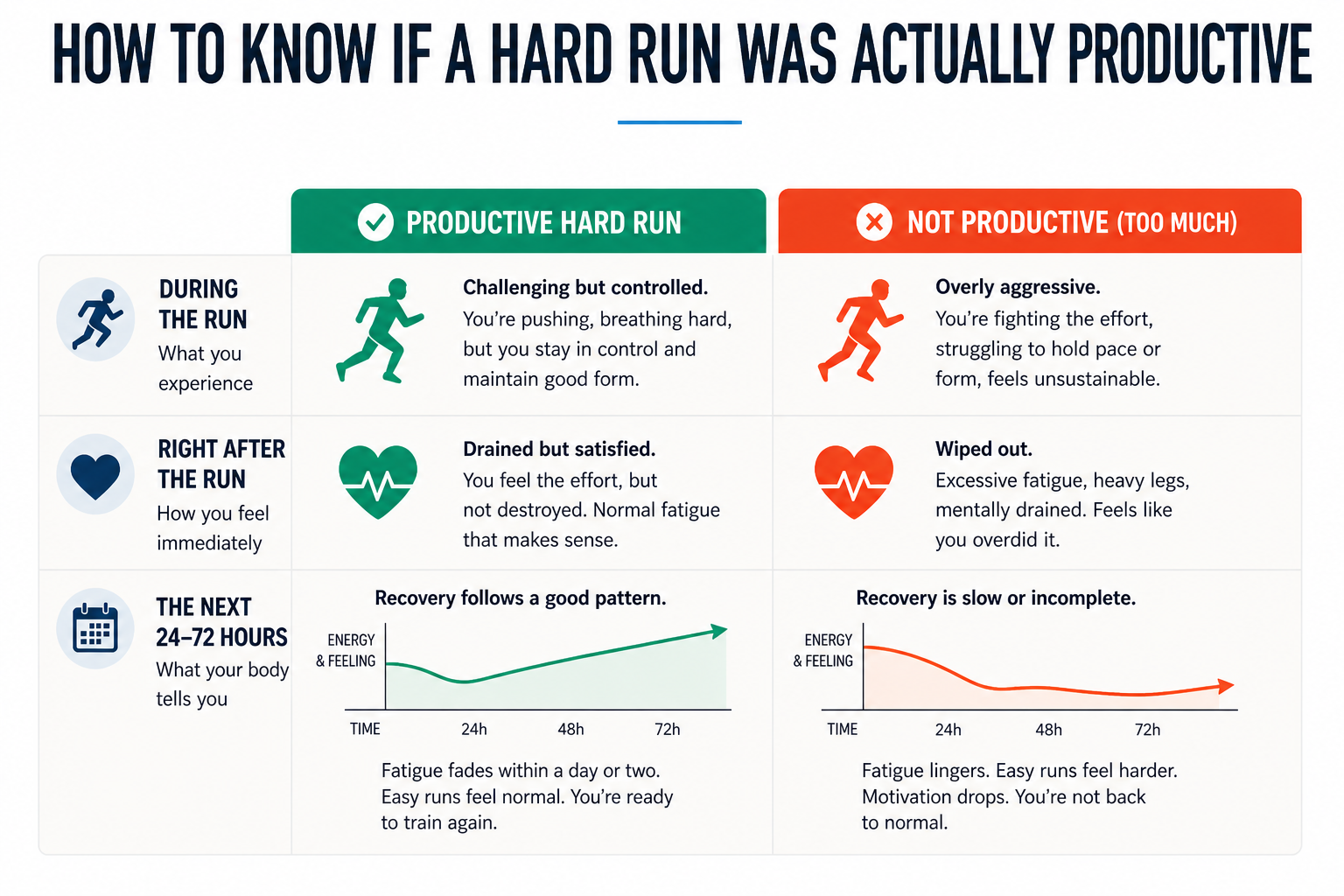
A productive hard run is not defined by how uncomfortable it feels during the session. It is defined by what happens afterward. Does the body recover normally? Does the workout fit into the larger training week? Does it create adaptation without creating excessive disruption?
To me, this is one of the most useful ways to think about harder training. The goal is not to accumulate as much fatigue as possible. The goal is to create the kind of fatigue that the body can transform into improvement.
That difference may seem subtle. But over time, I think it separates productive hard running from simply running hard.
What a Productive Hard Run Actually Feels Like
One reason productive workouts can be difficult to recognize is that they rarely feel the way many runners expect them to feel.
I think a lot of runners imagine a successful hard session as something dramatic.
Maximum effort. Complete exhaustion. Nothing left at the end.
But some of the best workouts rarely feel that way. A productive hard run usually feels controlled, even while it is challenging.
Your breathing is elevated, but it never becomes chaotic.
The pace requires focus, but it remains sustainable within the structure of the session.
The effort is high enough to demand something from you, yet not so high that everything starts falling apart.
To me, this is where productive discomfort and destructive discomfort begin to separate. One creates adaptation. The other simply creates fatigue.
During a productive workout, there is often a surprising sense of stability underneath the effort. You are working hard. But you remain in control.
This is closely connected to What a Good Training Day Actually Feels Like, because the most effective sessions often feel demanding without feeling overwhelming.
And perhaps the clearest signal appears after the workout is finished.
Fatigue is present. It should be. But the fatigue feels proportional to the work that was done.
Your legs feel used rather than destroyed.
Recovery feels necessary rather than intimidating.
The workout leaves a mark, but it does not leave damage.
Over time, I think many runners realize that the best hard sessions rarely feel like survival. They feel like a controlled conversation between stress and adaptation.
Where It Becomes Hard to Judge
The difficult part is that productive and unproductive hard runs often feel surprisingly similar while they are happening.
Both can feel challenging. Both can require focus. Both can push your breathing, your legs, and your willingness to keep going.
That is why judging a workout purely by how hard it felt can be misleading.
I think many runners expect the answer to be visible during the session itself. But the body rarely reveals the outcome that quickly.
A workout that is slightly too aggressive can feel almost identical to one that is perfectly balanced.
The difference often appears later. How quickly do you recover? How does the next run feel?
Does the session fit naturally into the training week, or does it disrupt everything around it?
To me, this is where productive training becomes less about individual workouts and more about how those workouts interact with the rest of the system. Because a hard run does not exist in isolation. Its value is determined partly by what happens afterward.
A session that creates adaptation usually allows training to continue.
A session that creates excessive fatigue often starts demanding recovery from future workouts before those workouts have even happened.
That distinction is not always obvious on the day itself. It becomes visible in the days that follow.
Over time, I think many runners realize that the quality of a hard workout is often measured less by the session itself and more by the chain of events it creates afterward.
What to Look for After the Run
The easiest mistake is assuming that a hard workout should be evaluated the moment it ends.
The breathing was hard. The effort felt significant. The pace looked good.
It is tempting to believe the answer is already available.
But I think the body often waits until afterward before revealing whether the session was truly productive. In many ways, recovery is the body’s vote on the workout.
A well-balanced hard run usually creates a predictable response. Fatigue appears, as it should.
The following day may feel slightly heavy. But recovery gradually unfolds in a familiar way. Easy runs return to a controlled rhythm. The training week continues moving forward without disruption.
The stress creates adaptation because the system can successfully absorb it. An overly aggressive workout often creates a different pattern.
Fatigue lingers longer than expected. Easy runs feel unusually expensive.
The next quality session feels less stable.
The body spends more time dealing with the consequences of the workout than benefiting from it.
This is closely connected to What Lingering Fatigue Actually Means in Running, because excessive fatigue is often less about how hard a workout felt and more about how difficult it becomes to recover from.
To me, this is where many runners discover that recovery is not separate from training.
Recovery is part of training. The workout provides the stimulus. Recovery reveals whether the stimulus was appropriate.
That is why one of the most useful questions after a hard run is surprisingly simple:
How quickly does the system return to normal? Because the speed of recovery often tells you more about the quality of the workout than the workout itself.
A hard run is productive when you can absorb it, not when you can survive it.
Why Consistency Matters More Than One Strong Session
One of the most important things hard workouts teach runners is that progress rarely comes from individual sessions.
It comes from what those sessions make possible afterward.
I think this is where many runners eventually change the way they think about training.
At first, it is easy to view workouts individually.
A great interval session feels successful.
A difficult tempo run feels productive.
A personal-best workout feels like evidence that everything is working.
But the body rarely judges training one session at a time. It responds to the accumulation of training over weeks and months.
That means the value of a hard workout is not determined only by what happens during the workout itself.
It is also determined by what happens next.
Can you recover? Can you complete the next sessions as planned? Can the training continue building forward instead of constantly rebuilding from fatigue?
This is closely connected to How to Balance Easy Runs and Hard Runs, because the role of a hard session is not to stand out in isolation.
Its role is to fit into a structure that supports consistent adaptation.
To me, this is where productive training becomes surprisingly simple. A successful hard workout should make future training possible. Not harder. Not easier. Possible.
When hard sessions are placed appropriately and executed with control, they begin building on each other over time.
The adaptations accumulate. The rhythm remains intact. The system keeps moving forward.
When hard sessions become too aggressive or too frequent, that rhythm often starts breaking down. And once consistency disappears, progress usually becomes much harder to maintain.
Over time, I think many runners realize that fitness is rarely built by extraordinary workouts. It is built by ordinary workouts that can be repeated consistently.
How to Adjust When a Hard Run Was Not Productive
One of the most common mistakes runners make after an overly aggressive workout is trying to fix it immediately.
The session felt wrong. Recovery feels slower than expected. The body does not seem to be responding well.
So the instinct is often to do more. More effort. More urgency. More training.
I think this reaction is completely understandable. But it is rarely the most productive one. When a hard run turns out to be too much, the goal is usually not to compensate for it.
The goal is to restore balance. That may mean allowing recovery to catch up. It may mean keeping effort lower for a few days.
It may mean adjusting the following sessions so the overall training week can regain its rhythm.
This is one reason How to Adjust a Run Mid-Workout Without Ruining It is such a useful skill. The earlier you recognize that a session is drifting beyond its intended purpose, the easier it becomes to prevent excessive fatigue from accumulating in the first place.
To me, this is where many runners discover that productive training is not about forcing every workout to succeed exactly as planned.
It is about protecting the overall system. A single workout rarely determines long-term progress. The ability to keep training consistently does.
That is why the goal is not avoiding hard runs. The goal is keeping hard runs within a range that the body can repeatedly absorb, recover from, and benefit from.
Over time, I think many runners realize that the smartest response to excessive stress is usually not adding more stress.
It is restoring the conditions that allow adaptation to happen again.
Conclusion
One of the biggest shifts that happens as runners gain experience is that they stop judging hard workouts by how much they suffer during them.
They start judging them by what those workouts make possible afterward.
I think this is where the meaning of productive training changes completely. A hard run is not valuable simply because it feels difficult. Difficulty alone does not create progress. Adaptation does. And adaptation only happens when the body can absorb the stress that the workout creates.
That is why some of the most productive sessions are not the ones that leave you completely exhausted.
They are the ones that fit naturally into the larger training process. They challenge the body. They create fatigue.
And then they allow recovery and adaptation to do their work.
Over time, I think many runners realize that the purpose of a hard workout is not to prove how hard they can work.
It is to create the conditions for future improvement. Because the best hard session is rarely the one that hurts the most.
It is the one that helps make the next week of training possible.
Frequently Asked Questions
How hard should a hard run feel?
Challenging but controlled. You should feel pushed, but still able to maintain form and stay within the intended structure of the workout.
Is it normal to feel tired after a hard run?
Yes. Some fatigue is expected. The key is that it should not interfere with your ability to return to normal training within a reasonable time.
What if every hard run leaves me exhausted?
That usually means the intensity or frequency is too high. Your body may not be getting enough recovery to absorb the stress.
Can an easy-feeling hard run still be effective?
Yes. Some sessions feel smoother due to good conditions or accumulated fitness. What matters is not how dramatic the effort feels, but how your body responds afterward.
If you want to track how your body responds to hard efforts more precisely, using a reliable device can help you see patterns in heart rate and recovery over time.
A guide like Best Heart Rate Monitors for Running can help you choose one that supports consistent tracking.