
Almost every runner has experienced this moment.
The workout looked reasonable before it started. The pace seemed manageable. The plan itself made sense.
But somewhere during the run, something changes. Breathing becomes heavier than expected. The legs stop responding normally. Easy effort suddenly feels expensive. The body feels slightly disconnected from the pace you planned to hold.
And immediately, another thought appears: Did I just ruin the workout?
Many runners struggle here because they treat training plans too rigidly. Once the session starts, they feel obligated to complete it exactly as written even when the body is clearly responding differently than expected.
But endurance training does not happen in a controlled laboratory.
The body changes constantly. Recovery fluctuates. Stress accumulates. Conditions shift.
And sometimes the smartest thing you can do during a workout is adjust it before the session starts creating more fatigue than adaptation.
Because good training is not about forcing perfect execution every single day.
It is about keeping the overall system stable enough that progress can continue long term.
A Good Adjustment Is Usually A Sign Of Awareness, Not Weakness
One reason runners resist adjusting workouts is emotional.
Changing pace, reducing intensity, shortening intervals, or easing effort mid-run can feel like failure. It feels like the original session somehow stopped counting.
But experienced endurance runners often think very differently.
They understand that forcing the wrong stress into the body simply because it existed on paper rarely creates better adaptation.
Sometimes it creates the opposite. Recovery becomes compromised. Fatigue accumulates unnecessarily.
The next sessions lose quality. The body stops absorbing training as efficiently.
This is especially true when the workout itself never really settles. Breathing keeps rising, effort feels unstable, or movement quality continues deteriorating despite trying to maintain the original plan.
That is often the moment where adjustment becomes smarter than stubbornness.
This is closely connected to How to Read Your Body Before a Run (Simple Daily Check), because one of the most useful endurance skills is recognizing when the body is responding normally — and when it quietly is not.
Good runners are not the ones who force every session perfectly.
Often, they are the ones who recognize when a session needs to evolve before it becomes destructive.
Most Workouts Do Not Fall Apart Instantly
Another reason runners panic mid-run is that difficult workouts often feel emotionally dramatic even when the actual physiological problem is still relatively small.
The body feels slightly heavy. Breathing becomes more strained. Pace starts feeling expensive earlier than expected.
And suddenly the entire workout feels “bad.”
But many sessions are still very salvageable at this stage.
The important thing is recognizing whether the body can stabilize once the load changes slightly.
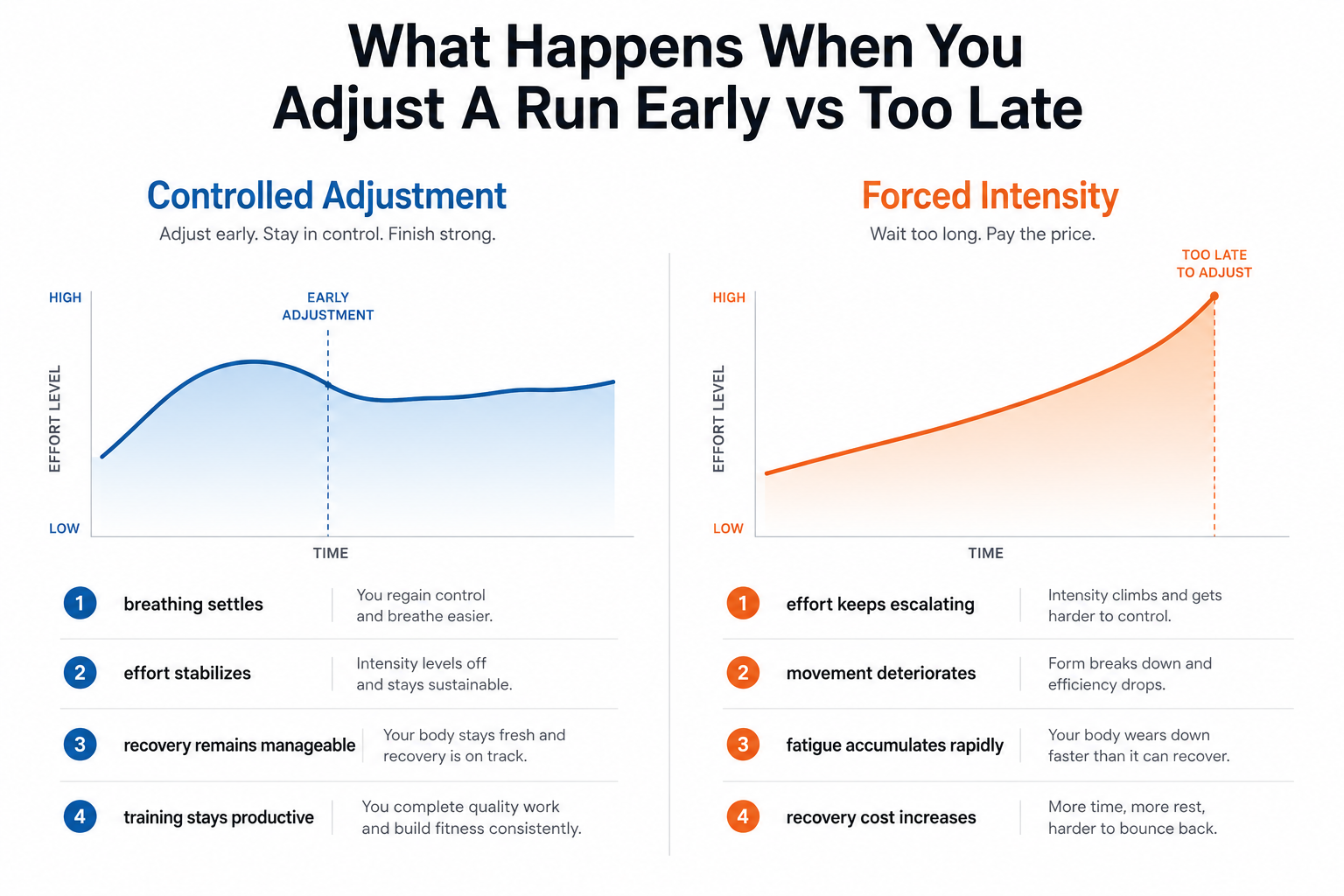
Sometimes simply reducing pace a little allows: breathing to settle, rhythm to return, and effort to become sustainable again.
That distinction matters enormously. Because there is a very large difference between: adjusting the stress of a session, and completely losing the value of the session.
This is one reason Signs You Should Stop a Run Early (And When Not To) matters so much. Many difficult-feeling runs do not actually require stopping completely. Often they simply require reducing the cost of the workout before fatigue escalates further.
A controlled adjustment often preserves more training value than forcing the original plan deeper into exhaustion.
The Body Usually Responds Better To Controlled Reduction Than Forced Intensity
One of the most misunderstood parts of endurance training is how sensitive adaptation is to recovery quality.
Many runners assume: more suffering automatically means more improvement.
But physiology does not really work that way.
Once effort moves beyond what the body can productively absorb, additional stress often starts creating disproportionately larger recovery cost without equivalent adaptation benefit.
That is why a slightly adjusted workout frequently produces better long-term training outcomes than a perfectly completed session that overwhelms recovery afterwards.
For example: slowing tempo pace slightly, shortening an interval session, extending recovery periods, or converting a harder run into aerobic work often allows the body to continue adapting instead of simply surviving the session.
This becomes especially important during higher-volume periods where hidden fatigue can accumulate quietly across multiple days.
What Happens If You Run Too Fast Too Often (And Why It Slows You Down) explains why moderate unresolved strain repeated consistently usually limits adaptation much more than runners initially realize.
Sometimes reducing intensity protects progress better than forcing it.
A Workout Is Not Ruined Just Because It Changes
This psychological shift is extremely important long term.
Many runners unknowingly think about workouts in only two categories: successful or failed.
But endurance training rarely works that cleanly in reality. A shortened session can still create useful aerobic stimulus. A slower tempo run can still support adaptation. A modified workout can still maintain rhythm, consistency, and movement quality.
And often, protecting recovery during one session improves the next several sessions afterwards.
This is one reason strong endurance runners gradually stop evaluating training emotionally run by run.
Instead, they start thinking in larger systems: weekly balance, accumulated fatigue, long-term consistency, and sustainable adaptation.
This is also why What a Balanced Running Week Looks Like becomes such an important framework. The body adapts far better to stable recoverable training systems than constantly fluctuating extremes between overpushing and collapse.
One adjusted workout rarely matters negatively. Uncontrolled accumulated fatigue often does.
The Best Mid-Workout Adjustments Usually Feel Calm
One interesting thing about experienced runners is that they often adjust sessions surprisingly quietly.
They do not panic immediately. They do not catastrophize one difficult-feeling run. And they rarely treat minor adjustments as failure. Instead, they simply observe the body.
Breathing staying unstable? Reduce pace slightly.
Effort continuing to rise? Extend recovery a little.
Movement becoming mechanically strained? Lower intensity before form deteriorates further.
The process becomes calm rather than emotional.
That matters because endurance training is not really about proving toughness every single day.
It is about managing stress intelligently enough that the body continues adapting consistently over time.
If effort itself currently feels difficult to interpret accurately during runs, What Does an Easy Run Actually Feel Like? helps explain the difference between sustainable work and subtle hidden strain much more clearly.
And if you want a more objective way to monitor whether aerobic effort is remaining appropriately controlled during uncertain sessions, the Heart Rate Zone Calculator for Running can help establish more realistic sustainable intensity ranges.
Good training decisions usually feel calmer than ego-driven ones.
Sometimes The Smartest Workout Is The One That Preserves Tomorrow
One overlooked part of training quality is what happens afterwards.
A workout should not only be judged by: how hard it felt, or whether every pace target was completed perfectly.
It should also be judged by: how recoverable it was afterwards.
Could the body absorb it productively? Did recovery remain stable? Does tomorrow still feel manageable?
Because strong endurance systems are usually built through training continuity much more than isolated heroic sessions.
This is why runners who improve sustainably long term often become less emotionally attached to individual workouts and more focused on keeping the overall system functioning well across weeks and months.
Sometimes protecting tomorrow is the most productive thing you can do during today’s run.
Frequently Asked Questions
Is it okay to slow down during a workout?
Yes. Adjusting pace during a session is often smarter than forcing unsustainable effort deeper into fatigue.
Does shortening a workout ruin it?
Usually not. A shortened or modified session can still create useful adaptation while protecting recovery quality.
How do I know if I should adjust the session?
Signs include breathing staying unusually strained, effort continuing to rise despite pace adjustments, unstable movement, or fatigue clearly accumulating faster than normal.
Should I stop completely or just reduce intensity?
That depends on how the body responds after adjustment. Many sessions stabilize once intensity decreases slightly. If strain continues rising regardless, stopping may be smarter.
Why do experienced runners adjust workouts more calmly?
Because they understand that long-term progress depends more on sustainable adaptation than perfectly executing every session exactly as planned.
If You Want Better Control During Workouts
Reliable pacing and heart rate feedback can make it easier to recognize when effort is drifting outside sustainable training intensity before fatigue escalates too far.
The goal is not obsessing over numbers.
It is understanding whether the body is continuing to absorb stress productively throughout the session.
If you want a practical comparison of the best tools available, Best Running Watches for Running (2026) breaks down the most useful options for pacing control, aerobic monitoring, and endurance-focused training.
Conclusion
Adjusting a run mid-workout does not automatically mean the session failed.
Very often, it means the runner recognized that the body was responding differently than expected and adapted the stress before recovery became unnecessarily compromised.
Because good endurance training is rarely about forcing perfect execution every single day.
More often, it is about keeping the body stable enough that adaptation can continue consistently over time.
And sometimes, the smartest decision during a difficult session is not proving that you can survive it.
It is recognizing how to reduce the cost before the workout starts taking more than it gives back.