
Running was supposed to get easier.
You started training consistently. You built routine, improved your pacing, and kept showing up week after week. But despite all of that, running still feels… like effort.
Your breathing is still noticeable. Your legs still work. Some runs still feel difficult. And eventually many runners start wondering whether they are actually improving at all.
That confusion is extremely common. Because most runners expect progress to feel like comfort. But endurance training rarely works that way.
Running usually does improve over time — just not in the way most people initially imagine.
These decisions become much easier when you can see how your body is responding instead of guessing from pace alone.
If you want a clearer picture of effort, recovery, and day-to-day readiness, you can explore our guide to the Best Running Watches for Running (2026).
Running Usually Becomes More Controlled, Not Effortless
One of the biggest misconceptions in endurance training is assuming fitness eventually removes effort.
In reality, running rarely becomes truly easy in the absolute sense. What changes instead is control.
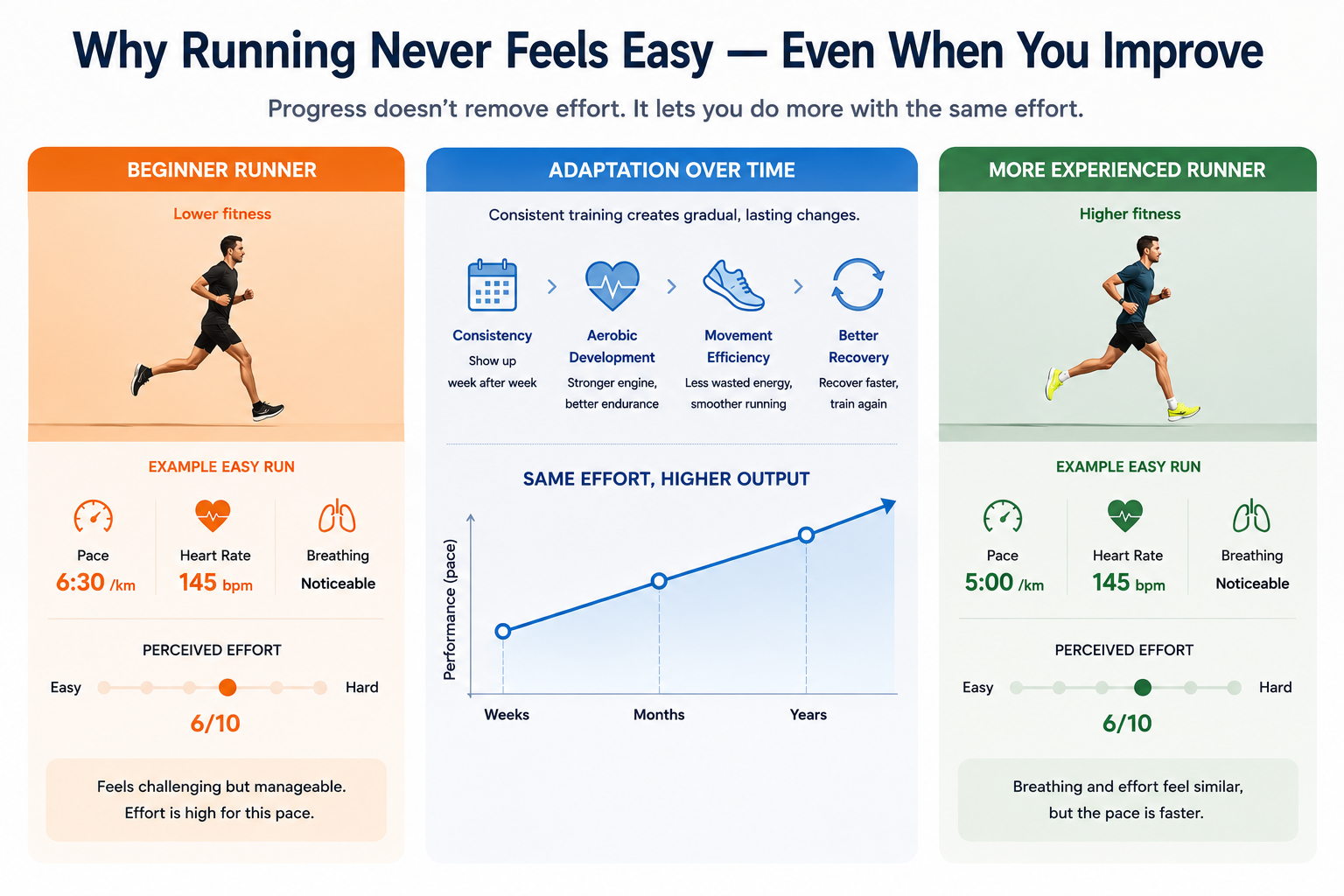
As fitness improves, the body becomes better at handling the same workload. Pace improves, recovery stabilizes, movement becomes more efficient, and effort becomes more manageable overall. But the sensation of working does not disappear completely.
That is where many runners become confused.
They expect progress to feel like dramatically lower effort. Instead, what usually happens is that they begin producing more output at roughly similar perceived effort.
The run still feels like running.
You are simply moving faster, more efficiently, and more sustainably at that same general effort level.
This is also why Running Feels Hard? Here’s Why becomes such an important concept. Difficulty itself is not always a sign that something is wrong. Very often, it simply reflects the normal reality of endurance effort.
Running usually does not become effortless. You simply become better at managing the effort.
Most Progress Happens Without Feeling Dramatic
One reason runners struggle to recognize improvement is because adaptation happens gradually.
There is rarely a sudden moment where running transforms into comfort. Instead, progress usually appears through smaller changes: slightly steadier breathing, slightly more stable pacing, slightly faster running at similar effort, or quicker recovery between sessions.
Because those changes happen slowly, they often become psychologically invisible.
What once felt difficult gradually becomes normal, so the brain stops recognizing it as improvement. Many runners continue waiting for some dramatic feeling of ease that never fully arrives.
But the progress is still happening underneath.
This is one reason comparing current effort only against expectation creates so much frustration. Runners often forget to compare current performance against where they were several months earlier.
That broader perspective usually reveals much more progress than daily feelings alone.
Effort Usually Stays Similar While Output Improves
This is one of the most important concepts in endurance training.
As fitness improves, effort often remains surprisingly familiar while performance improves around it.
An easy pace that once required significant focus may eventually become sustainable. A tempo effort that once felt difficult may later become manageable. Long runs may stabilize more smoothly even though the body still recognizes the workload as real effort.
The sensation itself does not disappear. Your ability to operate inside it improves.
This is also where heart rate becomes useful for understanding progress more objectively. If heart rate remains relatively stable while pace improves, that is often a very strong sign that aerobic development is occurring successfully.
If you want a clearer reference for understanding sustainable effort, What Is a Good Heart Rate for Running explains how heart rate and perceived effort work together during different types of runs.
And if you want a more practical estimate of sustainable aerobic intensity based on real running effort, the Heart Rate Zone Calculator for Running can help establish more realistic training zones than generic formulas alone.
Progress often means doing more work at the same effort. Not eliminating effort completely.
The Feeling Of “Hard” Never Fully Disappears
Even highly experienced runners still feel effort.
Breathing remains noticeable. Muscles still work. Fatigue still appears during longer or harder runs. The body still recognizes that running requires energy.
What changes is tolerance and familiarity. You become more comfortable operating inside manageable discomfort instead of expecting discomfort to disappear entirely.
This distinction matters enormously psychologically.
Many runners interpret the continued presence of effort as proof that training is failing. In reality, the opposite is often true. Controlled effort that feels sustainable and repeatable is usually exactly what productive endurance training looks like.
The dangerous mistake is chasing comfort instead of sustainability.
That mindset often pushes runners toward excessive pace, unnecessary fatigue, and constant questioning of whether training is “working.”
This connects closely with Am I Running Too Fast? How to Recognize the Signs Early, where many runners discover they have been unintentionally drifting into moderate-intensity effort far more often than they realized.
Running improvement usually does not remove effort. It changes your relationship with it.
Progress Often Feels Invisible Because Adaptation Becomes Normal
One of the strangest parts of endurance development is how quickly the body normalizes improvement.
A pace that once felt difficult eventually becomes ordinary. A distance that once seemed intimidating becomes routine. Breathing patterns that once felt demanding start feeling expected.
Because the adaptation becomes your new baseline, it stops feeling impressive. That psychological adjustment is one reason many runners underestimate their own progress so severely.
The body changes gradually enough that the runner experiences the improvement continuously rather than dramatically.
This is why progress often becomes much easier to recognize through patterns over time instead of individual runs.
Looking only at how today’s run feels can be misleading.
Looking at:
pace stability, recovery quality, heart rate trends, durability, and consistency across months usually reveals much clearer evidence of improvement.
If your runs constantly feel harder than expected, pacing may also be influencing the experience more than you realize. What It Means When a Run Feels Hard From the Start explains how accumulated fatigue and effort drift can quietly change perceived effort even when fitness itself is improving.
What Actually Improves Over Time
Even if running still feels like effort, many important things are changing underneath the surface.
Efficiency improves first.
The body learns how to waste less energy during movement. Stride becomes smoother, breathing rhythm stabilizes more naturally, and aerobic energy production becomes more sustainable.
Recovery improves too.
Fatigue resolves faster between sessions, allowing more consistent training without constantly feeling destroyed afterward.
Durability also increases significantly over time.
Longer runs become more stable. Pace fluctuations become smaller. Effort spikes happen less abruptly. The body handles workload more predictably.
None of these changes remove effort completely.
They simply allow the system to tolerate and manage that effort much more effectively.
That is why How to Lower Your Heart Rate While Running is often less about “forcing easier effort” and more about gradually improving the body’s efficiency through sustainable aerobic development.
Expectations Often Shape The Entire Experience
How running feels is influenced not only by physiology, but also by expectation.
Many runners unconsciously expect progress to feel like comfort:
lighter breathing, effortless movement, and easy pacing all the time.
But when normal endurance effort continues existing, it creates doubt.
The problem is not necessarily the run itself.
The problem is often the mismatch between expectation and reality.
Once runners understand that sustainable endurance training still includes noticeable effort, the entire experience becomes psychologically calmer.
You stop searching for signs that effort has disappeared and start recognizing signs that control, consistency, and durability are improving instead.
That shift changes how training feels emotionally.
And in many runners, it removes a tremendous amount of unnecessary frustration.
The Real Sign Of Progress Is Usually Better Control
The clearest long-term sign of improvement is rarely comfort.
It is stability.
Breathing settles more predictably. Effort becomes easier to manage. Pace stays more controlled throughout the run. Recovery becomes more reliable. Training weeks feel more sustainable overall.
Those are extremely important changes.
Because endurance development is not about making effort vanish.
It is about making effort more repeatable and sustainable over long periods of time.
This is where structure matters enormously. Consistent training allows runners to observe patterns more clearly instead of constantly reacting emotionally to individual runs.
If you want a stronger framework for balancing effort, recovery, and progression over time, Build a Weekly Running Structure explains how consistent organization helps make training feel much more stable overall.
Progress usually looks less like comfort and more like control.
What To Focus On Instead
If running still feels like effort, that does not automatically mean training is failing.
Very often, it means the system is adapting normally.
Instead of constantly asking:
Why doesn’t this feel easier?
A much better question is:
Does this effort feel controlled and sustainable?
That shift changes everything.
Once runners stop chasing comfort and start evaluating consistency, recovery quality, breathing stability, pacing control, and long-term sustainability instead, progress becomes much easier to recognize accurately.
Running is not about eliminating effort.
It is about building the ability to handle effort more effectively over time.
And that process is often much quieter — and much more gradual — than runners initially expect.
Frequently Asked Questions
Does running ever feel truly easy?
Usually not in the absolute sense. Running often continues feeling like noticeable effort, but the body becomes better at managing and sustaining that effort over time.
Why does running still feel hard after months of training?
Because fitness usually improves by increasing output at similar effort rather than removing effort completely.
How do I know if I’m improving?
Look for:
better pace at similar effort, more stable breathing, improved recovery, more consistent runs, and greater durability over time.
Should easy runs feel effortless?
They should feel controlled and sustainable, but not necessarily effortless. Truly easy effort is usually calmer than many runners initially expect.
Can pacing mistakes make running feel harder than it should?
Absolutely. Slightly excessive effort repeated consistently often creates accumulated fatigue that makes normal running feel unnecessarily difficult.
If you want your training to feel more stable and reduce unnecessary strain during runs, supportive gear can help as well.
You can explore options in our guide to the Best Running Shoes for Daily Training (2026).
Conclusion
Running usually does not become dramatically easier.
What changes is your ability to handle the effort more efficiently, more sustainably, and with much greater control.
That distinction matters because it completely changes how progress should be interpreted.
The goal of endurance training is not removing effort from running.
It is increasing what the body can do while that effort remains controlled, stable, and repeatable over time.
Once runners understand that difference, training often becomes much less frustrating — and progress becomes much easier to recognize clearly.