
Running should feel easier by now.
You’ve been consistent. You’ve built routine, logged the miles, and kept showing up even on days when motivation was low. So when a normal run suddenly feels heavier than expected, it becomes frustrating very quickly.
Your breathing feels unusually noticeable. Your legs lose freshness early. Pace feels harder to hold than it should.
And eventually the thought appears:
Why does running still feel this hard if I’m actually fit?
The answer is important because many runners misunderstand what these difficult-feeling runs really mean.
Usually, they are not a sign that training is failing.
Very often, they are simply part of how endurance training actually works.
If you want your training to feel more stable and reduce unnecessary strain during runs, supportive gear can help as well.
You can explore options in our guide to the Best Running Shoes for Daily Training (2026).
Running Is Not Supposed To Feel Perfect Every Day
One of the biggest misconceptions in endurance training is believing fitness should eventually make running feel consistently easy.
But even highly trained runners regularly experience runs that feel heavy, awkward, or unusually demanding.
Some days:
breathing feels slightly off, rhythm never fully settles, legs feel flatter than expected, or effort rises unusually quickly despite normal pace.
That variability is completely normal.
The body is not a fixed system. It is constantly adapting to training load, recovery, stress, sleep, hydration, and environmental conditions all at the same time.
Which means:
not every run will feel smooth, even during strong fitness periods.
This is also why a difficult-feeling run is not automatically a bad run.
Many runners panic the moment effort feels higher than expected, but discomfort itself is not proof that something is wrong. In many cases, it simply reflects normal adaptation and accumulated training stress.
If you have noticed your heart rate behaving differently during otherwise normal runs, Why Your Heart Rate Is High on Easy Runs explains why that often happens even when fitness itself is improving.
Running feeling hard sometimes is not failure.
It is part of the process.
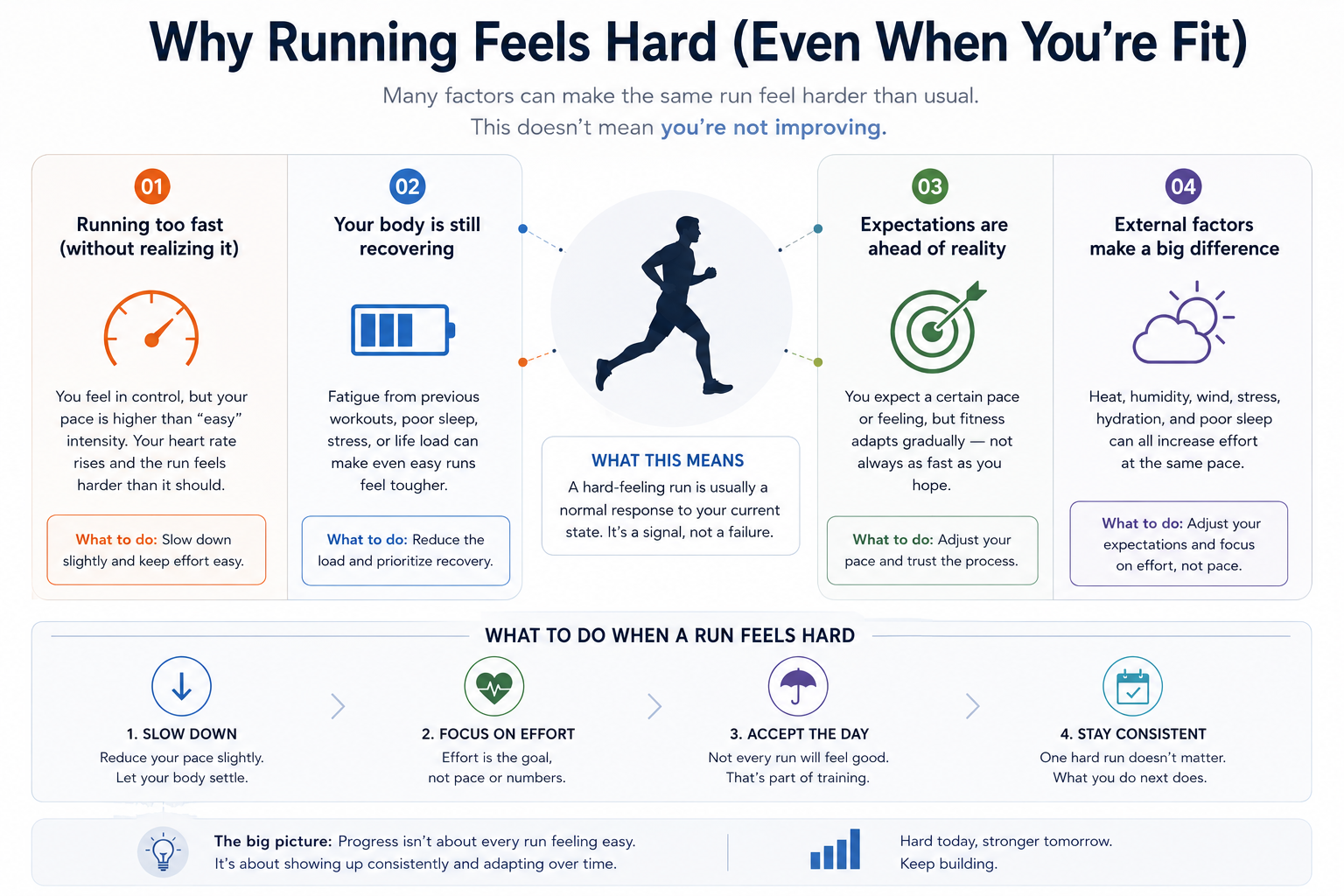
You May Be Running Slightly Too Fast Without Realizing It
One of the most common reasons ordinary runs feel harder than expected is surprisingly simple: pace drift.
Not dramatic overpacing. Just slightly too much effort.
That is what makes it difficult to recognize.
The run initially feels controlled and manageable. Breathing is not obviously heavy. Pace appears reasonable. But internally, the body is already operating above true easy intensity.
This creates the moderate-effort trap that many runners unknowingly live inside for months.
The pace is:
not hard enough for real quality training, but not easy enough for sustainable aerobic recovery either.
Over time, that small mismatch quietly accumulates fatigue across the entire week.
This is also why heart rate becomes such a useful tool. Perceived effort alone often reacts too slowly to detect small intensity mistakes early enough.
If you are unsure what sustainable easy effort should realistically look like, What Is a Good Heart Rate for Running explains how heart rate and perceived effort work together during different types of runs.
And if you want a more practical reference for sustainable pacing based on current fitness, the Running Pace Zone Calculator can help estimate training ranges that are actually realistic for your present fitness level instead of your expectations.
What feels easy is not always physiologically easy.
The body notices the difference even when the mind does not.
Recovery Fatigue Often Hides In Plain Sight
Sometimes the problem is not the run itself.
It is what your body is still carrying from previous days.
One of the hardest things about recovery fatigue is that it often remains partially invisible before the run begins. You may not feel obviously sore, mentally exhausted, or physically broken.
But the system is still processing stress underneath.
Previous workouts, accumulated mileage, poor sleep, life stress, heat exposure, and incomplete recovery all quietly influence how demanding the next run feels.
When recovery is incomplete:
heart rate rises faster, breathing becomes more noticeable earlier, pace feels less sustainable, and the run loses smoothness much sooner than expected.
This is where many runners make a damaging mistake.
They interpret higher effort as a signal to push harder instead of adjusting downward.
But often the body is asking for less stress, not more.
This connects closely with Why Some Runs Feel Easy and Others Feel Hard, where many runners discover how strongly accumulated recovery load affects perceived effort even when pace itself remains unchanged.
Sometimes the smartest training decision is simply allowing the body more room to stabilize.
Expectations Often Outrun Reality
Another reason running feels harder than expected is psychological.
Many runners quietly create timelines in their head about where they “should” be by now.
This pace should feel easier.
This distance should feel smoother.
Fitness should already be higher.
But endurance development rarely follows clean expectations.
Progress is gradual, uneven, and highly non-linear. Some weeks feel smooth and encouraging. Others feel surprisingly heavy despite consistent training.
That inconsistency is normal.
The problem appears when expectations move ahead of current adaptation.
Once that gap grows large enough, ordinary runs start feeling disappointing instead of normal.
The body is not necessarily underperforming.
The expectations are simply ahead of reality.
This is one reason How to Lower Your Heart Rate While Running becomes such an important long-term concept. Aerobic development happens gradually through sustainable training, not through constantly forcing higher output before the body is fully ready for it.
Running often feels hardest when expectations stop matching current adaptation.
External Conditions Change Effort More Than Most Runners Realize
Many runners underestimate how strongly external conditions influence perceived effort.
Even small environmental changes can significantly alter how difficult a run feels internally.
Heat, humidity, wind, poor sleep, stress, dehydration, and accumulated life fatigue all change the body’s workload response — sometimes dramatically.
The difficult part is that runners often expect pace to feel identical regardless of conditions.
But the body does not operate inside laboratory conditions.
The same pace can feel completely different depending on what the system is dealing with that day.
This is why effort-based training matters so much more than rigid pace chasing.
If environmental stress rises, maintaining the exact same pace often requires substantially more physiological cost.
That does not mean fitness disappeared overnight.
It simply means conditions changed.
This is another reason the Heart Rate Zone Calculator for Running can become useful over time. It helps runners interpret effort through physiological response instead of relying entirely on pace numbers alone.
Good training is not about forcing identical outputs every day.
It is about adjusting intelligently to what the body can sustainably handle.
Running Does Not Become Effortless — It Becomes More Controlled
Many runners secretly expect progress to eventually remove discomfort from running.
But that is not how endurance development works.
Fitness usually improves by increasing what the body can handle at similar effort — not by eliminating effort completely.
As fitness improves:
pace becomes more sustainable, recovery stabilizes, movement becomes more efficient, and breathing settles faster.
But the sensation of effort itself often remains surprisingly familiar.
This is exactly why Why Running Doesn’t Get Easier (And What That Actually Means) becomes such an important concept for long-term runners to understand.
The goal is not comfort. The goal is sustainable control.
Once runners stop expecting effort to disappear, training often becomes psychologically much calmer and much more consistent.
Progress is not about making running feel effortless.
It is about making effort more manageable and repeatable over time.
What To Do When Running Feels Hard
When a run suddenly feels unusually difficult, the worst response is usually fighting the feeling aggressively.
Most of the time, the better response is adjustment.
Slow the pace slightly and allow breathing to settle naturally. Stop chasing numbers for that day. Focus on whether effort feels sustainable instead of whether pace looks impressive.
Accept that not every run will feel smooth.
That is normal.
One difficult-feeling run almost never matters long term. What matters is how consistently you continue training afterward without turning temporary fatigue into chronic fatigue.
This is where structure becomes far more important than perfection.
If you want a more stable framework for balancing effort, recovery, and adaptation across the week, Build a Weekly Running Structure explains how sustainable training usually depends on managing overall load rather than trying to force individual runs.
Do not try to “win” every run.
Learn how to respond intelligently to the body instead.
The Run Effort Check Calculator can help determine whether the run was genuinely demanding or simply felt harder than expected on that particular day.
Frequently Asked Questions
Why does running feel hard even when I’m fit?
Because fitness does not remove effort completely. Recovery status, stress, pacing, sleep, weather, and accumulated fatigue all continue influencing how difficult a run feels.
Is it normal for some runs to feel unusually difficult?
Yes. Even experienced runners regularly experience difficult-feeling runs. Variability is a completely normal part of endurance training.
Can running slightly too fast make everything feel harder?
Absolutely. Small pacing mistakes repeated consistently often create accumulated fatigue that makes ordinary runs feel much harder than necessary.
Does running ever become easy?
Usually not in the absolute sense. Running often remains noticeable effort, but the body becomes better at controlling and sustaining that effort over time.
Should I slow down when a run feels hard?
Usually yes. Small adjustments early in the run often prevent unnecessary fatigue accumulation later.
These decisions become much easier when you can see how your body is responding instead of guessing from pace alone.
If you want a clearer picture of effort, recovery, and day-to-day readiness, you can explore our guide to the Best Running Watches for Running (2026).
Conclusion
Running feeling hard does not automatically mean something is wrong.
Very often, it reflects normal training stress, accumulated fatigue, environmental conditions, pacing drift, or simply the reality that endurance training still involves real effort even when fitness improves.
The important part is not eliminating difficult runs completely.
It is learning how to interpret them calmly.
Once runners stop treating every hard-feeling run like a problem that must immediately be fixed, training usually becomes more sustainable, more consistent, and psychologically much easier to manage long term.