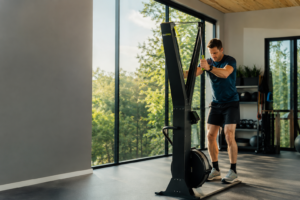
Elliptical vs Easy Run
Remove too much ordinary running and you remove some of the stimulus that creates that durability.
There are days when an easy run is exactly what your training plan says you should do, but running itself doesn’t seem particularly useful.
Maybe your legs are carrying more soreness than expected from yesterday’s workout. Maybe you’ve accumulated several days of running and another hour of impact feels unnecessary. Or perhaps you simply have access to an elliptical and start wondering whether sixty minutes there would accomplish roughly the same thing.
It’s an interesting question because, from the cardiovascular side, the two can look surprisingly similar. You can spend an hour moving continuously.
Heart rate can settle into a comfortable aerobic range. Breathing can remain controlled. You finish feeling as though you’ve trained without feeling particularly depleted.
On paper, that sounds very much like an easy run. And in one important sense, it is. Your cardiovascular system doesn’t require every aerobic stimulus to come from running. The heart still pumps blood. Working muscles still require oxygen. Sustained low-intensity work still creates an aerobic demand.
But running is more than an aerobic activity. Every stride also asks your muscles, tendons and connective tissues to absorb and return force while supporting your body against gravity. Your nervous system repeatedly coordinates a movement pattern that becomes more economical partly because you perform it thousands of times.
An elliptical removes much of that. That’s precisely why it can be useful. It’s also why it isn’t a perfect substitute.
Aerobically, They Can Be Surprisingly Similar
If you step onto an elliptical and work at a genuinely easy, sustainable intensity, your cardiovascular system doesn’t suddenly stop adapting because your feet aren’t hitting the ground.
You’re still performing continuous rhythmic exercise with large muscle groups. Oxygen demand rises. Heart rate increases. Energy production shifts toward supporting sustained aerobic work.
Keep that going long enough and you’ve created many of the conditions we deliberately seek during an easy run. This is why I think runners sometimes underestimate cross-training.
We become understandably attached to running because running is what we’re trying to improve. An hour recorded as elliptical can feel like an hour that somehow didn’t quite count. Your cardiovascular system is less sentimental about the activity. It responds to the demand placed on it.
That doesn’t mean heart rate needs to match your running heart rate perfectly either. Different movement patterns recruit muscles differently, body position changes and the relationship between perceived effort and heart rate may not be identical.
Trying to reproduce an easy run by forcing the elliptical to display exactly the same heart rate can therefore miss the point.
What matters more is creating a controlled aerobic effort that you could sustain comfortably without turning the session into another hard workout. In that sense, an elliptical can preserve a surprising amount of what you wanted from the easy run in the first place.
And this isn’t unique to the elliptical. Cycling vs Running for Aerobic Fitness explores the same broader idea from another direction: aerobic fitness can be developed through different forms of endurance exercise even though the activities themselves aren’t mechanically interchangeable.
The distinction becomes important when we ask the next question.
If the cardiovascular stimulus can be similar, what exactly are we losing when we don’t run?
Running Trains More Than Your Cardiovascular System
This is where the comparison begins to separate. During running, every step is a small mechanical event. You land. Your body absorbs force. Muscles and tendons control that load, store some of the energy and contribute to producing the next stride.
Then you repeat the process thousands of times. An easy run may not feel mechanically demanding because you’ve become accustomed to it, but that repeated loading is part of the training.
Bones respond to loading. Tendons adapt to repeated force. Muscles become accustomed to supporting the specific demands of running. Coordination becomes increasingly automatic. Even the ability to tolerate an hour of ordinary running is partly built by spending time doing ordinary running.
The elliptical changes that equation considerably. Your feet remain supported by the pedals and follow a guided path. There is no repeated landing in the same sense, and the impact forces associated with running are greatly reduced.
From one perspective, something is missing. From another, that’s the entire advantage. You can create cardiovascular work while asking much less from tissues that may already have absorbed plenty of running during the week.
This is why the question isn’t really whether the elliptical is as good as an easy run. It depends on what you’re trying to preserve. If you need more running-specific adaptation, running remains more specific. If you want aerobic work without another dose of running impact, the elliptical suddenly becomes very interesting.
I think this distinction becomes particularly useful once runners stop treating every session as an isolated workout and start looking at the week as a whole.
An individual easy run may be beneficial. That doesn’t automatically mean one more easy run is always the best thing to add. Sometimes the aerobic stimulus is useful while the additional mechanical load isn’t. And that is exactly the situation where an elliptical can earn its place.

When Replacing an Easy Run Actually Makes Sense
The most useful time to replace an easy run with an elliptical session isn’t necessarily when you can’t run.
Sometimes you can run perfectly well.
The question is whether another run adds anything you particularly need that day.
Imagine you’ve completed a harder workout the day before. Cardiovascularly, you feel fine, but the legs still carry some of the muscular fatigue from the session. Your training week would benefit from another hour of easy aerobic work, yet another hour of repeated impact isn’t obviously necessary.
You could run. But the elliptical gives you another option. You can keep the aerobic part of the day while substantially reducing the mechanical part.
I think this is where cross-training becomes much more interesting than simply being a substitute used when running isn’t available. It becomes a way of separating two types of training stress that normally arrive together.
Running gives you cardiovascular load and mechanical load at the same time. The elliptical allows you to keep much of the first while turning down the second.
That can be useful during higher-volume weeks, after demanding workouts or whenever the cumulative effect of running matters more than the difficulty of today’s individual session.
The important word there is cumulative. An easy run viewed by itself may look harmless. It probably is. But training isn’t experienced by the body as a collection of isolated calendar entries. Today’s easy run arrives on top of yesterday’s workout, the previous long run and everything else you’ve absorbed recently.
Sometimes another easy run fits perfectly. Sometimes adding aerobic work without adding as much running load makes more sense.
This is similar to the reasoning behind When to Replace a Run With a Ride. The goal isn’t to find a different activity that somehow beats running at being running. It’s to decide which part of today’s training stimulus you actually need.
There is another advantage too. Because the elliptical removes much of the impact, some runners can extend an easy aerobic session without the same muscular cost they would accumulate from a longer run.
That doesn’t automatically mean longer is better. It simply gives you another way to build aerobic volume when increasing running volume itself would be the less sensible option.
And once you start looking at cross-training this way, replacing an easy run doesn’t feel like missing training. It can be a deliberate training decision.
But Don’t Replace Every Easy Run
There is an obvious conclusion you could draw from all this.
If the elliptical gives you aerobic training with less impact, why not move most easy running onto the elliptical and save your legs for workouts and long runs?
For a runner, that’s where the logic starts breaking down. The mechanical load of running isn’t merely something we tolerate in order to access the cardiovascular benefits.
It’s part of what we’re training for. Your body becomes better at running partly because it repeatedly experiences running.
The tissues supporting each stride gradually become accustomed to the forces involved. Muscular endurance develops within the movement pattern itself. Coordination becomes economical through repetition.
This matters particularly because easy runs make up such a large proportion of running for many endurance athletes. They provide a relatively gentle way to accumulate thousands of strides without the additional intensity of workouts or racing.
If you replace all of that with low-impact cross-training, your cardiovascular fitness could remain excellent while your ability to tolerate sustained running gradually becomes the weaker part of the system.
That’s an awkward imbalance. You can have the engine for a long run without having prepared the chassis for the same amount of running. To me, this is why the elliptical works best as a complement rather than a default replacement.
One substituted run can reduce mechanical stress while preserving aerobic work. Several strategically placed sessions can allow a runner to build more total endurance training than running alone would comfortably support.
But the more running you remove, the more you need to ask whether you’re still developing enough running-specific durability for what you’re preparing to do.
There isn’t a universal percentage where that suddenly becomes a problem. A runner doing four runs each week and replacing one occasionally is in a very different situation from someone running twice and doing most remaining aerobic work on an elliptical.
The race you’re preparing for matters too. If the goal is running 42.2 kilometres, eventually the body needs considerable experience handling the repeated mechanical demands of running.
The elliptical can support that preparation. It can’t completely manufacture it.
This is one reason How to Build Endurance for Running isn’t simply a story about developing a bigger aerobic engine. Running endurance emerges from several adaptations working together, including the ability to keep producing the running movement as fatigue accumulates.
How Hard Should an Elliptical Session Feel?
There is a slightly ironic way to ruin an easy run without actually running.
Get on an elliptical. Increase the resistance because the first few minutes feel too easy. Start pushing a little harder because there is no impact and the legs still feel reasonably fresh.
Twenty minutes later, breathing is noticeably deeper, the resistance has crept upward again and the easy aerobic session you intended to do has quietly become something closer to moderate training.
Nothing about the elliptical prevents this. In some ways, it can make the mistake easier.
Running gives you familiar reference points. Most experienced runners have a reasonably good sense of what easy running feels like, even if they occasionally allow pace to drift upward.
The elliptical is less familiar. There is no meaningful running pace to anchor yourself to, and resistance levels vary enormously between machines. Even heart rate may behave somewhat differently because the movement pattern and muscular involvement aren’t identical.
So I wouldn’t try too hard to recreate the numbers from the run you’re replacing.
Recreate its purpose. If today was supposed to be an easy run, the elliptical session should feel comfortably sustainable. Breathing should remain controlled. You shouldn’t find yourself gradually turning the resistance upward simply because you can.
You should probably finish with the sense that there was more available.
That may sound obvious, but I suspect runners who are accustomed to measuring training through distance and pace can find low-impact cross-training strangely unsatisfying. Ten easy kilometres feels like a concrete piece of training. Fifty minutes on an elliptical can somehow feel less substantial.
So we compensate. We make it harder. And in doing so, we remove one of the main reasons for choosing the elliptical in the first place.
The objective was to preserve aerobic work while reducing the overall cost of the day. If the replacement session creates significant fatigue of its own, the equation has changed.
This is where How to Decide Between Easy, Moderate, or Hard on Any Day becomes useful beyond running itself. Training intensity describes the demand you’re creating, not the machine or sport you happen to be using.
Easy is still easy. Even when there is no pace on the screen to prove it.
An Elliptical Is Most Useful When You Know Why You’re Using It
I think this is ultimately what separates useful cross-training from simply collecting more exercise.
There should be a reason for the substitution. Perhaps you want another aerobic session without another hour of running impact. Perhaps yesterday’s workout left the legs more mechanically tired than expected. Perhaps you’re gradually increasing total endurance volume and the cardiovascular system can comfortably handle more work before your running tissues are ready for more mileage.
In all of those situations, the elliptical solves a fairly specific problem.
But if you’re recovering normally, running volume is appropriate and today’s easy run fits comfortably into the week, there isn’t an obvious reason to replace it simply because the elliptical is lower impact.
Running still has the advantage of being running. That sounds almost too simple, but specificity matters. Every ordinary easy run gives you aerobic work while also reinforcing the movement, tissue tolerance and durability required for the sport you’re trying to improve.
The elliptical becomes valuable when you deliberately decide that you want less of that mechanical component today.
Not zero training. Less running stress. That’s a very different idea from viewing cross-training as an inferior substitute.
Over time, I think many runners realise that the best training week isn’t necessarily the one containing the maximum amount of running their body can survive. It’s the one containing enough running to develop running-specific fitness while leaving enough capacity to absorb the entire week.
Sometimes the elliptical can help create that balance. Sometimes the easy run is already the better choice. The machine doesn’t make the decision for you.
The purpose of the day does.
Conclusion
The elliptical becomes much easier to evaluate once you stop asking whether it is as good as running. That’s probably the wrong comparison.
An easy run does several things at once. It develops aerobic fitness, but it also gives your muscles, tendons and bones another exposure to the repetitive loading of running. It reinforces the movement itself. Over thousands of ordinary strides, it helps build the durability that eventually allows you to run farther and more consistently.
The elliptical separates some of those demands. You can keep working aerobically while removing much of the impact and running-specific mechanical stress.
Sometimes that’s exactly what you want.
If your legs are absorbing training well and another easy run fits naturally into the week, running remains the more specific choice. There is little reason to remove useful running simply because a lower-impact alternative exists.
But there are other days when the equation changes. You want the aerobic work. You don’t particularly need another dose of running load.
That’s when the elliptical stops looking like a second-rate replacement and starts looking like a useful training tool.
I think the distinction matters because runners can become overly focused on preserving mileage. A missed easy run can feel like something has disappeared from the week, even when replacing it with controlled aerobic work may have been the better training decision.
The body doesn’t count kilometers in isolation. It absorbs the whole week. And sometimes protecting that whole week matters more than protecting one run.
So the mental model I’d use is simple. If you need the aerobic work and the running-specific load, run.
If you need the aerobic work but don’t need more running load today, the elliptical can do something genuinely useful.
It doesn’t replace running. It gives you another way to manage it.
Cross-training also makes training data more interesting because pace and distance stop being directly comparable between sessions. Heart rate, duration and overall training trends can provide more useful context when running and low-impact aerobic work are combined in the same week. Our guide to the Best Running Watches Used by Elite Runners looks at watches designed to bring that broader endurance-training picture together.
Frequently Asked Questions
Can an elliptical replace an easy run?
Yes, occasionally. An elliptical can provide sustained aerobic work while substantially reducing the impact and mechanical loading associated with running. What it cannot fully reproduce is the running-specific tissue loading, coordination and movement practice that come from actually running.
How long should I use the elliptical to replace an easy run?
There doesn’t need to be an exact kilometre-to-minute conversion. If you’re replacing an easy run, using roughly the planned duration of the run is a sensible starting point. The more important consideration is keeping the session comfortably aerobic rather than making it harder to compensate for not running.
Should my heart rate be the same on the elliptical as when running?
Not necessarily. Heart-rate response can differ because the movement pattern, muscle recruitment and body mechanics are different. Treat your normal running heart rate as context rather than a number you must reproduce exactly.
Is the elliptical good for running recovery?
It can be useful when you want gentle aerobic movement without adding the same amount of running impact. But an elliptical session is still training. If what your body actually needs is rest, replacing a run with another workout doesn’t automatically create recovery.
Can I build running fitness using an elliptical?
You can develop and maintain significant aerobic fitness through elliptical training, but running performance also depends on running-specific adaptations. If running is your goal, some substantial part of your training still needs to involve running.
Is an elliptical better than cycling for runners?
Neither is universally better. Both can provide aerobic training with less impact than running. The better choice may simply be the movement you tolerate well, can perform comfortably and can keep at the intended intensity. The purpose of the session matters more than finding one universally superior cross-training machine.