
Most runners imagine consistency as something cleaner and more perfect than it actually is.
They picture uninterrupted training, constant motivation, steady improvement, and weeks where everything feels controlled and productive all the time.
But real consistency rarely looks like that.
Over months of training, there are always harder weeks, lower-energy days, disrupted routines, and runs that feel flatter than expected.
Motivation changes. Recovery fluctuates. Life stress interferes. Some sessions feel smooth while others feel unexpectedly difficult for no obvious reason.
This is completely normal. Consistency is not the absence of fluctuation.
It is the ability to keep returning to training even while those fluctuations continue happening.
That difference becomes extremely important over longer periods of development, because most meaningful running progress comes from accumulated months of stable work rather than isolated perfect weeks.
Over time, most endurance progress comes from repeatable structure and stable training habits — not from endlessly optimizing tiny variables every day. Interestingly, many elite runners approach running watches the exact same way: prioritizing reliability, clarity, and consistency over feature overload.
Best Running Watches Used by Elite Runners (And Why Simpler Often Wins)
Consistency Is Usually Less Dramatic Than People Expect
One reason runners struggle with consistency is that they often expect it to feel highly motivated and purposeful all the time.
But long-term training usually feels much quieter than that.
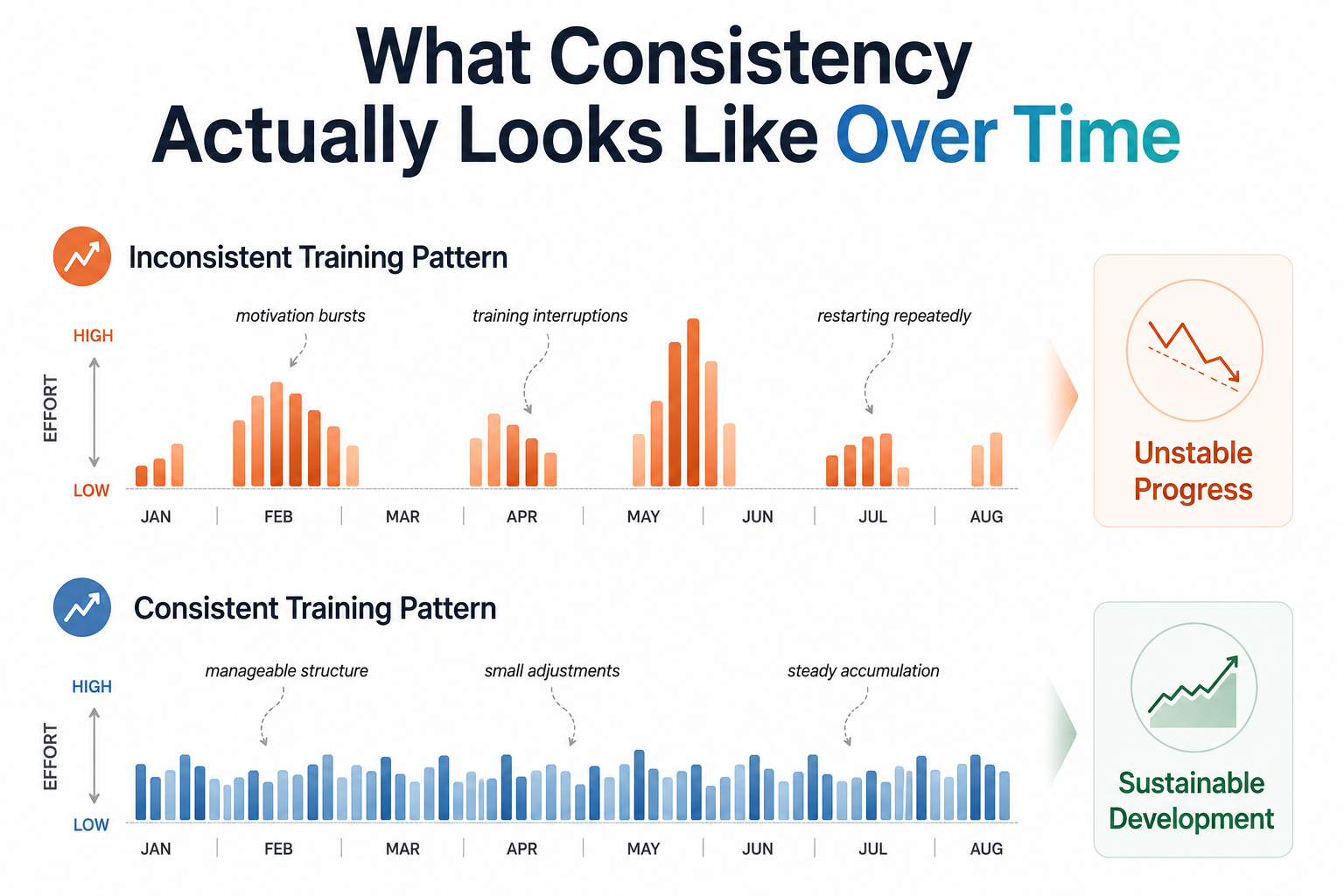
Many productive weeks feel fairly ordinary while they are happening. You complete your runs, recover reasonably well, and continue repeating manageable training without any dramatic breakthrough feeling attached to it.
That repetition is exactly what creates long-term adaptation. The body responds much more strongly to sustainable stress repeated consistently over time than to occasional periods of extreme motivation followed by disruption or burnout.
This is closely connected to why consistency matters more than intensity, because the body adapts more reliably to training it can continue absorbing month after month.
Consistency is rarely built through heroic effort.
Most often, it is built through manageable repetition.
Real Consistency Includes Imperfect Weeks
Many runners unintentionally break consistency by assuming every week needs to feel successful.
But sustainable training always includes imperfect periods.
There will be weeks where sleep is worse than normal, recovery feels slower, or motivation temporarily drops. Some runs will feel heavier for no clear reason. Occasionally, life stress reduces how much energy the body has available for training.
None of that automatically ruins consistency. The mistake is usually not the difficult week itself. The mistake is assuming one imperfect week means the entire process has failed.
Experienced runners often stay consistent precisely because they stop expecting perfection. They understand that training can continue moving forward even when every week does not feel ideal individually.
This is one reason what a balanced running week looks like is very different from what many runners initially imagine. Long-term consistency is usually much more flexible and forgiving than perfection-based thinking allows.
Consistency Quietly Builds Adaptation
One reason consistency becomes difficult to appreciate is that the results often appear slowly.
You usually do not notice adaptation during individual runs. Instead, changes accumulate quietly underneath the surface over many weeks and months. Recovery gradually improves. Effort becomes easier to control. The body handles normal training with less disruption than before.
Those changes are easy to overlook because they rarely arrive dramatically.
This is also why runners sometimes become impatient during quieter phases of development. They assume progress has stopped simply because improvement no longer feels obvious week to week.
But adaptation is often still happening underneath stable training.
This connects closely to when progress slows down and what to do about it, because slower visible improvement is often part of longer-term development rather than evidence that training has stopped working.
Why Sustainable Consistency Requires Flexibility
Long-term consistency does not mean following the plan rigidly no matter what happens.
In reality, sustainable runners usually adjust training more often than people expect.
They shorten runs when recovery is unstable. They reduce intensity during stressful periods. They allow easier weeks to remain easier instead of forcing unnecessary effort into every session.
That flexibility is often what protects long-term consistency.
Rigid training frequently creates more interruption than intelligent adjustment does. The body usually responds better to stable training with occasional small corrections than to constant cycles of overreaching and forced recovery.
This is one reason how to adjust your training week on the fly becomes such an important skill over time. Consistency is not about never changing the plan. It is about protecting the ability to continue training sustainably through changing conditions.
A comfortable daily training shoe can also make consistent mileage easier to maintain over longer periods by reducing unnecessary mechanical fatigue. Best Daily Training Shoes for Running explains which models tend to feel most sustainable during repeated weekly mileage.
Real consistency is not perfect training repeated forever.
It is sustainable training repeated often enough for adaptation to accumulate over time.
Conclusion
Consistency over months of training rarely looks dramatic from the inside.
Most of the time, it looks ordinary. You complete manageable training, recover reasonably well, make small adjustments when needed, and continue returning to the process even when some weeks feel less ideal than others.
That repetition is what gradually creates long-term adaptation. The important thing is not eliminating every difficult week or maintaining perfect motivation constantly.
It is maintaining enough stability for training to continue accumulating over time. Because long-term running progress is rarely built through isolated breakthrough moments.
Most often, it is built through many ordinary weeks connected together consistently enough for the body to keep adapting underneath them.
Frequently Asked Questions
Does consistency mean never missing runs?
No. Real consistency still includes imperfect weeks, missed runs, and periods where training needs adjustment.
Why does consistent training sometimes feel slow?
Because long-term adaptation usually happens gradually. The body often improves quietly underneath repeated stable training.
Can flexible training still be consistent?
Yes. Sustainable consistency often requires small adjustments rather than rigidly forcing the original plan every week.
What breaks consistency most often?
Overreacting to short-term fluctuations usually causes more disruption than the difficult weeks themselves.
Is consistency more important than hard workouts?
For long-term development, usually yes. The body responds more reliably to sustainable repeated training than to occasional extreme effort.