
But real life does not always follow that structure neatly. Some days feel off. Some sessions do not go as expected. Some weeks simply do not unfold the way you imagined.
You miss a run. You feel more tired than expected. Work, sleep, stress, weather, or recovery changes the picture.
And suddenly it can feel like the whole week is broken.
But one changed session does not ruin a training week.
What matters is how you adjust.
If your easy and recovery runs have started to feel heavier, the shoes you use can also influence how smoothly your body handles regular training load. The right daily trainer can reduce unnecessary strain and support more comfortable movement over time.
You can explore options in Best Shoes for Long Runs.
Your Plan Is Not Meant to Be Perfect
It is easy to think that a training week has to be completed exactly as written.
Easy run on Monday. Intervals on Tuesday. Tempo on Thursday. Long run on Sunday.
That kind of structure is useful, but it is not the point.
A plan is not a script. It is a framework.
The purpose of the plan is to guide your training, not to make every day rigid. A good week should be stable enough to give direction, but flexible enough to survive real life.
What Actually Matters in a Week
Each training week has a purpose.
Not every individual run carries the same importance. What matters most is the week as a whole.
A balanced week usually includes enough easy running to build volume, one or two quality sessions to create stimulus, and recovery that allows the body to adapt. The exact order can change, but the balance should remain clear.
That is why adjusting a week does not mean starting from zero.
It means protecting the role of each session.
If you already understand the basic structure of a good week, this becomes easier. That idea is explained more clearly in Build a Weekly Running Structure.
The Moment Things Start to Shift
Most runners face the same situation sooner or later.
Something changes.
You skip a session. You feel too tired for a workout. You do not have enough time. The weather turns bad. Your legs feel heavier than expected.
And then the question appears. Did I just ruin my week?
Usually, the answer is no.
Missing or changing one session does not break your training. But reacting poorly can.
Trying to make up missed workouts, stacking hard sessions too close together, or skipping recovery to “catch up” often creates more problems than the missed session itself.
The issue is rarely the adjustment. The issue is panic.
Think in Roles, Not Days
The easiest way to adjust a week is to stop thinking only in fixed days.
Instead of thinking Tuesday equals intervals, think this week needs one controlled hard session.
That small shift changes everything.
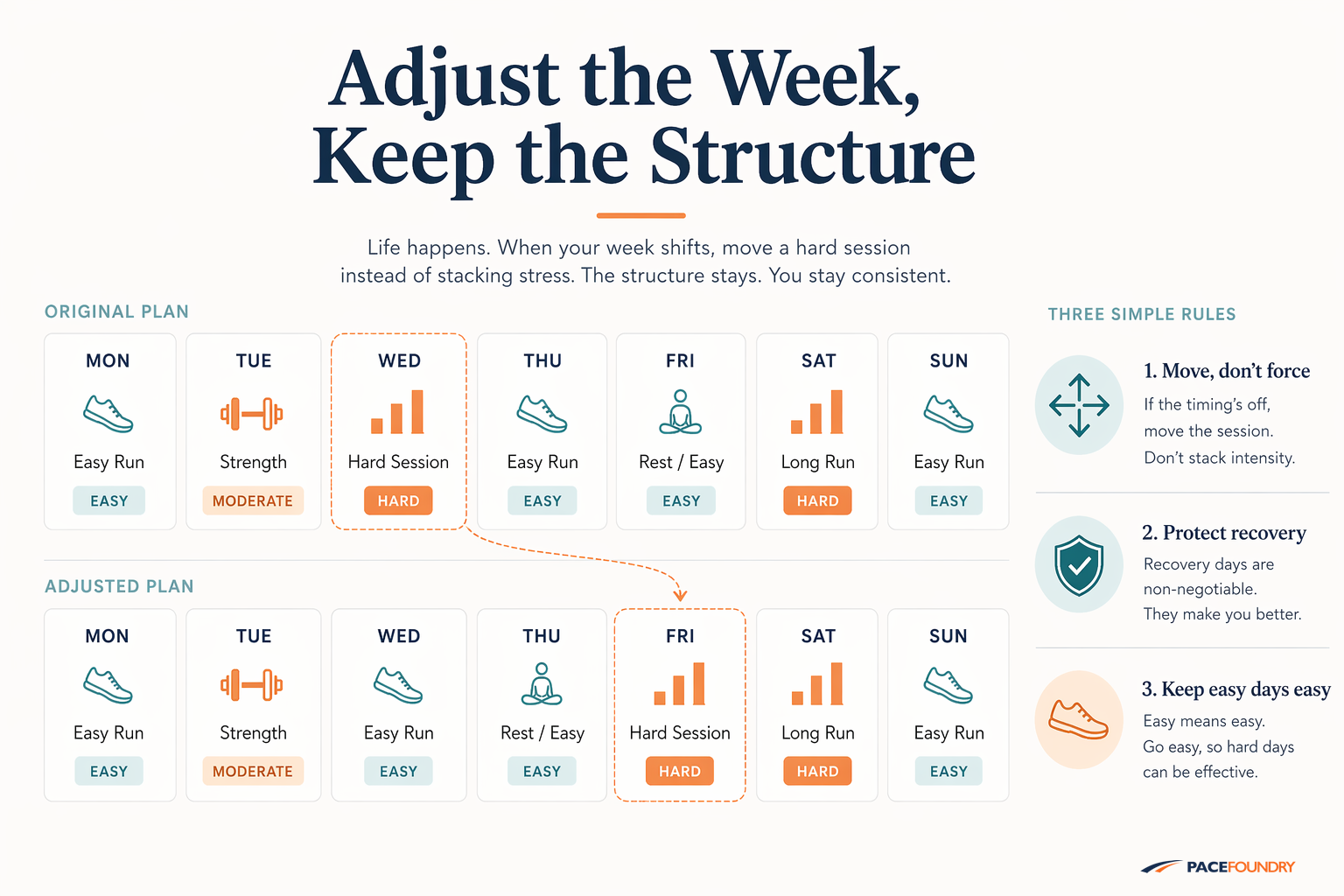
Now the session has a role, not a locked position. You can move it, reduce it, or replace it without losing the structure of the week.
This is how flexible training works.
You are not ignoring the plan. You are preserving the purpose behind it.
The Three Roles Every Week Needs
Most effective weeks are built around three basic roles.
Easy running gives you volume and recovery.
A quality session gives your body a clear training stimulus.
Recovery allows the work to become adaptation.
Everything else is flexible.
This does not mean every week needs to look the same. Some weeks may include more easy running. Some may include one harder session instead of two. Some may need more recovery than planned.
But the core logic stays the same.
You are trying to keep the system balanced.
When You Need to Adjust
Adjustments should not happen randomly.
They happen when the situation changes.
Your fatigue level changes. Sleep is worse than usual. Stress is higher. Recovery feels incomplete. Your body feels different from what the plan assumed.
That is not failure.
That is information.
The better you become at reading those signals, the easier it is to adjust without overreacting. This is closely connected to When to Push and When to Hold Back in Training, because good adjustments come from interpretation, not guessing.
A Simple Way to Adjust Your Week
You do not need to rebuild the whole plan.
Most of the time, you only need a small correction.
Do not stack hard days too close together. Protect recovery after demanding sessions. Move hard workouts instead of forcing them. Shorten a run instead of skipping it completely when that makes sense.
These are small decisions, but they keep the week intact.
They also protect the balance between easy and hard running. If that balance disappears, the week may still look full on paper, but it becomes harder for your body to absorb. This is why How to Balance Easy Runs and Hard Runs is such an important part of understanding flexible training.
If You Miss a Hard Session
This is where many runners overreact.
A missed hard session feels important because it stands out. It was supposed to be the workout that moved things forward.
But you do not need to catch up automatically.
You can move the session later if the week still allows enough recovery. You can replace it with something lighter if fatigue is already high. Or you can skip it completely if forcing it would damage the rest of the week.
One session does not define progress.
The pattern does.
If You Feel More Fatigued Than Expected
Unexpected fatigue is a signal, not a failure.
If your body feels heavier than the plan assumed, the week needs to shift.
That might mean turning a hard day into an easy run, delaying intensity, shortening the session, or allowing more recovery. The goal is not to avoid all discomfort. The goal is to avoid adding stress your body cannot absorb.
This is where daily decision-making matters. If you are unsure whether your body is ready for training or needs rest, Should You Run Today or Rest? gives a simple way to think through that decision.
It also helps to understand Fatigue vs Lack of Fitness, because not every hard-feeling day means the same thing.
If You Feel Better Than Expected
Feeling better than expected can be just as tricky.
This is where runners often make the opposite mistake.
The body feels good, so they add more. A little extra pace, a longer run, another hard effort. It feels harmless in the moment because the energy is there.
But not every good day needs to be used.
A strong training week is not built by spending all available energy. It is built by applying effort where it belongs and keeping the rest controlled.
Consistency beats opportunistic effort.
Your Week Is a System
A good training week is not a checklist.
It is a system.
Each run affects the next one. Each hard session needs support. Each easy day protects the structure. Each recovery point allows the training to keep working.
That is why changing one day does not automatically break the week.
If the roles are still clear, the structure can survive.
Even when the order changes.
Why This Matters
Real training is not perfect.
It is dynamic.
A plan gives you direction, but your body gives you feedback. Learning how to adjust without losing structure is what makes training sustainable over time.
You do not need every week to go exactly as planned.
You need a week that can bend without breaking.
Frequently Asked Questions
Should I make up a missed run?
Not automatically. If making it up forces hard sessions too close together or removes recovery, it is usually better to move on or replace it with an easier run.
Can I move a hard workout to another day?
Yes, as long as there is still enough recovery before and after it. The role of the session matters more than the exact day.
What should I do if I feel tired before a hard session?
Adjust the session. Make it easier, shorten it, delay it, or replace it with an easy run if fatigue is clearly high.
Does changing the plan mean I failed?
No. Good training includes adjustment. The goal is not perfect execution, but sustainable progress.
Adjusting your training becomes easier when you understand how your body is responding.
A reliable heart rate monitor can help you detect when effort is higher than expected — see Best Heart Rate Monitors for Running (2026).
Key Takeaway
You don’t need a perfect week.
You need a balanced one.