
You have been training consistently for weeks. The structure is working. The runs are getting done. Nothing feels particularly wrong. Then something changes.
Or more accurately, something stops changing. The pace no longer improves. The same routes start producing the same results.
The little signs of progress that felt easy to notice a few weeks ago suddenly become much harder to find. And that is usually when the word plateau appears.
I think almost every runner has experienced this moment. Not because training has become harder. But because improvement has become harder to see.
At first, progress often feels obvious. Small gains appear regularly enough to keep motivation high. Then eventually the process becomes quieter. The body is still adapting. The evidence simply becomes less visible. That is why plateaus can be surprisingly difficult to interpret.
Because in running, a plateau does not always mean progress has stopped. Sometimes it means progress has become less obvious than before.
And honestly, I believe many runners make their worst training decisions during this phase, because they assume the absence of visible improvement means the absence of improvement itself.
Modern running watches allow you to track pace, distance, heart rate, cadence, VO2 max and much more during workouts.
If you’re choosing one for training, see our guide to the Best Running Watches for Running (2026).
Why Running Progress Does Not Move in a Straight Line
One reason plateaus feel so frustrating is that most runners expect improvement to behave like a trend line.
You train consistently. You recover. You get fitter. The numbers should keep moving upward. At least that is how we imagine the process working.
The body is usually much less predictable than that.
Aerobic fitness, muscular endurance, connective tissue strength, movement economy, and recovery capacity are all adapting at the same time. Yet they do not improve at the same speed, and they do not always reveal themselves through the same signals.
That creates an interesting situation. The body may still be adapting while the evidence appears to have disappeared.
I think this is where many runners become discouraged unnecessarily. A few weeks of visible improvement create an expectation that the next few weeks should look similar.
When they don’t, it feels as if something has stopped working. But adaptation is rarely that straightforward. Sometimes progress becomes visible. Sometimes it becomes hidden.
This is closely connected to Why Your Progress Is Not Linear, because the body does not reward every productive training week with an immediately faster pace, lower heart rate, or better workout.
Over time, I think many runners realize that periods of obvious progress and periods of invisible progress often exist side by side. The difficult part is learning to trust the process during the second one.
Because a plateau is not always a sign that adaptation has stopped. Sometimes it is simply a period where adaptation has become harder to see.
What a Real Plateau Usually Looks Like
One of the biggest mistakes runners make is assuming that a lack of visible progress automatically means a lack of progress.
I honestly believe those are often two very different situations. A real plateau is rarely one disappointing run. It is rarely one average week.
And it is almost never a temporary period where training simply feels ordinary. A true plateau is a pattern.
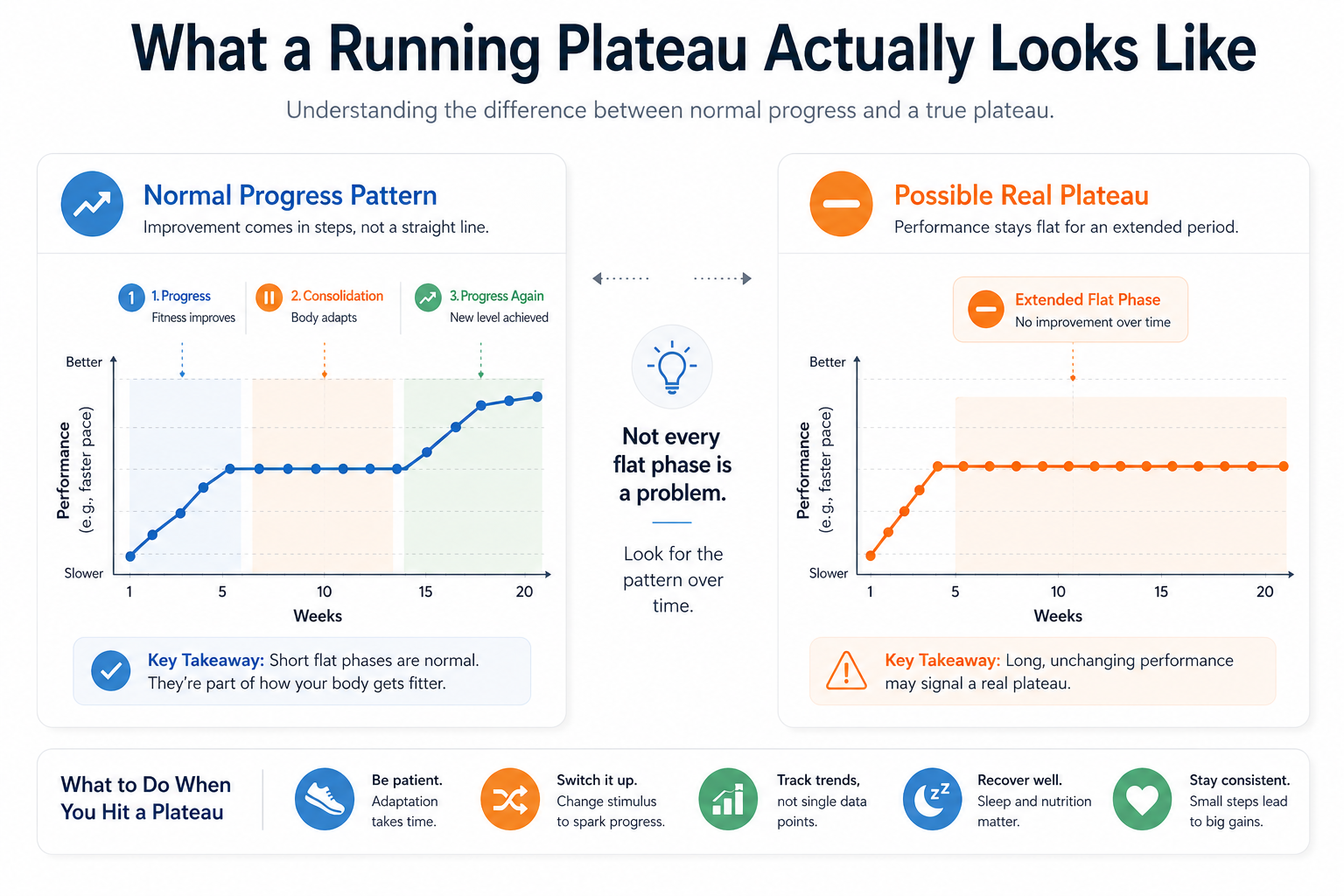
The same types of runs keep producing the same outcomes. Similar workouts stop feeling easier. Pace stops improving. Effort stops becoming more manageable. The system appears to have settled into a level that is no longer changing.
The important word is appears. Because this is where plateaus become difficult to interpret. If your easy runs still feel stable, your recovery remains predictable, and your harder sessions are not gradually deteriorating, there is a good chance you are not actually stuck.
You may simply be in a period where adaptation is continuing without producing obvious external signals.
To me, this is where many runners confuse consolidation with stagnation. The body is still absorbing training. It is simply not advertising the process very loudly.
A genuine plateau becomes more likely when the same sessions continue feeling flat for weeks, recovery becomes less responsive, and there is little evidence that the system is adapting in any meaningful direction.
That combination tells a much more complete story than any individual pace, heart rate, or workout result ever could.
This is one reason How to Recognize Real Progress vs Random Good Days matters so much.
The same principle works in both directions. Just as one great run cannot prove progress, one disappointing run cannot prove stagnation.
The body tends to reveal both through patterns. And over time, I think many runners realize that the difference between a plateau and a consolidation phase is often only visible when you zoom out far enough to see the bigger picture.
The Difference Between a Plateau and Normal Training Variation
Part of what makes plateaus so confusing is that normal training variation can look surprisingly similar. One week feels excellent. The next week feels average.
A few runs feel heavy for no obvious reason. Then everything settles again. That is not unusual. In fact, it is a normal part of training.
Sleep, stress, weather, hydration, recovery, work demands, and countless other factors influence how a run feels on any given day. Even when training is highly consistent, the experience of training rarely is.
This is one reason I think many runners become concerned too quickly. They interpret short-term variation as evidence that something bigger has changed. A plateau usually behaves differently.
Instead of fluctuating, it repeats.
The same types of runs continue producing the same outcomes. Similar workouts feel no easier than before. The relationship between effort and performance remains largely unchanged over an extended period.
That repetition is what makes a plateau meaningful. But even then, I honestly believe curiosity is usually more useful than panic.
Because the existence of a plateau does not automatically tell you why it exists.
Before assuming that harder training is the answer, it is worth asking a few deeper questions. Is the current training creating enough stimulus for adaptation? Is recovery allowing that adaptation to occur? Is progress actually absent, or has it simply become harder to detect?
To me, this is where many runners make their biggest mistake. They treat a plateau as a problem to solve immediately instead of a signal to understand first.
And those are not the same thing.
A plateau is not one bad run.
It is a repeated pattern where similar training stops producing new signals.
Why Plateaus Can Be a Normal Part of Improvement
One reason plateaus are so easy to misinterpret is that many runners expect fitness to behave like a continuously rising graph.
Train consistently. Get fitter. See better results. Repeat.
The body rarely works that neatly. Fitness often develops in stages.
A new level of capacity is created first. Then the body spends time learning how to operate comfortably at that level. Only after that does the next visible improvement begin to emerge.
I think this middle phase is where many runners become impatient. Because the work is still happening, but the evidence becomes much harder to see. To me, this is where the distinction between adaptation and performance becomes important. Sometimes the body is still adapting even when performance appears unchanged.
The system is not standing still. It is learning how to make the previous improvement sustainable. That process can look surprisingly similar to stagnation from the outside.
But internally, something very different may be happening.
This is especially common after a period of noticeable progress. The early gains often arrive relatively quickly, but once the body adjusts to a new training load, further improvements tend to become smaller, slower, and less obvious.
That does not automatically mean you need more intensity, more volume, or a completely different plan. Sometimes it simply means the body needs more time.
If you are unsure whether progress is still occurring, What Counts as Progress in Running provides a useful perspective because improvement is not always measured through pace alone.
Sometimes it appears as steadier effort. Sometimes it appears as more predictable recovery. And sometimes it appears as something surprisingly simple.
Fewer bad days. Over time, I think many runners realize that some of their most productive training periods looked remarkably ordinary while they were happening.
The improvement only became obvious in hindsight.
When a Plateau Actually Needs Attention
Not every plateau requires action. But not every plateau should be ignored either.
I think this is where interpretation becomes especially important. A plateau by itself is often neutral. The bigger question is what else is happening around it.
If your easy runs still feel controlled, recovery remains predictable, and training generally feels stable, there is usually little reason to panic simply because visible progress has slowed. But sometimes the situation starts changing.
Easy runs become harder than they used to be. Recovery takes longer. Motivation gradually declines. Workouts that once felt manageable begin feeling unusually demanding.
At that point, the conversation is no longer really about the plateau. It becomes a conversation about whether the system is adapting effectively.
To me, this is where many runners accidentally make things worse. They assume the absence of progress means the absence of effort. So they respond by adding more effort.
More intensity. More volume. More pressure.
But if adaptation is already struggling, additional stress is not always the solution.
Sometimes it is the problem.
That is why What Makes a Training Week Actually Effective becomes so relevant during these periods.
The goal is not simply accumulating more training. The goal is creating a balance where training stress and recovery continue supporting each other.
Because when progress stalls and recovery begins falling behind at the same time, the issue is often not that the body needs more work.
It may be that the body needs a better environment in which to absorb the work it is already doing. Over time, I think many runners realize that productive training is not about constantly forcing adaptation.
It is about recognizing when adaptation has stopped keeping pace with the stress being applied.
What to Do Before Changing Everything
One of the most common reactions to a plateau is the urge to fix it immediately. The pace has stopped improving. The workouts feel familiar. The evidence of progress becomes harder to find.
Naturally, the mind starts searching for solutions. Maybe the training needs more intensity. Maybe the mileage should increase. Maybe the entire plan needs to change.
I honestly believe many runners make their biggest mistakes at this stage because they become impatient before they become curious.
A plateau often creates pressure to act. But the smartest first step is usually observation. Instead of looking at the last few days, look at the last few weeks.
Has training been consistent enough to judge? Have the conditions been comparable? Has recovery changed? Are easy runs still serving their intended purpose?
To me, this is where many plateau decisions become much clearer. Because sometimes the issue is not the training itself.
Sometimes the issue is simply that not enough time has passed to evaluate the training properly. If the plateau is relatively short and the overall system still feels stable, patience is often the most productive response. If the same patterns continue repeating for longer periods, then adjustments may become useful.
The important part is making those adjustments gradually.
One change at a time. A little more recovery. A small increase in volume. A refinement to harder sessions. Better protection of easy days.
Whatever the adjustment happens to be, it should help create a clearer environment for adaptation rather than simply adding more stress.
Over time, I think many runners realize that successful training is rarely built on dramatic resets.
It is usually built on small corrections applied to a system that was already working reasonably well.
Good tracking can help here, especially when you want to compare effort and heart rate across similar runs.
If your current data feels inconsistent, a reliable device from a guide like Best Heart Rate Monitors for Running can make it easier to separate real patterns from measurement noise.
Conclusion
One of the most useful things a runner can learn is that progress and visibility are not always the same thing.
Sometimes improvement is obvious. The pace improves. The workouts feel easier. The results become difficult to miss.
But sometimes the body is still adapting while the evidence becomes harder to see.
I think this is why plateaus can feel so uncomfortable. They force you to continue training without the reassurance of constant visible progress. And honestly, I believe that is where many runners make their most important decisions.
Some become impatient and start changing everything. Others learn to step back and look at the bigger pattern.
Because a plateau is rarely defined by one difficult run, one average week, or a temporary lack of improvement. It is defined by what continues happening over time. Over time, I think many runners realize that some of their most productive training periods looked surprisingly ordinary while they were living through them.
The progress only became obvious later. That is why a plateau does not always need to be broken. Sometimes it simply needs to be understood.
Frequently Asked Questions
How long does a running plateau usually last?
A short flat phase lasting one or two weeks is often normal training variation. A plateau becomes more meaningful when similar runs show little change for several weeks despite consistent training and reasonable recovery.
Does a plateau mean I need to train harder?
Not always. Sometimes the issue is not too little effort, but poor balance between stress and recovery. Before adding intensity, look at your easy runs, recovery days, sleep, and overall weekly structure.
Can I still be improving during a plateau?
Yes. Some adaptations happen before they show clearly in pace or workout performance. Better recovery, steadier effort, and more consistent runs can all suggest that progress is still happening beneath the surface.
What is the biggest mistake runners make during a plateau?
The biggest mistake is reacting too quickly. Many runners add harder workouts before they understand whether the flat phase is normal consolidation, fatigue, or a real need for a new training stimulus.