
At some point, almost every runner reaches a phase where progress becomes harder to notice.
The changes that once felt obvious start slowing down. Your pace no longer improves every few weeks. Easy runs stop feeling dramatically easier. Training still continues, but the feeling of momentum becomes much less clear.
This is usually the moment when doubt begins to appear.
You start wondering whether your training is still working, whether you should change something, or whether you may have stopped improving altogether.
But in most cases, nothing is actually wrong.
Progress slowing down is not usually a sign that adaptation has stopped. More often, it is a sign that your body has moved beyond the early phase where improvement feels obvious and immediate.
Running development almost never continues in a straight line.
The longer you train consistently, the more progress begins happening quietly instead of dramatically.
If you want your easy and recovery runs to feel smoother and reduce unnecessary strain during this phase, even small factors like footwear can help. You can explore options in our guide to Best Running Shoes for Long Runs (2026).
Why Progress Slows Down Over Time
In the beginning, improvement often feels surprisingly fast.
You run more consistently, and your body responds quickly. Easy pace improves, recovery gets smoother, and almost every few weeks something feels noticeably better than before.
But that phase does not continue forever.
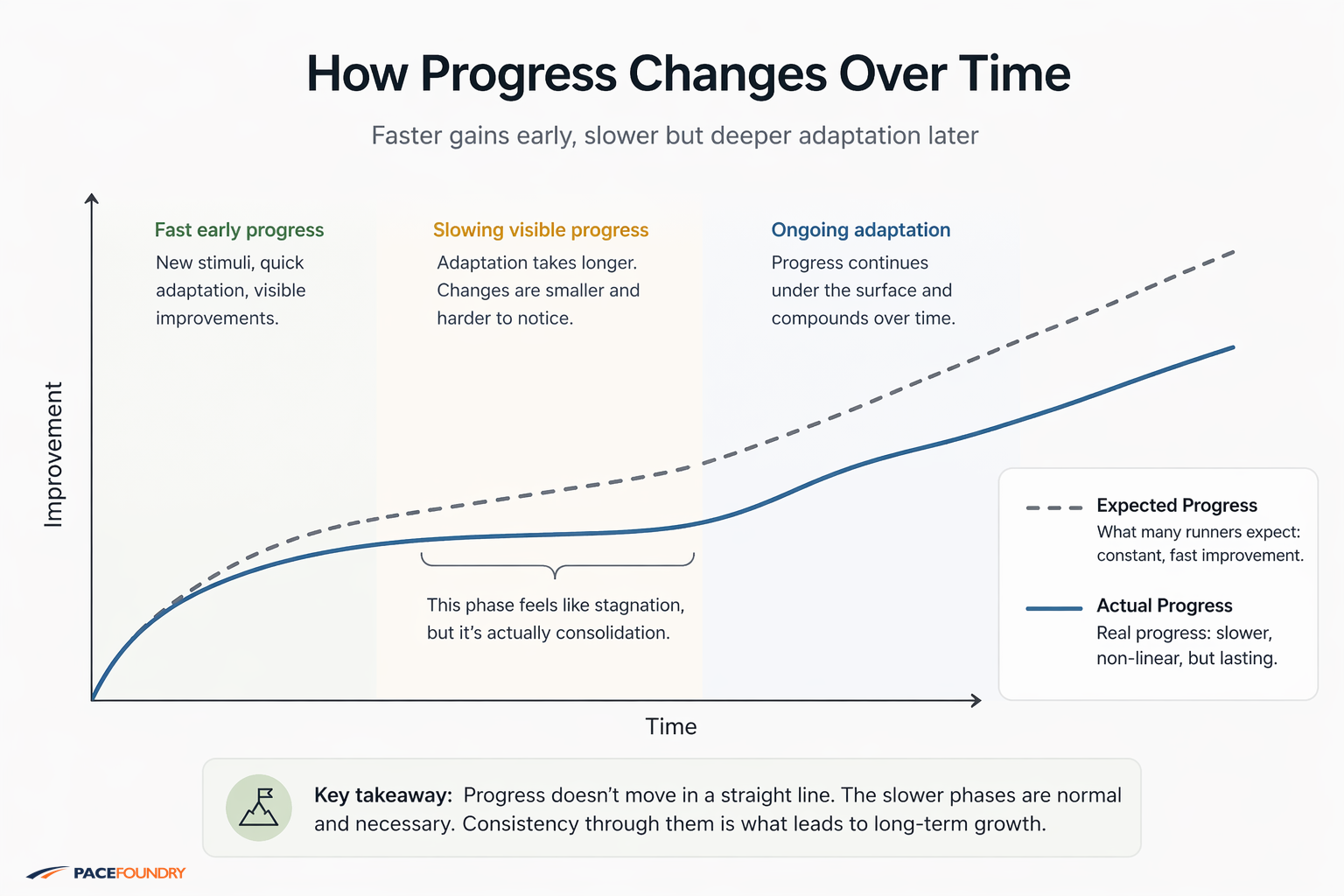
As your fitness develops, progress naturally begins slowing down. Not because adaptation has stopped, but because your system has already become more efficient. The body is no longer reacting to completely new stress. It is refining an ability that already exists.
That changes how improvement appears
Early in training, small inputs can create visible changes very quickly. Later, the same training may still be working perfectly well, but the results become smaller, quieter, and harder to notice from week to week.
Nothing is broken during this phase.
The body simply needs more repetition and more time for each next level of adaptation to become visible.
This is one reason many runners become frustrated unnecessarily. They expect progress to continue at the same speed as it did early on, even though running development almost never works that way long term.
As you move closer to your current fitness level, changes naturally become more gradual. Not your ultimate potential, but the level your body is currently prepared to support consistently.
That is why progress can begin feeling less dramatic even while meaningful adaptation is still happening underneath.
Fatigue can make this even more confusing
During harder or more consistent training periods, accumulated load often changes how running feels day to day. Effort feels slightly higher, pace feels flatter, and runs stop producing the same sensation of momentum that they once did.
This creates the illusion that progress has stopped completely.
In reality, the body is often still adapting underneath temporary fatigue.
This is why understanding how to tell the difference between fatigue and lack of fitness becomes extremely valuable, because the feeling of stagnation is sometimes caused more by accumulated training stress than by an actual loss of development.
Plateaus Are Often Part of the Adaptation Process
One reason progress slowing down feels uncomfortable is that runners often interpret quieter periods as empty periods.
But a plateau does not mean nothing is happening.
Very often, it means the body is stabilizing what it has already built. The system is strengthening adaptations, improving durability, and making your current fitness level more repeatable and sustainable.
This is part of how long-term progress actually works.
Running improvement rarely happens through constant visible breakthroughs. More often, it moves through alternating phases of visible progress and quieter consolidation. One phase creates adaptation. The next phase helps the body hold onto it more consistently.
This connects closely to why your progress is not linear, because periods where improvement feels less visible are often part of the upward trend itself rather than evidence that development has stopped.
The difficult part is psychological
When progress slows, the natural instinct is usually to act. To change something, add more intensity, increase mileage, or force momentum back into training.
At first, that reaction feels logical.
If progress has slowed, it seems reasonable to assume that more effort must be required.
But this is also where many runners quietly lose direction.
If the body is already carrying significant fatigue or adaptation load, adding more stress does not necessarily accelerate progress. Very often, it simply increases strain faster than recovery can keep up.
Fatigue begins accumulating more quickly than adaptation. Recovery becomes less complete between sessions. Performance starts fluctuating unpredictably. Running no longer feels controlled in the same way.
What originally felt like productive effort slowly turns into constant strain.
Strain is not the same thing as progress
This is one reason runners benefit from understanding what counts as progress in running beyond pace, because development often continues quietly even when obvious performance changes temporarily slow down.
Periods of slower visible improvement usually require patience more than aggression.
The goal during these phases is usually not forcing change immediately. It is maintaining enough consistency and stability for the body to continue adapting underneath the surface.
That may mean keeping your structure stable, protecting recovery carefully, and resisting the temptation to constantly chase visible improvement every single week.
This is also why runners who stay patient through quieter phases often continue improving longer than runners who repeatedly overreact to every temporary slowdown.
Patience is not separate from training.
In many phases of running development, patience becomes part of the training itself.
Most of the Time, Small Adjustments Are Enough
When progress slows down, runners often assume something major needs to change.
But in reality, meaningful improvements rarely come from dramatic overcorrections.
More often, the solution is surprisingly small.
A slightly more stable weekly structure. Better recovery consistency. A gradual increase in volume that the body can actually absorb properly. Sometimes the biggest improvement simply comes from removing unnecessary strain rather than adding more stress.
This is one reason experienced runners tend to make smaller adjustments than newer runners expect. They understand that fitness usually responds better to sustainable consistency than constant reinvention.
At this stage, progress also becomes much less visible from run to run.
You no longer notice improvement every week the way you might have early in training. Some runs still feel average. Others feel slightly flat. The feeling of constant momentum disappears, even though development may still be continuing underneath.
Over time, however, something gradually shifts.
Effort becomes more controlled. Recovery stabilizes. Consistency becomes easier to maintain. The body handles normal training with less disruption than before.
These changes are quieter than obvious pace breakthroughs, but they are often more important long term.
This is closely connected to how to recognize real progress vs random good days, because meaningful development often appears first through stability, control, and repeatability rather than dramatic performance jumps alone.
Why This Phase Matters More Than It First Appears
This is the phase where many runners quietly lose patience.
Progress no longer feels exciting or obvious, so it becomes easy to assume that nothing meaningful is happening anymore. Some runners start changing direction constantly. Others begin forcing intensity into training in an attempt to restart momentum. Some simply lose confidence in the process altogether.
But this quieter phase is often where deeper adaptation actually happens.
The body is not only improving performance. It is improving durability, efficiency, and the ability to handle training more consistently over time. Those adaptations usually develop more slowly, but they are also what support long-term progress later on.
This is one reason sustainable runners often appear patient from the outside.
They understand that not every phase of development feels dramatic. Some phases are about visible breakthroughs. Others are about strengthening the foundation underneath those breakthroughs.
Staying consistent through this period is what often separates short-term improvement from long-term development.
Because long-term progress is rarely built through constant acceleration.
Very often, it is built by continuing forward even when improvement temporarily becomes harder to see clearly.
Frequently Asked Questions
Is it normal for progress to slow down?
Yes. As your fitness improves, progress always becomes slower and less visible.
Does this mean I have reached my limit?
No. It usually means you are approaching your current level, not your full potential.
Should I push harder to break through?
Usually not. Consistency and controlled effort are more effective than adding intensity.
How long does this phase last?
It varies, but it is always temporary if your training remains consistent.
When progress feels slow, objective feedback helps.
A reliable heart rate monitor can reveal subtle improvements in efficiency and recovery that pace alone doesn’t show — see Best Heart Rate Monitors for Running (2026).
Key Takeaway
Slower progress doesn’t mean no progress.
It means you’ve moved into a deeper phase of adaptation.