
You expect progress to look like a straight line.
Each week a little better.
Each run a little easier.
Each pace a little faster.
It feels logical. If you’re training consistently, something should improve every time.
But that’s not what happens. Some runs feel great. Others feel average. Some feel worse than before.
And that’s usually the moment when doubt starts to appear.
If you want your easy and recovery runs to feel smoother and reduce unnecessary strain, the shoes you use can make a difference.
You can explore options in our guide to Best Shoes for Long Runs, where different models are explained based on how they actually feel during real training.
Progress Doesn’t Move in Straight Lines
Running improvement doesn’t happen step by step.
It happens in waves. You move forward, then you plateau, then you feel a small drop. And then you move forward again.
From the inside, it feels inconsistent. From the outside, it’s exactly how adaptation works.
This is one of the biggest shifts in understanding training. Progress is not something you can measure run by run. It is something that emerges over time.
Your Body Adapts in Cycles
Every run creates stress.
But your body doesn’t immediately turn that stress into improvement. It processes it over time.
Some days you feel the fatigue from recent training. Some days you feel the adaptation starting to show. Most days, you are somewhere in between.
You are not seeing pure progress in each run. You are seeing different phases of the same process.
This is why it helps to understand what counts as progress in running beyond pace, because not every sign of improvement is visible in speed.
Good Days and Bad Days Belong Together
It is easy to assign meaning to how a run feels.
A good run means you are improving. A bad run means something is wrong.
But that is not accurate.
A great run does not prove progress. And a difficult run does not erase it. They are both part of the same system.
The mistake is trying to separate them, when in reality they only make sense together.
Fatigue Often Hides Progress
One of the biggest reasons progress feels inconsistent is simple: fatigue.
You might actually be improving, but your body is carrying load from previous sessions.
That can make runs feel heavier, slower, and less responsive.
It creates the illusion that nothing is working.
This is why learning how to tell the difference between fatigue and lack of fitness is one of the most important skills you can develop. Without that understanding, it is easy to misinterpret temporary tiredness as failure.
Not every difficult run is a sign of poor fitness. Many are a sign that your body is adapting.
Adaptation Is Delayed
The work you do today does not show up tomorrow.
It shows up later. Sometimes a few days later. Sometimes weeks later.
This delay makes progress harder to see. You are putting in the work now, but the result has not surfaced yet.
That does not mean nothing is happening. It means something is building.
Plateaus Are Part of the Process
Plateaus often feel like stagnation.
Like you are stuck.
But they are not empty phases. They are consolidation phases.
Your body is stabilizing, adapting, and preparing for the next step.
Without this, progress would not hold.
The Emotional Trap
When progress feels inconsistent, the instinct is to react.
To fix it. To push harder. To add intensity. To force improvement.
But most of the time, the problem is not your training. It is your expectation.
You expect visible progress all the time. Your body does not work that way.
What Progress Actually Looks Like
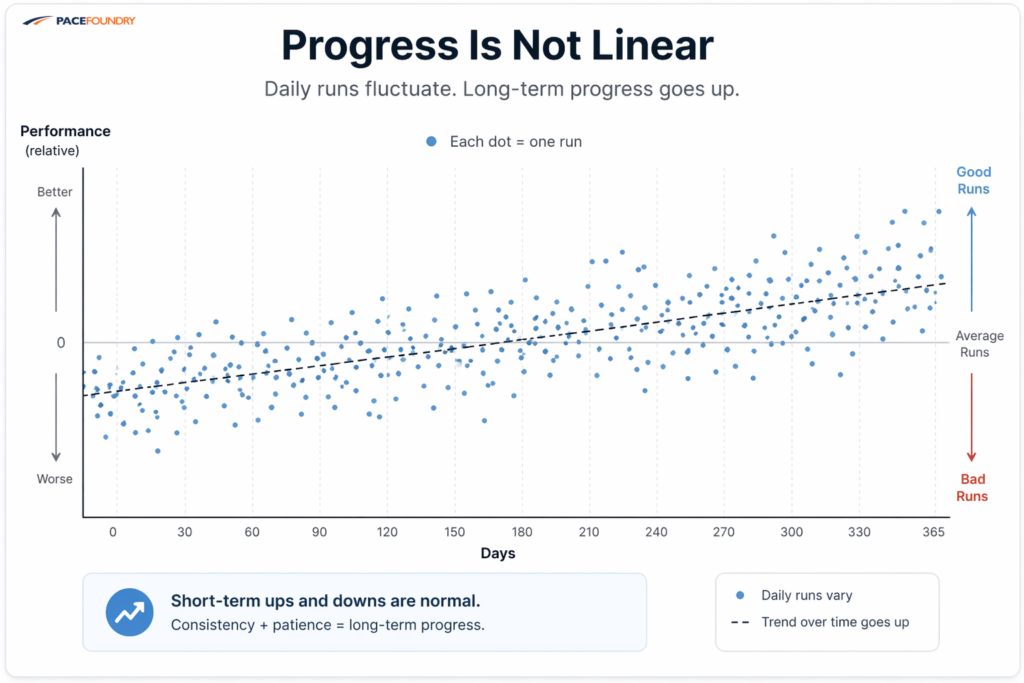
If you zoom in on your training, progress looks messy.
Up and down. Good days and bad days. No clear pattern.
But if you zoom out, something becomes clear. The trend is moving forward.
That is what matters.
What To Focus On Instead
Instead of trying to prove progress in every run, focus on the system.
Consistent training. Controlled effort. Patience.
Let runs be what they are. Some will feel great. Some will not.
Both are part of the process.
This becomes much easier once you understand how good effort actually feels at different stages, because it gives you a more stable reference point than daily performance.
Progress is not proven in individual runs. It is revealed over time.
Frequently Asked Questions
Why do some runs feel worse even when I’m training consistently?
Because fatigue and adaptation overlap.
Is short-term regression normal?
Yes — it’s part of the process.
How do I know if I’m improving?
Look at patterns over time, not single runs — especially how effort and recovery change.
Should progress feel consistent?
No — it should feel variable, even when the overall trend is positive.
Seeing patterns over time is what makes progress visible.
A reliable heart rate monitor helps you recognize trends instead of reacting to single runs — see Best Heart Rate Monitors for Running (2026).
Key Takeaway
Progress is not a straight line.
It’s a pattern that only makes sense when you zoom out.