
Returning After Long Break
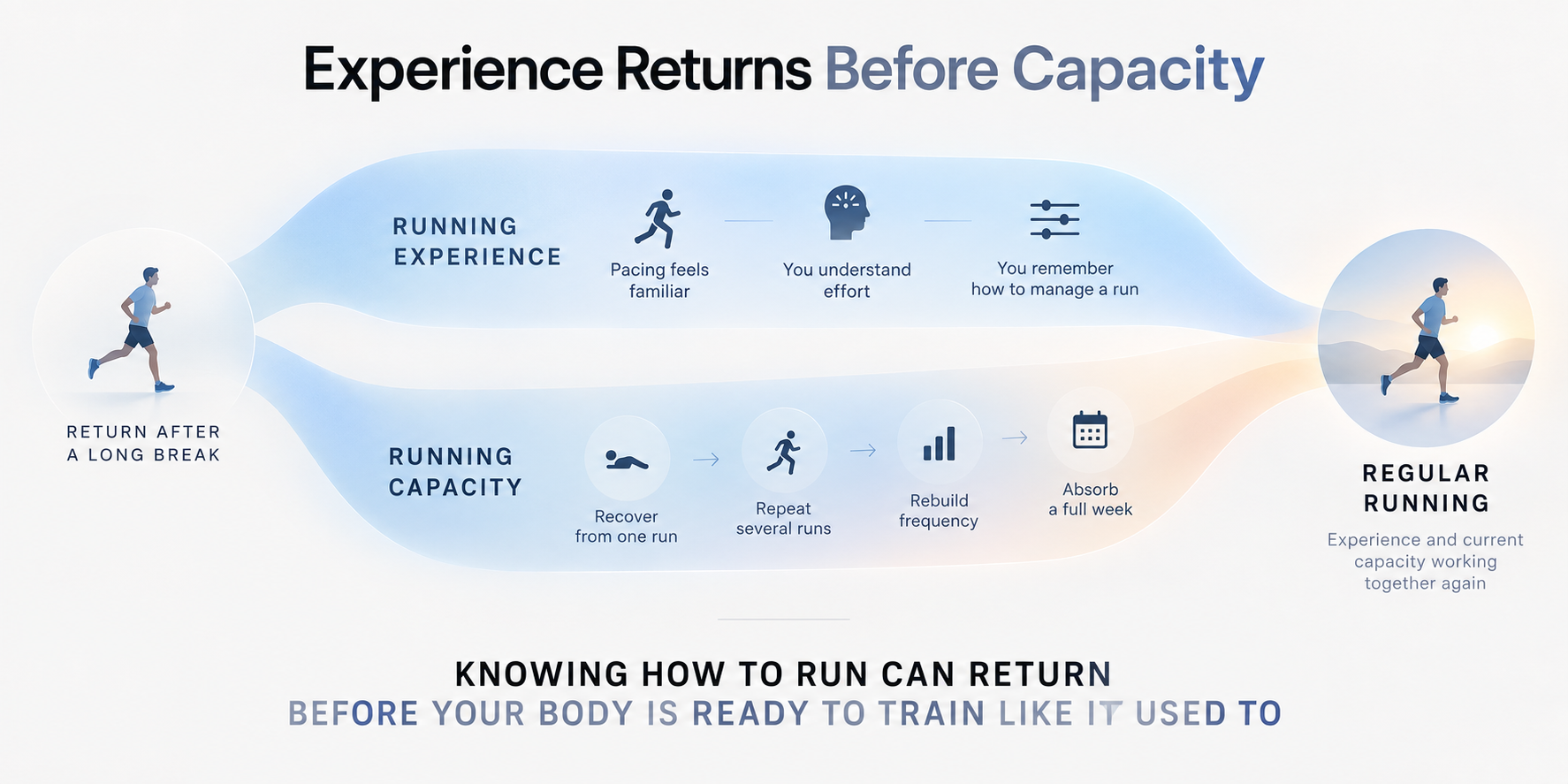
After a long break, your experience can return immediately even when your running capacity does not.
A long break from running can create an unusual feeling when you finally come back.
You remember running clearly. You know how an easy run is supposed to feel, how to settle into a rhythm and how much effort different paces used to require. You may remember entire training weeks almost physically: the ordinary weekday runs, the longer weekend session and the sense that running several times a week required very little negotiation.
Then you go out for the first run and discover that knowing all of this does not make your body behave as if it remembers in quite the same way.
The movement may feel familiar, but heavier. Breathing can become noticeable much earlier than expected. A distance that once barely qualified as a run can suddenly feel substantial, and the pace on your watch may bear little resemblance to the pace you still associate with yourself.
That mismatch can make a long return surprisingly frustrating. A complete beginner has no previous version of running against which every session is being compared. A returning runner does. You are experiencing what your body can do now while simultaneously remembering what the same activity once felt like when years of adaptation sat underneath it.
The longer the break, the less useful it becomes to treat those two versions as if they should immediately match.
That does not make your previous running irrelevant. Experience still matters. You understand effort better than someone who has never run consistently. You already know that some days feel worse than others, that fitness develops slowly and that one difficult run says very little about what will eventually become possible.
But experience and current capacity are different things.
The ideas in Should You Start Running Where You Left Off? become particularly important after a long break because your previous training can provide context without providing the correct starting point. The old distances, paces and weekly mileage tell you what you once adapted to, not what your body is currently prepared to repeat.
I think accepting that distinction is the real beginning of the comeback. You do not need to forget the runner you were. You simply need to stop requiring your first weeks back to look like them.
Your Running Experience Will Come Back Faster Than Your Running Capacity
One of the advantages of having run seriously before is that many parts of running do not need to be learned again.
You already understand that the first kilometer can feel awkward before the body settles. You know the difference between an effort that is merely uncomfortable and one that is genuinely too hard. You have probably made enough training mistakes in the past to recognize some of them before repeating them.
That experience can make the early return feel surprisingly competent.
Within a few runs, pacing becomes more natural. You stop thinking about every step. Familiar routes begin triggering old rhythms, and you may find yourself making small adjustments automatically in a way that reminds you how deeply running was once embedded in your life.
The problem is that competence can create the appearance of capacity.
Because you know how to manage a run, you may be able to make a distance look much more comfortable than your recent training history would suggest. You can control the effort, settle the breathing and finish without falling apart. The session feels successful, so increasing the next one seems reasonable.
But running capacity is not only your ability to manage the session while it is happening. It includes what the session leaves behind.
Can you recover normally from it? Does another run fit comfortably a few days later? When you repeat the same week, does it feel increasingly natural or does fatigue begin accumulating underneath otherwise successful sessions?
The Recovery Check Calculator becomes useful here because it shifts some of the attention away from how skilfully you completed the run and toward how well your current body absorbed it.
I think experienced runners need this distinction more than beginners sometimes do. Experience gives you tools for getting through a run that your current running capacity may not yet fully support. You can pace intelligently, tolerate discomfort and draw on years of familiarity.
Those are genuine advantages. They just should not be mistaken for adaptations you have not rebuilt yet.
Let the experience make the comeback easier. Do not let it make the comeback unnecessarily fast.
Do Not Use Your Old Fitness as the Standard for Every Run
The comparison with your previous running becomes most noticeable when the basic act of running starts feeling normal again.
At first, you are simply pleased to be outside and moving. Then the awkwardness fades, and the watch begins attracting more attention. A pace appears that would once have been very easy. You remember what heart rate you used to see there, how long you could maintain it and what the same route looked like when you were training consistently.
Suddenly, a perfectly appropriate run can feel disappointing.
This is one of the strange disadvantages of having good historical data. The numbers are accurate, but the comparison they invite is not always useful. Your old pace describes what a previously trained version of your body could produce. It does not tell you what today’s run should cost.
For a while, I would allow effort to become the more important reference. If the run feels comfortably sustainable but the pace is slower than you remember, that slower pace is not evidence that the session went badly. It is simply the current relationship between effort and speed.
The Run Effort Check Calculator can help during this stage because it brings attention back to what the run actually demanded rather than how closely the numbers resemble an old training log.
That relationship will change as fitness returns. A pace that initially requires concentration may become ordinary. The same route begins costing less. Eventually, some of the old numbers may reappear without you deliberately chasing them.
What I would avoid is trying to shorten that process by turning every easy run into a quiet attempt to recover your old pace. It is remarkably easy to do because the difference may be small enough to seem harmless. Ten or fifteen seconds per kilometre faster can make the watch look more familiar while changing the character of the run more than expected.
Your old fitness is useful evidence of what you have been capable of building. It does not need to become the minimum standard for what counts as a good run now.
Once that comparison loses some of its power, the comeback becomes much easier to see for what it actually is: new training producing new adaptation, rather than a series of attempts to erase the distance between the present and the past.
Rebuild the Week Before You Rebuild the Long Run
Long runs tend to occupy a special place in a runner’s memory. You may forget plenty of ordinary Tuesday sessions, but you remember being able to leave the house for ninety minutes or two hours without treating the distance as something particularly significant.
After a long break, that memory can make shorter running feel temporary. A few five- or six-kilometre runs are acceptable because you are returning, but the long run can quickly become the session that seems to represent becoming a runner again.
I would rebuild the week first.
The reason is not that longer running needs to be avoided. It is that a long run becomes much more useful when it grows out of a stable pattern of ordinary running. If you are running two or three times a week and those sessions are becoming increasingly easy to absorb, one of them can naturally begin extending. The longer run then develops alongside your overall running capacity rather than becoming the session around which the rest of the week has to recover.
This is where How Long Should a Long Run Be becomes more useful than remembering how far you used to run on Sundays. The appropriate long run belongs in the context of your current training, not your historical maximum.
There is also something psychologically helpful about allowing the week to become normal first. You begin rebuilding the identity of being someone who runs regularly without requiring one particular session to prove it. Monday’s easy run matters. Thursday’s ordinary forty minutes matters. The fact that you can repeat them next week matters.
Then, when one of those runs gradually becomes sixty minutes, seventy-five minutes or longer, it does not feel like an attempt to recover a missing piece of your old running life.
It is simply where the current training has taken you. A long break may have removed the endurance that once made long runs ordinary. The best way to make them ordinary again is not necessarily to chase them first. It is to rebuild enough ordinary running underneath them that being out there longer stops feeling exceptional.
Let Running Frequency Become Normal Again
After a long break, it is easy to think about progress mainly in terms of what happens inside each run. You notice that forty minutes has become easier, that the pace is improving or that the longer run is beginning to stretch out again. But another part of running fitness is being rebuilt more quietly: the ability to place runs close enough together that they form a training week.
This can feel surprisingly different from simply being capable of running. You may complete a comfortable session on Tuesday and have no doubt that you could run again on Wednesday, yet still find that three or four running days create more accumulated fatigue than you remember. The individual sessions are manageable; the repeated exposure is what is new again.
I would let frequency grow from how well the existing week is being absorbed rather than from the schedule you used to follow. If three runs fit comfortably, there is no urgency to turn them into four simply because four used to be normal. Once those three runs begin leaving plenty of room around themselves, another running day can become a relatively small change instead of another demand layered onto a week that is already developing.
The thinking in How Many Times a Week Should You Run is useful here because frequency is not just a way of reaching a weekly mileage target. Each additional running day changes the balance between training and recovery, and after a long break that balance needs to become familiar again too.
This is also where patience starts producing something that is difficult to see on a watch. Running gradually occupies less space in your recovery. You finish a session and the rest of the day feels normal. The next morning does not carry much evidence of yesterday’s run. Eventually, another session can enter the week without making the whole structure feel more demanding.
That is a meaningful form of returning fitness, even if neither pace nor distance changes very much while it is happening.
And once frequency has become ordinary again, you have far more options. One run can grow longer without dominating the week. Faster running can eventually return without sitting on top of too little recovery. Weekly volume can increase because there is somewhere sensible to distribute it.
You are no longer rebuilding isolated runs. You are rebuilding the ability to live with running as a regular part of the week.
Do Not Rush to Add Intensity Just Because Running Feels Familiar
There is often a point in a long comeback when easy running stops feeling like enough.
The basic rhythm has returned, several runs fit comfortably into the week and the pace is beginning to look respectable again. If you used to train with tempo runs, intervals or faster progression runs, you may start missing the feeling of doing something more purposeful than simply accumulating easy kilometres.
That is a good sign. It usually means running is beginning to feel like training again rather than an activity you are cautiously reintroducing. But feeling ready to run faster and having enough structure to absorb faster running are slightly different things.
A returning runner can often produce a surprisingly good hard session because previous experience makes the effort familiar. You know how to pace it, how discomfort develops and how much you can ask from yourself near the end. The workout itself may therefore look convincing long before the surrounding training week has regained the depth it once had.
I would look at what is underneath the workout before worrying about whether the old pace is available. Are easy runs already repeatable? Is frequency stable? Has one run become longer without making the rest of the week noticeably harder? If those pieces are behaving normally, intensity has somewhere to sit.
The distinction explored in How to Know If a Hard Run Was Actually Productive becomes especially useful here. A successful workout is not simply one in which you can reproduce a familiar pace. It also needs to leave the surrounding training intact.
When faster running does return, it can return modestly. You do not need to begin with the interval session you remember doing at peak fitness. A few controlled faster sections, relaxed strides or a shorter tempo effort can reintroduce speed without simultaneously asking the whole training structure to jump forward.
This is one of the places where previous experience should make the return calmer rather than faster. You already know that fitness does not depend on one impressive workout. You also know how quickly harder sessions can become normal once there is enough ordinary running underneath them.
There is no need to prove that you can still run hard. Build the week that makes running hard useful again.
Stop Measuring the Comeback Against the Calendar
A long break creates a strong temptation to ask how long the return should take.
If you have been back for a month, perhaps you should already be running four times a week. After two months, the long run ought to look more substantial. By three months, it can seem reasonable to expect something resembling normal training again.
The problem is that the calendar measures how long you have been back. It does not measure how much running you have actually rebuilt.
Two runners can both be three months into a comeback and have accumulated completely different training. One may have run consistently throughout that period, gradually increasing frequency and distance. The other may have managed several good weeks interrupted by travel, work, minor illness or simply the practical difficulty of making running regular again. Counting months makes their returns look similar when their recent running histories are not.
I think this is where returning runners can borrow something useful from What Beginner Progress Actually Looks Like. Progress is often easier to understand through what has become less costly and more repeatable than through how much time has passed since you started.
Look at what has become ordinary.
Perhaps thirty minutes of running once felt substantial and now barely affects the rest of the day. Three runs used to require careful spacing and now fit naturally into the week. A longer run has started growing without creating several days of heavy legs. These changes tell you that running capacity is accumulating even if the headline numbers still look modest compared with the past.
The opposite can also be true. Three months may have passed, but if every increase still makes the following week noticeably harder, the calendar does not create an obligation to progress anyway.
That is one of the advantages of treating a long comeback as new training rather than a restoration project. There is no deadline by which the old runner has to reappear.
At some point, you may notice that you have stopped counting how long you have been back.
Running has become too normal for the question to matter very much. And that is probably a more meaningful milestone than reaching any particular week on the calendar.
Conclusion
A long break changes running, but it does not erase everything you learned from being a runner.
Your experience is still there. You know what different efforts feel like, how training gradually develops and how ordinary a distance can become once enough consistent running sits underneath it. That knowledge can make returning easier, but it can also make the present look unnecessarily inadequate when you compare it with what used to be normal.
The way through that tension is not to forget your old running. It is to stop asking your current running to match it immediately.
Let effort find its current pace. Let several ordinary runs become a week, and let that week become something you can repeat. Allow the long run to grow from the running underneath it, and bring harder training back when the surrounding structure is ready to make it useful.
The practical side can remain equally uncomplicated. Most of this rebuilding happens through ordinary running, so a comfortable, versatile daily trainer is enough for the majority of it. Best Running Shoes for Daily Training 2026 covers exactly that role without requiring the comeback to revolve around specialized workouts.
Over time, some old numbers may return. Perhaps most of them will. You may eventually become fitter than you were before the break.
But that does not need to define whether the return has succeeded.
The more meaningful change happens when running stops feeling like something you are rebuilding and starts feeling like an ordinary part of your life again.
At that point, the long break is no longer deciding what your running looks like. You are running again.
Frequently Asked Questions
How long does it take to get back into running after a long break?
There is no single timetable because the length of the break, your previous running history, current activity level and consistency after returning all matter. Rather than measuring the comeback only in weeks or months, look for changes in what has become repeatable: ordinary runs feel easier to absorb, recovery becomes predictable and running begins fitting naturally into the week again.
Do experienced runners regain fitness faster after a long break?
Previous experience can make some parts of returning easier because pacing, effort awareness and familiarity with training do not necessarily disappear with fitness. That does not mean previous running capacity remains intact. Experience can return much faster than the physical adaptations needed to support regular running.
How far should my first runs be after a long break?
There is no distance that works for every returning runner. Start with an amount of running that feels comfortably manageable and leaves you confident about recovering for the next session. The first runs are more useful when they establish something repeatable than when they demonstrate the longest distance you can still complete.
Should I use run-walk intervals when returning after a long break?
They can be useful if continuous running currently makes the effort rise too quickly or leaves you excessively fatigued. Previous running experience does not make walking breaks a step backwards. They are simply one way of controlling the amount of continuous running while your current capacity develops.
How many times a week should I run when coming back?
Begin with a frequency that allows the individual runs to settle into the week without accumulating increasing fatigue. The appropriate number will differ between runners. Frequency can increase once the existing pattern feels ordinary enough that another running day is a relatively small addition.
When should I start doing long runs again?
You do not need to wait until you have recovered your previous fitness, but it helps to establish some regular running first. Once the week is stable, one run can gradually become longer without forcing the rest of your training to revolve around recovering from it.
When can I start intervals or tempo runs again?
Harder running makes more sense once easy running, frequency and recovery have become reasonably predictable. The first faster sessions do not need to reproduce the workouts you did before the break. Controlled amounts of faster running can return gradually as part of a training week that is already working.
What if my old easy pace now feels hard?
Let it go for the moment. Your previous easy pace reflected the fitness and running economy you had at that time. Run according to your current effort and allow pace to improve as adaptation returns rather than trying to force the old relationship between pace and effort.
Will I ever get back to my old running fitness?
You may, but a successful return does not depend on reproducing a previous version of yourself exactly. Your circumstances, goals and available training may now be different. The first meaningful achievement is rebuilding running that works consistently in your current life.