
What Beginner Progress Actually Looks Like
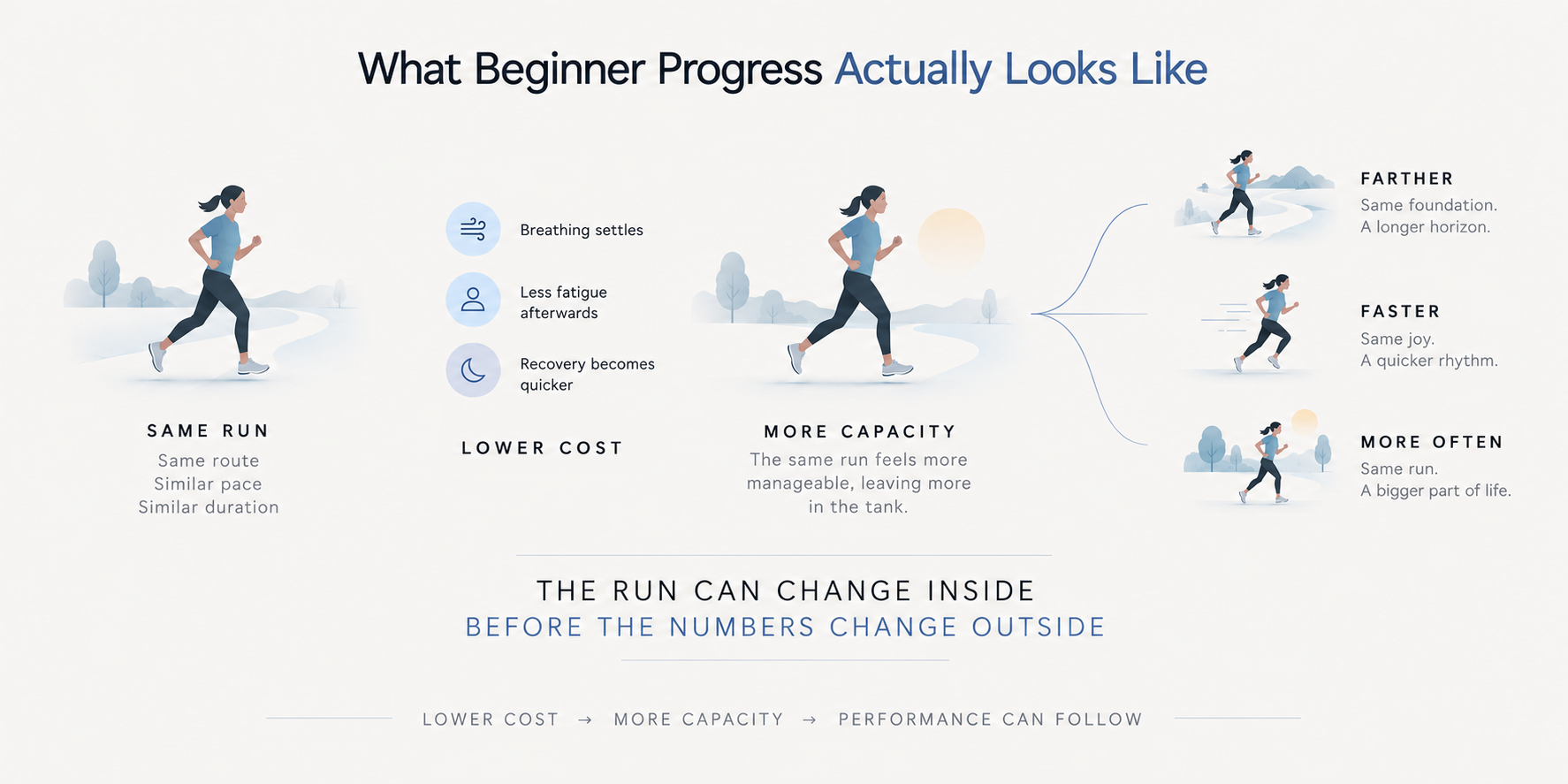
Beginner progress often appears first as a reduction in what running costs you, not an increase in what you can produce.
Beginner running progress is surprisingly easy to miss. You start running and naturally expect something to move. Perhaps the first run takes thirty minutes and covers four kilometers. A few weeks later, you look at the watch and see almost the same thing. Thirty minutes. Roughly four kilometers. The pace has barely changed.
If those are the numbers you have been using to measure improvement, it can look as though very little has happened. But the two runs may be completely different.
During the first one, your breathing became noticeable within a few minutes. The final ten minutes required concentration. Your legs felt unusually tired later that evening, and the following morning you were very aware that you had run.
A month later, you cover the same route at almost the same pace. This time your breathing settles. You stop thinking about how far remains. The run finishes without becoming a negotiation. An hour later, you are simply getting on with your day. The watch sees two similar runs. Your body does not.
I think this is one of the most important things to understand during the first months of running, because the easiest forms of progress to measure are not necessarily the first ones to arrive.
Distance is obvious. Pace is obvious. Running continuously for longer is obvious. But adaptation often begins by changing what the same amount of running costs. This is why Your First Month of Running — What to Expect is better understood as a period of familiarization rather than a short test of how quickly your performance improves. Early running progress can be happening even while the visible output changes very little.
The same run can require less breathing. Less concentration. Less recovery. Less disruption afterwards. None of those changes looks particularly impressive in a training log. Together, they mean something important. Running is becoming more ordinary to your body. And that may be the first real form of progress.
Progress Often Appears Between Runs Before It Appears During Them
There is another place beginner progress tends to hide. Between the runs. When you first start, a thirty-minute run can occupy much more than thirty minutes of your life. You notice your legs when you walk upstairs later. Perhaps you feel slightly stiff when you stand up after sitting for a while. The next morning, there is still a trace of yesterday’s run in the body. Nothing is necessarily wrong. Running is simply a relatively large event.
After several weeks, the run itself may look almost unchanged while everything around it begins to change. You finish. You shower. You eat. And then you stop thinking about the fact that you ran.
I have gradually come to think this is one of the clearest signs that a beginner is adapting well. The body is not merely becoming capable of completing the session. It is becoming better at absorbing it.
That difference matters because running fitness is not particularly useful if every run requires a disproportionate amount of recovery before you can comfortably do another one.
The Recovery Check Calculator can make this easier to notice because progress is sometimes clearer in how quickly your normal state returns than in what happened during the run itself. Eventually, this changes the shape of the whole week. A run on Tuesday no longer determines how Wednesday feels. By Thursday, you are not simply capable of running again. Running again feels normal. That gives you options.
Perhaps the same three weekly runs become easier to maintain. Later, another running day may fit naturally. A slightly longer run may stop affecting the rest of the week. Training can gradually expand because the existing training has become less expensive.
This is a different kind of progress from setting a faster pace. But it often creates the conditions that make faster running possible later. The beginner who recovers more easily has not spent a week standing still. They have increased the amount of running their life and body can comfortably absorb. And that is capacity too.
The Same Run Can Become Easier Without Becoming Slower
Eventually, progress starts becoming visible during the run too. But even then, it does not always appear where you expect it.
You may run the same familiar route at roughly the same pace and notice that breathing no longer rises as quickly. A hill that used to interrupt your rhythm passes without much thought. You reach the point where you normally started wondering how much farther you had to go and realize that the question never appeared.
The numbers may still be remarkably ordinary. What has changed is the relationship between those numbers and you. This is where perceived effort becomes useful.
A pace of 6:30 per kilometre is not inherently better than 6:45. But if 6:30 once required concentration and now feels relaxed enough to sustain without thinking about it, something meaningful has changed.
The Run Effort Check Calculator can help separate those two ideas. Pace tells you what you produced; effort helps describe what producing it required. For beginners, I would pay particular attention to the moments that disappear. The moment when you first become conscious of your breathing. The point where your legs begin feeling heavy. The temptation to stop at a familiar corner. The need to check the watch because you want to know how much longer you have left.
As running becomes more familiar, those moments often move farther into the run. Then some of them disappear entirely. This is easy to overlook because nothing dramatic replaces them. You simply run. That may not produce a personal best. But it tells you that the same external task is requiring less from the runner completing it. And once that happens consistently, you have created something much more useful than one unexpectedly fast day.
You have created room.
Progress Does Not Need to Appear in Every Run
Beginner progress is a trend in what running asks from you, not a promise that every run will be better than the one before it.
Once you begin noticing improvement, it is tempting to expect it to continue in a straight line.
Last Tuesday felt easier. Saturday was slightly faster. This week should therefore be better again. Then you go out for an ordinary run and everything feels strangely heavy. The pace is slower. Breathing becomes noticeable earlier. Your legs do not have the same rhythm they had a few days ago.
For a beginner, this can feel like losing progress almost immediately. But fitness does not disappear and rebuild itself from one run to the next. Sleep changes. Stress changes. Weather changes. The route changes. Previous training leaves different amounts of fatigue behind. Sometimes there is no obvious explanation at all.
That is why Why You Should Not Judge Fitness From One Workout becomes particularly important when improvement first starts becoming noticeable. A single good run does not establish a new level of fitness, and a single poor run does not remove the adaptation that came before it.
Progress becomes much easier to see when you stop comparing individual runs and begin comparing periods of running. Think about how running felt a month ago. How long did it take before breathing became uncomfortable? How much did you think about stopping? How did your legs feel later that day? How ready were you to run again? Those comparisons are usually much more informative than asking whether today’s pace was better than Tuesday’s.
There will still be unusually good runs. Enjoy them. There will also be unexpectedly poor ones. Let them pass. Once you begin looking at progress this way, a difficult day loses some of its authority. It becomes one run inside a much larger pattern. And the pattern is where adaptation lives.
Do Not Spend Every Improvement Immediately
There is a point in beginner running where progress creates its own temptation. The familiar run becomes easier. You finish with more energy. Recovery is quicker. And almost immediately, the extra capacity starts looking like something that should be used.
Perhaps you run a little farther. Then the pace begins creeping upward. A fourth running day suddenly seems reasonable. Within a few weeks, the runner who was adapting beautifully is once again finishing most runs with roughly the same level of fatigue as before.
It can feel as though the progress disappeared. Usually, something else happened. You spent it. This is one of the more interesting things about improving at running. Greater fitness does not necessarily mean that running will keep feeling easier and easier. It gives you the capacity to produce more running at a similar effort.
There is nothing wrong with eventually using that capacity. That is how training develops. But you do not have to use all of it immediately.
If thirty minutes of running has recently changed from something demanding into something comfortable, there can be real value in leaving it there for a while. Let comfortable become familiar. Let recovery become predictable. Let the new capacity settle before asking what else it can buy.
This is the same reason How To Increase Weekly Running Volume Safely? matters even when the increase you are considering seems small. Progression is not only about whether you are capable of completing more running. It is also about whether adding more preserves the adaptation you have already created.
Sometimes progress therefore looks almost absurdly uneventful. You run the same distance. At roughly the same pace. On the same number of days. And it keeps getting more manageable. Nothing in the training log is expanding. Your capacity underneath it is.
That gap between what you could do and what you are currently asking yourself to do is not wasted fitness. It is room to progress. And you do not need to fill that room the moment it appears.
Faster Pace Is Usually a Later Form of Progress
Eventually, the changes underneath the run begin appearing in the numbers. You look down after an easy run and notice that the pace was faster than usual. Not dramatically faster. You may not even have noticed while running. The important part is that you did not create that pace by trying harder. It appeared at roughly the same manageable effort.
That is very different from deciding that progress means you should run faster and then increasing the effort required to produce the number. In the first case, pace is showing you something that has already changed. In the second, pace is asking your body to create the change on demand.
This distinction is why I would not make faster running an early test of whether beginner training is working. The adaptation can be developing long before it becomes obvious as speed.
Your movement becomes more economical. The familiar effort carries you slightly farther. A pace that once required attention begins appearing naturally during an ordinary run. And because you are not forcing it, the faster pace does not necessarily bring the old recovery cost back with it.
The Running Pace Zone Calculator becomes more useful at this stage because pace is beginning to acquire context. It can help describe the running you are already capable of rather than becoming a number you need to chase.
This is also where progress can become slightly deceptive. Once you see faster numbers, they are much easier to celebrate than quieter improvements such as better recovery or lower perceived effort. So they begin receiving more attention. But the faster pace is often only the visible end of a much longer process. The important change happened earlier.
Running became familiar enough that your body could produce more from roughly the same effort.
Beginner progress does not always mean learning to work harder. Very often, it means getting more running from the effort you already know.
And when faster pace eventually appears that way, you do not need to chase it. You have already earned it.
Conclusion
Beginner progress becomes much easier to recognize once you stop expecting it to look like constant improvement in performance. At first, very little may change on the watch. You run roughly the same distance. At roughly the same pace. Perhaps even on exactly the same route. But the run begins occupying less space in your body and in your day.
Breathing settles earlier. The difficult part arrives later. Your legs recover sooner. You stop needing to think about every minute of the run. And when the next running day arrives, you are increasingly ready to do it again. Those changes are easy to dismiss because none of them looks like a personal best.
But together they tell you that running is becoming less expensive. That is where I would look for progress first. Later, that reduced cost creates capacity. You can run farther. You can run more often. Or the same comfortable effort begins producing a faster pace. At that point, progress becomes much easier to see. The mistake is assuming that the visible improvement was where the process began.
Usually, it began much earlier, during all those ordinary runs that gradually became easier to absorb.
This is also why beginner equipment does not need to progress alongside fitness. You do not need faster shoes because your pace has improved by a few seconds per kilometre. A comfortable everyday shoe can remain useful across a surprisingly wide range of running, which is the role considered in Best Running Shoes for Daily Training 2026.
There will still be difficult runs. There will be weeks when the numbers barely move. And eventually, as you become fitter, you may deliberately use that fitness to run farther or faster and discover that running feels difficult again.
That does not mean progress has stopped. The question is no longer simply whether running feels easy. It is what the same amount of effort can now produce. A few months earlier, that effort may have carried you through twenty difficult minutes. Later, it may carry you comfortably through thirty.
Eventually, it may carry you much farther or much faster. The effort is still yours. What changes is what your body can do with it.
Frequently Asked Questions
How quickly should a beginner improve at running?
There is no reliable weekly rate of improvement. Some changes can appear within the first few weeks, while others develop gradually over months. Early progress is often easier to see in breathing, recovery and how manageable familiar runs feel than in pace or distance.
How do I know if I am getting better at running?
Compare similar runs across several weeks rather than consecutive sessions. Notice whether the same running requires less effort, whether breathing settles more easily, whether difficult moments occur later and whether you recover more quickly afterwards.
Is running the same pace every week a sign that I am not improving?
No. The same pace can represent very different levels of effort. If a familiar pace is becoming easier to sustain and recover from, you may be improving even while the number on the watch remains almost unchanged.
Should beginner runners try to get faster every week?
No. Trying to produce faster numbers can increase effort without representing an improvement in fitness. It is usually more useful to allow manageable running to become familiar and let pace change as your capacity develops.
Is being able to run farther always progress?
It can be, but only completing a longer distance does not tell you how well you absorbed it. A useful progression should remain manageable enough that the additional running does not continually disrupt recovery or the rest of your training.
Why do I sometimes run worse even though I am getting fitter?
Individual runs are affected by fatigue, sleep, stress, weather, terrain and many other short-term factors. Fitness develops across longer periods, so one slower or more difficult run does not necessarily indicate that your progress has reversed.
When should a beginner increase their training?
A good time to consider progression is when the current amount of running has become repeatable and recovery is predictable. The Training Load Check Calculator can be useful when deciding whether adding distance, duration or another running day represents a modest change or a larger increase than it initially appears.
Does running ever become easy?
A familiar pace can certainly become much easier. But runners often use their growing fitness to run farther or faster, so perceived effort does not necessarily keep falling forever. Fitness gives you more capacity; what you do with that capacity determines how the running eventually feels.