
Should You Start Where You Left Off?
What you could do before the break describes your history. It does not prescribe your starting point after it.
Returning to running creates a strange problem that beginners do not have. You already know what your normal used to be. Perhaps you ran four or five times a week.
An ordinary weekday run was eight or ten kilometres. The weekend had something longer. You knew your easy pace without thinking about it, and forty minutes of running barely registered as a significant session.
Then running stopped. Maybe for six months. Maybe for three years. Eventually, you decide to come back. The obvious question is where to begin. And the old training provides a very tempting answer.
You know that you used to run ten kilometer’s comfortably, so perhaps five kilometres already feels conservative. You used to run five days a week, so three seems almost excessively cautious. Even your old easy pace is still sitting there in your memory, quietly defining what proper running looks like.
The problem is that your old training describes a body that had already adapted to doing it. Those ten-kilometer runs were not ordinary because ten kilometers is inherently an ordinary distance. They became ordinary because you had accumulated enough running for your body to treat them that way.
The same was true of your weekly mileage, your running frequency and your pace. After a substantial break, you cannot assume that all of those adaptations have remained simply because you remember them.
This is the distinction underneath How to Start Running Again After Years Away. Previous experience gives you useful knowledge, but it does not give you an automatic starting volume. In fact, experience can make the first weeks slightly more deceptive. You know how to run. You understand pacing. Your movement may become familiar remarkably quickly.
So the first few runs can feel much more capable than the amount of recent running underneath them would suggest. That is why I would not start by asking: How much of my old training can I still do? I would ask something quieter.How much running can I do now and be ready to do again? Those questions can produce very different starting points.
What You Can Still Do Is Not Necessarily Where You Should Start
One of the confusing things about returning to running is that you may still be capable of quite a lot.
Suppose you used to run ten kilometers several times a week. After a long break, you decide to test five kilometers and discover that it goes surprisingly well. The breathing is more noticeable than before and the legs feel slightly rusty, but you complete the distance without any real difficulty.
That immediately changes your perception of where you are. Five kilometers no longer looks like a starting point. If you can already do that, perhaps seven or eight kilometers would be more appropriate. Perhaps the old ten-kilometer run is not very far away at all. You may be completely right about what you can complete. But completing a run answers only one question.
It tells you that your body was capable of producing that amount of running today. It does not tell you how much that run cost, how quickly you will recover from it or whether the same distance still works when it becomes part of a full week of running.
That difference matters enormously during a return.
A runner with years of previous experience can often reach surprisingly far into their old fitness for a single session. Movement comes back. Aerobic fitness may have been partly preserved through other activities. Experience helps you regulate effort much better than a complete beginner could.
The Recovery Check Calculator becomes useful here because the information you need increasingly appears after the run. How do the legs feel later that day? What remains the following morning? When the next planned run arrives, are you genuinely ready for it or merely capable of doing it?
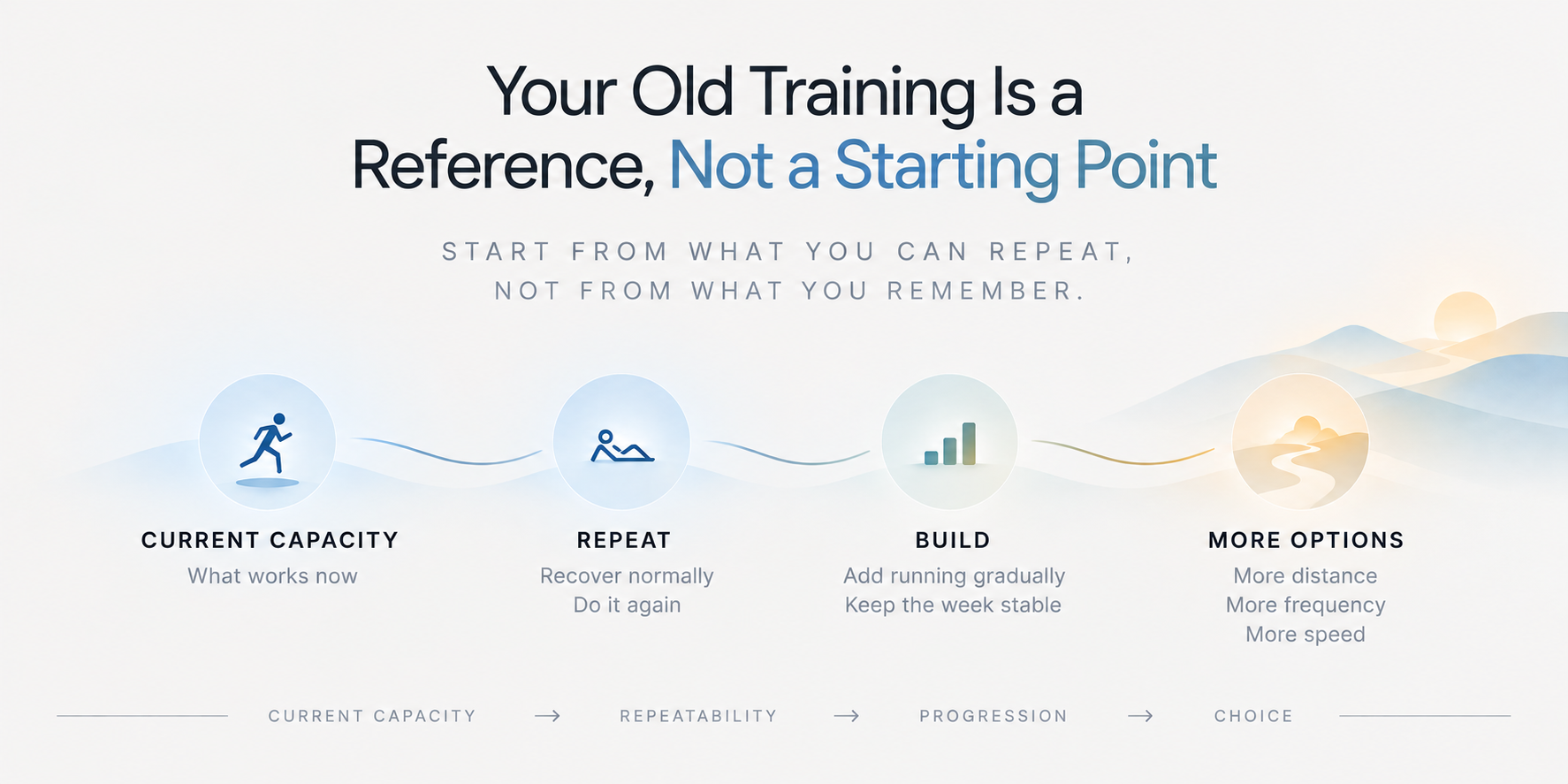
This gives us a much better definition of a starting point. Your starting point is not the maximum amount of old running you can successfully reproduce once. It is the amount of current running that leaves enough capacity for the training around it to keep working.
That may initially look almost absurdly modest compared with your old training. But if you can repeat it comfortably, it gives you somewhere to build from. A bigger first week only tells you how much of the past you can still reach. A repeatable first week begins telling you what you can build next.
Your Old Weekly Mileage Is Probably the Wrong Number to Rebuild First
Weekly mileage has a way of becoming part of a runner’s identity. If you spent years running 40, 50 or 70 kilometers a week, that number can remain surprisingly powerful even after the training itself has disappeared. It becomes the reference point against which the comeback is measured.
That can quietly distort the first weeks. Twenty kilometers may feel like almost nothing because you remember doing twice as much. Three running days can look incomplete because five used to be normal. The temptation is to close that gap as efficiently as possible.
But your old weekly mileage was never just a collection of kilometers. It represented a level of training your body had gradually learned to absorb. You could run on Tuesday partly because Monday had not left much behind. You could make Sunday longer because the previous five or six days existed inside a structure you had already adapted to.
When you return, it makes more sense to rebuild that relationship than the number itself.
I would pay attention to what happens when a week repeats. If three runs fit comfortably into one week, can essentially the same three runs fit into the next without the second week feeling heavier? If you add a little distance somewhere, does the rest of the week continue behaving normally? That tells you much more than how quickly the weekly total is approaching an old number.
This is also where How To Increase Weekly Running Volume Safely? becomes more useful than the old training log. The purpose of progression is not to recover lost kilometres as quickly as possible. It is to increase running while preserving your ability to absorb what you have already rebuilt.
There is something psychologically reassuring about this approach too. You stop treating every lower-mileage week as evidence that you are still far from where you were. Instead, each stable week becomes a piece of training capacity that belongs to you again.
Perhaps 25 kilometers becomes ordinary. Then 30 does. Later, 35 may arrive without creating much disruption at all. At some point you may reach your old weekly mileage. You may also discover that you no longer need to.
The important thing is that by then the number will once again describe your training rather than dictate it.
Do Not Restore Pace, Distance and Frequency at the Same Time
A comeback can accelerate almost without you noticing because there is more than one way to make running bigger.
You can make an individual run longer. You can run more often. You can allow the pace to increase. Later, you can reintroduce harder sessions. None of these changes needs to look particularly dramatic on its own, yet together they can transform the training week very quickly.
This is especially easy to do when several parts of your old running begin returning naturally. Your comfortable pace improves without much effort. A five-kilometer run becomes seven because stopping earlier feels unnecessary. Then an additional running day seems reasonable because recovery has been good. Within a short period, almost every dimension of training has moved upward.
The individual decisions can all make sense while the combined change is still too large.
That is why I think returning runners benefit from allowing one part of the training to move while the others remain relatively boring. If distance is increasing, frequency does not also need to rush upward. If another running day has just been added, the existing runs can remain familiar for a while. And when faster running eventually returns, it does not need to arrive during the same period in which weekly volume is expanding rapidly.
The Training Load Check Calculator can help make this visible because the stress of a comeback is rarely contained in one obviously excessive run. More often, it appears through several reasonable increases accumulating on top of each other.
There is no need to turn this into a rigid progression formula. The point is simply to leave enough stability in the week that you can tell how your body is responding to the thing you changed.
Your previous training history can make every individual step look familiar.
What matters now is whether the combination is familiar to your current body.
Do Not Rebuild the Exact Runner You Used to Be
What you could do before the break describes your history. It does not prescribe your starting point after it.
There is another assumption hidden inside the idea of starting where you left off: that the destination should be the same place too.
Sometimes it will be. If you enjoyed your old training, it fitted your life and it produced the kind of running you wanted, there may be every reason to move gradually back toward it. But a long break also creates distance from habits that once seemed unquestionable.
Perhaps five running days worked because your schedule was different. Perhaps the long run gradually became longer because that was simply what you had always done. Maybe certain hard sessions remained in the week long after you stopped being sure what they were adding. Even your old easy pace may have become a number you protected more carefully than the effort it was supposed to represent.
Coming back gives you an unusual opportunity to notice these things.
Instead of reconstructing the old schedule piece by piece, you can watch what your current running actually needs. Three days may naturally become four. A longer run may gradually emerge because the shorter ones no longer create much fatigue. Faster running can return when ordinary running feels established enough to support it.
The framework in Build a Weekly Running Structure is useful at this stage because a training week does not need to be inherited from your previous one. It can be rebuilt around the runner you are now, the time you have now and the training you are currently ready to absorb.
I suspect this is one of the more valuable parts of returning after a long break. At first, losing old fitness can make the break feel like something you simply need to undo. But you are not required to reverse time.
You already have the experience of the runner you used to be. You can keep the parts that still make sense without treating every old habit as something that must be recovered.
The comeback then becomes less about recreating an old training log and more about discovering which parts of that runner still belong in the next version of your running.
Let the Old Training Become an Option, Not a Target
Eventually, something interesting happens during a successful return. The training you used to do stops looking impossible.
The distances are available again. Running several days a week no longer creates the same recovery cost. Familiar paces begin appearing without being forced. You may even reach the point where an old workout would fit comfortably into the week.
This is where I would allow the past back into the conversation. Not because you now need to reproduce it, but because you finally have enough current running underneath you to make a meaningful choice.
Perhaps you genuinely miss the longer weekend runs and want to rebuild them. Perhaps regular faster sessions were part of what made running interesting. Maybe you have another race in mind and the old training structure happens to suit what you want to prepare for.
Those are very different reasons from increasing training simply because the numbers used to be higher.
The distinction is subtle, but important. Early in a comeback, your old training can behave almost like an instruction: this is what a real week of running should look like. Later, once your current training has become stable, the same history becomes useful information. You can borrow from it without being controlled by it.
This is also why How Fast Does Running Fitness Come Back? matters beyond the question of fitness itself. Different parts of your running return at different speeds, and the moment an old pace becomes possible is not necessarily the moment the entire old training structure becomes appropriate.
By the time that structure genuinely fits again, you may see it differently anyway. You may rebuild almost exactly what you had before. You may keep half of it and change the rest.
Or you may discover that the training you are doing now suits you better. That is a much stronger position to reach than simply getting back to where you left off.
Your old running is available again. It just no longer has to decide what comes next.
Conclusion
You probably should not start where you left off. But that does not mean your previous running is irrelevant.
It gives you experience. You already know what different efforts feel like, how a training week fits together and what kind of running you enjoy. Some of that knowledge may return almost immediately, even while your physical capacity is still catching up.
The mistake is turning that experience into a starting prescription.
Your old weekly mileage was appropriate for a body that had adapted to it. Your old long run belonged inside a training week that could support it. Even your easy pace reflected fitness and running economy built through months or years of consistent running.
Those numbers can become useful again. They simply do not need to lead the comeback. Start with running you can absorb. Let it become repeatable. Change one part of the week without feeling compelled to restore all the others. As your capacity grows, the old distances, frequencies and paces can gradually become available again.
And while that happens, it is worth keeping the practical side equally uncomplicated. Comfortable, versatile shoes are enough for most of this rebuilding, which is why Best Running Shoes for Daily Training 2026 is a more natural place to begin than trying to recreate an old rotation built around workouts you are not yet doing.
Eventually, you may arrive very close to where you left off. The difference is that you will have arrived there from the present rather than trying to jump there from the past. Your previous running tells you what you once built. Your current running tells you where to build from now.
Frequently Asked Questions
Should I start running at the same mileage I was doing before my break?
Usually, your previous weekly mileage is better treated as historical context than as an immediate target. The amount you can safely rebuild depends on how long you were away, what activity you maintained during the break and how your current running is being absorbed. A lower but repeatable volume gives you a more useful foundation than immediately reproducing one large week.
What if my old running distance still feels easy?
That is encouraging, but the run itself is only part of the picture. Notice how you recover and whether similar running remains comfortable across the rest of the week. Being capable of completing an old distance once does not necessarily mean it is ready to become your normal training distance again.
Should I use my old easy pace when I start running again?
You can use it as a reference, but it should not control the run. If the same pace now requires noticeably more effort, allow the pace to change. Easy running is defined more usefully by the effort it creates than by whether the watch displays a familiar number.
How many days a week should I run when returning?
There is no universal number that applies to every returning runner. Begin with a frequency that leaves meaningful recovery between runs and see how the whole week behaves. Additional running days become much easier to justify once the existing schedule feels consistently manageable.
Can I return faster if I stayed fit during the break?
Maintaining fitness through cycling, walking, strength training or another sport can make the aerobic side of returning easier. It does not necessarily preserve all of the running-specific tolerance that comes from repeated impact, so it is still useful to allow running volume to rebuild progressively.
When should I increase my running again?
A useful sign is that your current training has stopped feeling like something you are recovering from and has started feeling normal. Runs are manageable, recovery is predictable and repeating a similar week does not produce increasing fatigue. Progression can then be small enough that this stability remains intact.
When can I return to speed work?
There is no need to restore speed work simply because it appeared in your old schedule. Let ordinary running become repeatable first. Faster running is much easier to integrate when the surrounding week already has enough capacity to absorb it.
Should I follow my old training plan?
It can be useful as a record of what previously worked, but it does not automatically describe what is appropriate now. Your available time, goals, fitness and recovery may all be different. Treat the old plan as a source of ideas rather than instructions.
How do I know if I have started with too much running?
One difficult run is not always the clearest signal. Pay attention to what accumulates: persistent heaviness, recovery taking progressively longer, ordinary runs becoming harder and the next week feeling more difficult than the previous one. The pattern across several runs is usually more informative than any single session.