
How to Start Running Again After Years Away
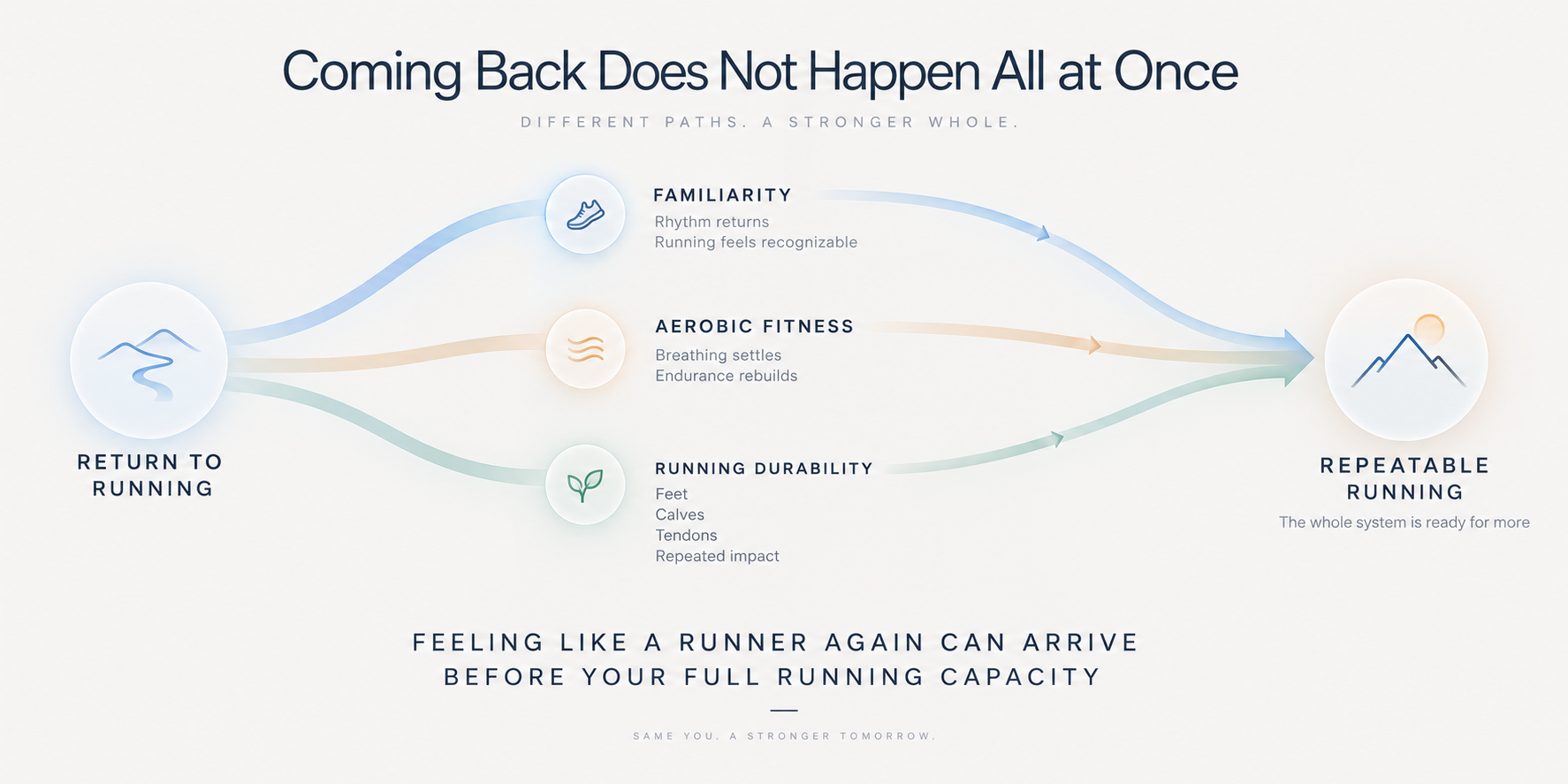
The hardest part of returning to running is often not learning how to run again. It is accepting that your memory of running may return faster than your running capacity.
Coming back to running after several years away feels very different from starting for the first time.
You already know what running is supposed to feel like. You remember settling into a rhythm without thinking about every step. You remember familiar routes, comfortable distances and perhaps a pace that once felt completely ordinary.
Then you go running again. For the first few minutes, something encouraging happens. The movement feels surprisingly familiar. Your legs remember more than you expected. You find a rhythm. Perhaps you glance at the watch and realize that you are not moving particularly slowly either.
Then the rest of the body begins catching up with the idea. Breathing becomes more noticeable. The legs start feeling heavier. The pace that initially felt natural becomes increasingly expensive.
And suddenly there is a strange mismatch between what running remembers like and what your current body is ready to sustain. I think this is what makes returning after years away deceptively difficult.
A complete beginner has very little reference point. A returning runner has one. The problem is that the reference point belongs to a different version of the runner.
Your previous fitness may have been built through months or years of consistent training. Your tendons, muscles and bones were accustomed to repeated running impact. Your aerobic system supported distances that eventually felt normal because you had accumulated enough running for them to become normal.
Time away changes that. How much it changes depends on what happened during those years. Someone who remained active through cycling, hiking or another endurance sport may return with substantial general fitness. Someone who became mostly sedentary may be rebuilding much more.
But neither person can simply assume that old running capacity is waiting underneath the first few sessions.
This is where How to Start Running From Scratch can still be useful even when you do not feel like a beginner. The underlying principle is the same: begin with an amount of running your current body is ready to repeat.
The important word is current. Not the runner you remember. Not the distance you used to consider short. Not the pace that still looks familiar when you see it on the watch. The runner standing at the door today. That is the runner you are training now.
Your Old Easy Pace May Not Be Easy Anymore
Pace is one of the quickest ways the old runner can interfere with the new one. You remember what easy running used to look like. Perhaps 5:30 per kilometer was relaxed. Perhaps it was 6:00. The number itself does not matter very much. What matters is that it became part of your internal definition of running.
Years later, you start again and see 6:30 on the watch. It feels slow. Not necessarily because the effort is easy, but because you are comparing the number with a pace that once belonged to you.
So you gently accelerate. The movement may even feel better. Your stride becomes more familiar and for a while you feel more like the runner you remember. But familiarity of movement and sustainability of effort are not the same thing.
Ten or fifteen minutes later, breathing has changed. The run that was supposed to be an easy return has quietly become moderate work. This is where returning runners sometimes need to do something psychologically harder than complete the run.
They need to let the old pace go. Not permanently. You are not deciding that you will never run that speed again. You are simply refusing to use an old performance level to define what easy running should feel like today.
The same principle behind What an Easy Run Should Feel Like becomes especially useful on a return because effort gives you a current reference point. Pace gives you a historical one.
For the first weeks, I would trust the current reference much more. That may produce some surprisingly slow numbers. It may also mean walking on hills that you once ran without thinking. A familiar five-kilometre route might need to become shorter, or contain a walking break even though you used to consider five kilometres an ordinary recovery run.
None of this erases what you did before. And you do not need to pretend that you are delighted about being slower.
You simply need to separate where you were from where training needs to begin.
If you can do that, pace becomes useful again later. Instead of trying to recreate an old number, you can watch a much more interesting process unfold. The same manageable effort begins carrying you faster. And this time, the pace is describing the fitness you have rebuilt rather than demanding that you prove you still have it.
Your Fitness May Return Faster Than Your Running Durability
There is another trap waiting for returning runners, particularly those who stayed active while they were away.
Your cardiovascular fitness may not feel completely gone.
Perhaps you cycled regularly. You walked a lot. You went to the gym, skied, hiked or simply maintained a generally active life.
When you return to running, that fitness can be reassuring. Your breathing settles reasonably well. You can keep going longer than expected. After a few runs, you may already feel as though the engine is coming back.
The legs can tell a different story. Running exposes the body to thousands of repeated impacts. Calves, feet, Achilles tendons, knees and the surrounding tissues have to become accustomed not merely to exercise, but specifically to running again.
General fitness does not completely prepare them for that. This creates an unusual situation where you may have enough aerobic capacity to run for forty minutes before your running-specific durability is ready to absorb forty minutes repeatedly.
And because the run itself feels manageable, the limitation can be difficult to notice. It often appears afterwards. A little more stiffness the following morning. Calves that still feel loaded when the next run begins. A small ache that disappears once you warm up and therefore seems easy to dismiss. Nothing necessarily dramatic. Just evidence that one part of the system is adapting more slowly than another.
The Recovery Check Calculator is useful during this phase because the question is not only how good you felt while running. What happens between runs tells you whether the amount you are doing is becoming repeatable.
I would pay particular attention to that if your endurance returns quickly. It is tempting to treat good breathing as permission to extend the run.
Instead, let the legs have a vote. Finish some runs while the cardiovascular system still feels capable of considerably more. Then see what happens the next day. And the day after that. The goal during a return is not to discover how much running your remaining fitness allows you to complete.
It is to discover how much running your whole body is currently ready to absorb. Those two numbers may be quite different at first. Giving them time to meet again is part of coming back.
Do Not Try to Recover Lost Time
Once the first few runs go reasonably well, returning can accelerate surprisingly quickly. A run that felt awkward on Monday feels more natural a week later. The familiar route begins looking manageable again.
You remember how you used to structure your week, and suddenly the old training starts appearing not only as a memory but as a possibility. Perhaps you once ran five days a week. Now you are running three. Perhaps your normal run used to be ten kilometers. Now you stop after five or six. It becomes tempting to close that gap. One more running day. A slightly longer weekend run. Another kilometer because today’s legs feel good.
Individually, none of those decisions looks particularly aggressive. Together, they can rebuild training much faster than your body is rebuilding its ability to absorb it.
This is where I would be especially careful with the phrase getting back to where I was. It creates the impression that the old training is your destination and the current training is merely an inconvenient path back to it. But you do not owe your previous running anything. You are not behind schedule. There are no missed kilometres to repay.
The principles in How To Increase Weekly Running Volume Safely? become particularly relevant during a comeback because returning runners can increase several dimensions almost without noticing: frequency rises, individual runs become longer, and pace improves at the same time.
Your body experiences the combined change. It does not separate them into three reasonable decisions. So when running starts feeling better, I would resist using every improvement immediately. Let three runs remain three runs for a while. Let five kilometers become ordinary before it becomes eight. Let the easier breathing be something you notice rather than something you immediately convert into faster pace.
Eventually, that may take you surprisingly close to what you once did. It may even take you beyond it. But there is no advantage in reaching your old training sooner if getting there makes the new training harder to sustain.
You are not recovering lost time. You are creating another period of running.
Let Familiarity Return Before You Add Structure
If you used to run seriously, you probably remember more than routes and paces. You remember training. Long runs on weekends. Easy days between harder sessions. Tempo runs, intervals, hills or whatever structure belonged to your old routine.
Once ordinary running begins feeling comfortable again, those sessions can start calling surprisingly early. Partly because they are familiar. Going out for twenty-five easy minutes may feel like rehabilitation. Completing a proper workout feels like being a runner again.
I would resist that distinction. During the first part of a return, ordinary running is already training. Your body is relearning the impact. Your movement is becoming economical again. The gap between one run and the next is becoming easier to absorb. None of that requires a workout name.
And there is something useful about leaving the training simple for long enough that you can observe what is actually returning.
Can you run three times this week and arrive at the third run with normal legs? Does an easy run stay easy rather than gradually becoming work? Can you extend one run slightly without feeling it for several days afterwards?
Those questions tell you much more about the state of your return than whether you can still complete an interval session you remember doing years ago.
This is where Training Load Check Calculator can be useful. A returning runner may see each individual session as modest compared with previous training, while the important question is how much total demand the current body is absorbing.
There will be time to make the week more sophisticated. A longer run can emerge. Faster running can become deliberate again. Strength work and other training can find their places around it. But I would let those things arrive because simple running has stopped asking very much from you, not because your old training schedule says they belong there.
Your previous experience is still valuable. It can help you understand effort, recognize rhythm and eventually rebuild training intelligently. It just should not be allowed to set the timetable.
First let running become familiar again. Then give that familiar running somewhere to develop.
Your First Good Runs Can Be More Dangerous Than the Difficult Ones
The difficult comeback runs usually regulate themselves. You feel rusty. Breathing is more noticeable than you remember.
The legs become tired early. There is very little temptation to pretend that you are already back. The more interesting moment comes later. One day, everything suddenly works.
You step outside and the stride feels familiar almost immediately. The pace comes naturally. Breathing stays controlled. A route that felt surprisingly long two weeks earlier passes without much thought.
For the first time, you feel like yourself again. That can be an important moment psychologically. It can also be a terrible moment to redesign the training plan. One good run makes the next step look obvious. Perhaps you extend the run because there is plenty left. Perhaps tomorrow becomes another running day. Perhaps you start thinking that the cautious return was unnecessary and your previous fitness has simply switched back on.
I understand the temptation. A good run feels like evidence. But it is evidence of one good run. The more useful question is whether this version of running has become repeatable.
That is why Why You Should Not Judge Fitness From One Workout matters just as much during a comeback as it does when training is going badly. We usually think about that principle after a disappointing session, but unusually good sessions can distort our judgement too.
Let the good run happen. Enjoy the fact that running suddenly felt familiar again. Then leave it alone. Go home with something left. Follow the recovery you had already planned. See whether the next run feels similarly normal. If it does, and then another does, you have learned something much more valuable than you learned from the first one.
You are not merely capable of producing your old running for an afternoon. Some of that running is beginning to belong to you again. There is a subtle difference between those two things, but I think it defines a successful return. You do not know that you are back because one run finally feels like the old days. You know the return is working when ordinary running stops feeling like a comeback at all.
Conclusion
Coming back to running after years away creates an unusual relationship with progress. You are moving forward while constantly remembering something behind you.
A pace you once ran easily. A distance that used to feel short. A weekly routine that once seemed completely normal.
Those memories are not useless. They are part of your running experience, and some of what you learned may return surprisingly quickly. But they are poor instructions for how much running you should do today.
Your current body has its own starting point. The most useful thing you can do is allow that starting point to be real. Run slowly enough that effort remains manageable. Finish some sessions knowing you could have continued. Give the legs time to become accustomed to running impact again. Let several good runs accumulate before deciding that one particularly good day has changed everything.
And when the old pace begins appearing naturally, let it arrive without chasing it. There is something encouraging about this too. You are not trying to recreate your first experience of becoming a runner. You already know that ordinary runs can eventually feel ordinary. You know that distances which currently seem demanding can become familiar. You know that pace can improve without forcing every run to become harder.
The task is simply to give that process enough time to happen again.
The same restraint applies to equipment. Returning runners sometimes feel that they need to rebuild the old running setup along with the old training, but usually they do not. A comfortable, versatile daily shoe is enough for most of this phase, and Best Running Shoes for Daily Training 2026 looks at exactly that kind of everyday running shoe.
Perhaps you eventually return to exactly the runner you remember. Perhaps you become faster. Perhaps your priorities are completely different this time and you never return to the old mileage at all.
None of those outcomes defines whether the comeback worked. At some point, you will stop comparing every run with the past. You will simply go running. That may be the moment when the comeback is actually complete.
Frequently Asked Questions
How should I start running again after years away?
Begin with an amount of running that feels manageable for your current body rather than trying to reproduce your previous routine. Keep the first weeks simple, allow recovery between runs and judge progression by how well you are absorbing the running rather than how quickly old distances return.
How many days a week should I run when returning?
Two or three running days can be a sensible starting point for many returning runners, but your previous experience does not automatically determine your current frequency. Leave enough space between runs to see how your body responds before adding another day.
Should I use run-walk intervals if I used to be an experienced runner?
Yes, if they help keep the current effort manageable. Walking is not reserved for complete beginners. It can be a useful way to rebuild running-specific tolerance without forcing continuous running simply because you were once capable of it.
How long does it take to regain running fitness?
There is no single timetable. Your return will depend on how long you were away, how active you remained, your previous running history and how your body responds to running again. Cardiovascular fitness and running-specific durability may also return at different rates.
Why does my old easy pace feel so hard?
The pace was easy because it belonged to the fitness and running-specific adaptation you had at the time. After years away, the same number can require substantially more effort even though the movement itself still feels familiar.
Should I follow my old training plan?
Usually not as a starting point. Your old plan was built around a different level of running capacity. Its general structure may eventually become useful again, but your first weeks back should be guided by what your current body can repeatedly absorb.
What should I do if a comeback run suddenly feels unusually hard?
One difficult run does not necessarily mean the return is going badly. Consider recent running, recovery, sleep and how unusual the feeling is before deciding what comes next. The Today’s Run Decision Calculator can help frame that decision when you are unsure whether the next run should continue as planned or be reduced.
When can I start speed work again?
There is no need to attach a particular week to it. Faster training makes more sense once ordinary running has become consistently manageable, recovery is predictable and several weeks of running have established that your body is tolerating the current load well.
Will my previous running fitness come back faster the second time?
Previous running experience can make parts of the return feel familiar quickly, particularly movement, pacing awareness and understanding of effort. But that does not guarantee that every aspect of fitness or tissue tolerance will return at the same rate. Treat what you can currently repeat as more informative than what you remember being able to do.