
Why Running Feels Harder Than You Remember
Your old pace is a memory of what a familiar effort once produced, not a definition of what that effort should produce today.
Coming back to running can be surprisingly confusing when you remember being reasonably good at it.
You may remember heading out for an ordinary run without thinking much about the first kilometre. You remember settling into a pace, letting the distance accumulate and finishing with the feeling that you had been running rather than constantly managing the act of running. Even harder sessions tend to survive in memory as something familiar: demanding, certainly, but understandable.
Then you start again and the experience does not quite match.
Your breathing becomes noticeable earlier than expected. A pace that looks slow compared with your old training can require more concentration than it seems to deserve. Your legs may feel awkward or heavy, and a distance that once barely registered as a training session can suddenly feel like a substantial run.
That difference can be unsettling because your memory gives you a very convincing reference point. You know what running used to feel like, and the movement itself is still familiar enough that part of you expects the old experience to appear as soon as you put your shoes on.
But memory and current running capacity do not return in the same way. As we explored in Returning to Running After a Long Break, previous experience is a genuine advantage. You have not forgotten everything simply because you stopped running. You may still understand pacing, recognize different levels of effort and move with far more confidence than someone taking their first running steps.
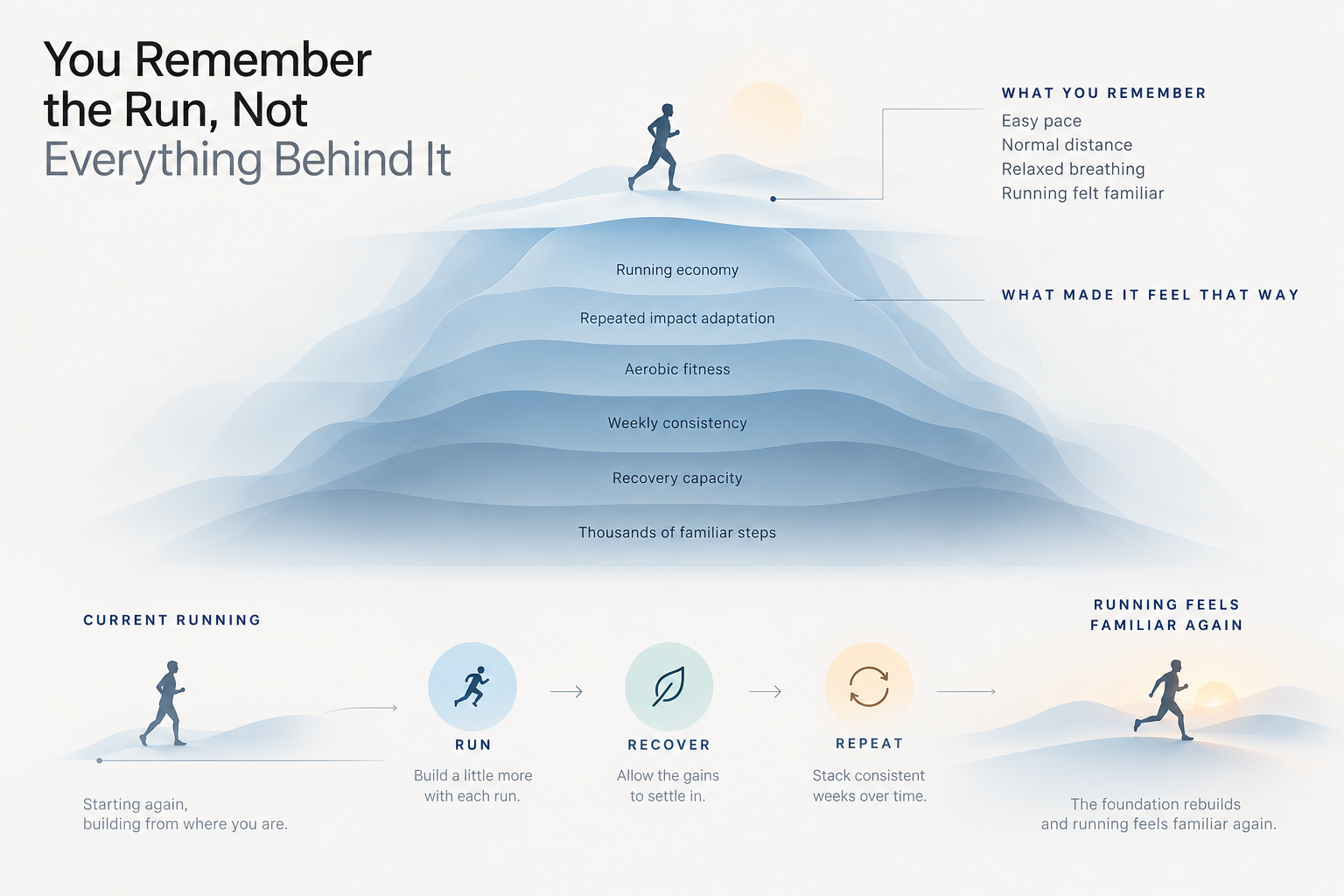
What you remember, however, is not just running. You remember running with a body that had already adapted to it.
That distinction explains much of the disappointment people feel during a comeback. The first weeks are not necessarily showing you how much running ability you have lost. They are showing you what running feels like before all the small adaptations that once made it ordinary have had time to return.
And because those adaptations used to work quietly in the background, you may not remember how much they were doing for you.
You Remember the Adapted Version of Running
Memory is selective in a way that can make returning to running particularly deceptive.
You probably do not remember every ordinary Tuesday when your legs felt slightly flat, the first few weeks of a training cycle when your rhythm was still developing, or all the uneventful runs that gradually made later running feel easier. What tends to remain is a more general impression of yourself as a runner: the distances that were normal, the pace you usually saw on your watch and the level of effort you associated with an easy day.
That memory was built after hundreds or perhaps thousands of kilometres of adaptation.
By then, running economy had improved, your legs were accustomed to repeated impact and your cardiovascular system was familiar with supplying a sustained running effort. Even the movement itself required less attention. None of these things needed to announce themselves during every run. Together, they simply made running feel normal.
After a break, some of that background support has changed. This is one reason the experience can resemble what beginners discover in Why Running Feels So Hard at the Beginning, even though a returning runner is clearly not a beginner. In both cases, the effort you feel is partly the cost of asking the body to do something that is not currently as well rehearsed as it may eventually become.
The difference is that a beginner has little previous running experience against which to judge that sensation. You do.
So when an easy-looking pace suddenly produces heavier breathing or tired legs, it is natural to interpret the difference as evidence that something has gone wrong. Yet the comparison itself is uneven. You are comparing today’s partially rebuilt running with the remembered experience of a body that had already spent months or years becoming good at it.
The old feeling was real. It just came with far more adaptation underneath it than memory tends to include.
Familiar Pace Can Create Unfamiliar Effort
Pace is often where the mismatch between memory and current fitness becomes most obvious.
If you used to run regularly, certain numbers on the watch can become deeply familiar. You may remember roughly where easy running sat, what pace felt steady and what happened when you began pushing toward a harder effort. Those numbers become part of your understanding of yourself as a runner, so it is tempting to use them again when you return.
The problem is that pace remembers nothing.
A kilometer completed at 5:30 per kilometre is simply a kilometre completed at that speed. It does not know that the same pace used to feel effortless, that you once ran much faster, or that you still think of it as conservative. Your body only experiences the physiological cost required to produce that pace today.
This is why returning runners sometimes slow down and are surprised that running still does not feel particularly easy. They have already made what appears to be a generous adjustment from their old pace, yet breathing remains more noticeable and the effort still feels higher than expected. The assumption is often that slowing down should immediately restore the familiar easy-running sensation.
It may not.
For a while, effort is usually the more useful reference. What an Easy Run Should Feel Like helps separate easy running from the pace you happen to associate with it. If today’s genuinely comfortable effort produces a number that would once have looked unusually slow, that number is not evidence of failure. It is simply where your current relationship between effort and pace happens to sit.
As adaptation returns, that relationship can change without being forced. The same effort begins carrying you slightly farther. A pace that once required attention becomes ordinary, and eventually you may notice familiar numbers appearing again without having deliberately chased them.
That is a very different process from trying to make today’s body reproduce yesterday’s pace. Your old pace is a memory of what a familiar effort once produced, not a definition of what that effort should produce today.
Your Breathing May Recover Before Your Legs Feel Normal
One of the stranger parts of returning to running is that different parts of the experience do not necessarily improve at the same speed.
After a few weeks, you may notice that breathing has already become more controlled. You can hold a conversation again, hills no longer produce the same sudden rise in effort and the cardiovascular side of running begins to feel reassuringly familiar. Yet your legs may still feel heavier than you remember, particularly later in a run or the following morning.
That mismatch can make fitness difficult to judge. If breathing feels good, it is easy to assume that the rest of the body should be ready for more as well. You extend the run, add another running day or increase the pace, only to discover that the cost appears later rather than during the session itself.
Running asks more than your aerobic system to adapt. Muscles, tendons and other load-bearing tissues are repeatedly absorbing and producing force, while the movement becomes more economical through repetition. These adaptations are less obvious than breathing because you cannot watch them changing on a screen or feel them working in isolation. You mostly notice the result when running begins to leave less of a footprint on the hours and days that follow.
This is why the Recovery Check Calculator can be more informative during a comeback than judging fitness from the run alone. A run that feels surprisingly comfortable while you are doing it may still be slightly ahead of what your current training structure can absorb.
Over time, the pieces begin to align. Comfortable breathing is accompanied by legs that remain more responsive, recovery becomes less noticeable and another run no longer feels like something the week has to make room for.
That is when running starts to resemble the version you remember — not simply because you can produce the movement again, but because your body has become better at living with it.
The First Part of a Run May Feel Harder Than It Used To
There is another small difference that returning runners often notice: getting into a run can take longer.
When running was deeply established, the transition from everyday movement to running may have felt almost automatic. You started, gave the body a few minutes to settle and soon stopped paying much attention to the mechanics of what was happening. After a long break, those opening minutes can feel surprisingly prominent. The stride may seem stiff, breathing can feel slightly out of proportion to the pace and the whole activity requires more attention than you remember.
That does not necessarily tell you how the rest of the run will feel. As regular running returns, the body becomes familiar again with moving from rest into sustained effort. The rhythm of the stride settles, breathing catches up with the demand and the initial stiffness often fades. A run that feels awkward for the first ten minutes can become perfectly comfortable once everything has had time to organize itself.
The difficulty comes when those opening sensations are treated as an immediate verdict on fitness. A returning runner may speed up to search for a more familiar rhythm, or become discouraged because even the beginning of an easy run feels harder than expected. Neither response gives the body much opportunity to settle into the effort it is currently capable of sustaining.
This is one reason Run Effort Check Calculator can be useful when old pace and present sensations are giving you conflicting messages. The question is not whether the first kilometre feels as effortless as you remember. It is whether the run settles into an effort that remains controlled and appropriate once you are properly moving.
I think this is one of the quieter signs that running is returning. You stop needing the first few minutes to feel good. You know that the run is allowed to find its rhythm.
Do Not Mistake Harder for Wrong
Running does not have to feel like you remember before your comeback can be working.
When running feels harder than you remember, it is easy to assume that something about the comeback needs fixing.
Perhaps you are returning too quickly. Perhaps your fitness has disappeared more completely than expected. Perhaps you should slow down even further, change the structure of the week or wait until running feels better before allowing yourself to think of the return as successful.
Sometimes an adjustment really is needed. Persistent fatigue, worsening recovery or a training load that becomes harder to absorb are useful signals, and How to Tell If Your Training Load Is Too High (Without Metrics) can help distinguish those patterns from the ordinary discomfort of rebuilding.
But running feeling harder than you remember is not, by itself, evidence that the training is wrong. There is a simpler explanation that is easy to overlook: running is currently costing you more. Your body is using more of its available capacity to produce a run that once required less of it. You notice the breathing, the legs and the effort because there is less spare capacity around them.
That changes with adaptation.
The interesting part is that you may not notice the change happening from one run to the next. There is rarely a morning when you suddenly step outside and discover that running has become familiar again. Instead, the same routes gradually require less attention. The first kilometres settle sooner. Recovery occupies less of the following day, and distances that initially felt substantial stop carrying the same psychological weight.
This is also why constantly testing whether your old fitness has returned can obscure the progress that is already happening. If every improvement is immediately converted into more pace or more distance, running can continue to feel difficult even while your capacity is increasing.
Running does not have to feel like you remember before your comeback can be working. The remembered feeling usually returns through repetition, not through trying harder to recreate it.
Let the Familiar Feeling Return on Its Own
The awkward thing about remembering easier running is that the memory can become something you actively search for.
You head out wondering whether today will finally be the day when the stride feels light again. A good run creates optimism, while a heavier one can make it seem as though progress has stalled. Without intending to, you begin evaluating the comeback through individual runs rather than through what is changing across several weeks.
That gives each run more meaning than it deserves.
Returning fitness rarely develops in such a tidy sequence. Sleep, weather, accumulated fatigue, terrain and ordinary variation can all change how a particular run feels. Even when the overall direction is clearly positive, there will still be days when running feels strangely difficult. Why You Should Not Judge Fitness From One Workout becomes especially relevant during a comeback because the gap between expectation and sensation can make those individual days unusually persuasive.
The better signal is what gradually becomes normal. You recover more predictably. Running several times in a week no longer feels ambitious. The distance you once thought about before leaving home becomes an ordinary route, and the pace on genuinely comfortable days begins moving in the direction you remember without requiring you to push it there.
Eventually, you may realize that you have stopped asking whether running feels like it used to.
Not because every run has become easy, and not necessarily because all your old fitness has returned. The comparison simply becomes less interesting once your current running has developed enough history of its own.
That is probably the point worth waiting for.
Not the moment when you successfully recreate an old run, but the moment when the running you are doing now starts to feel familiar in its own right.
Conclusion
Running can feel surprisingly unforgiving when your strongest reference point is a version of yourself that had already spent years adapting to it.
You remember the pace, the distances and the ease with which running once fitted into the week. What is harder to remember is everything underneath that experience: the accumulated kilometres, the movement economy, the durability and the ability to recover from running without giving it much thought.
Those things can return. They simply do not return because you remember having them.
For a while, let current effort matter more than historical pace. Give individual runs time to settle, pay attention to what happens between them and allow repeated weeks to do the work that no single impressive run can accomplish. If you are rebuilding most of that consistency through ordinary easy running, Best Running Shoes for Daily Training 2026 is also the kind of simple gear choice that fits this phase well; the comeback does not require a complicated shoe rotation.
There may eventually be a morning when you notice that the pace is quicker, your breathing is quiet and the route that once felt surprisingly substantial has become completely ordinary again. More likely, you will not notice exactly when the change happened.
That is part of the point.
The familiar feeling is not something you need to chase back. Give yourself enough ordinary running, and one day you may realize it has been quietly returning all along.
Frequently Asked Questions
Why does running feel so much harder after a break?
Your memory of running was formed when your body was already adapted to regular training. After a break, you may retain much of your experience and understanding of effort while some of the physical adaptations that made running economical and repeatable have declined. That creates the unusual experience of knowing how to run while running itself costs more than you remember.
How long does it take for running to feel normal again?
There is no universal timetable. The length of the break, previous training history, current fitness and how consistently you run after returning all influence the process. A more useful sign than a particular number of weeks is that familiar runs begin requiring less attention and recovery becomes increasingly predictable.
Why am I out of breath at a pace that used to be easy?
The same pace can represent a different physiological demand at different levels of fitness. Your old easy pace reflected the capacity you had after regular training. During a comeback, slowing down enough to match your current effort is usually more useful than trying to restore the old pace immediately.
Why do my legs feel tired even when my breathing feels fine?
Aerobic fitness and running-specific durability do not necessarily return at exactly the same rate. Your breathing may begin feeling controlled while your muscles and other load-bearing tissues are still becoming accustomed to repeated running. How your legs recover between sessions can therefore tell you something that breathing during the run does not.
Is it normal for the beginning of a run to feel especially hard?
It can be. After time away, the transition into running may feel more noticeable than you remember, with stiffness, awkward rhythm or breathing that takes time to settle. Judge the run by how the effort develops rather than assuming the first few minutes represent how the entire session will feel.
Should I keep running if every run still feels difficult?
Difficulty alone does not necessarily mean something is wrong, particularly early in a return. What matters is whether the amount of running is becoming more manageable and repeatable over time. If fatigue keeps accumulating, recovery worsens or ordinary running becomes progressively harder rather than more stable, the training load may need adjusting.
Should I try to run at my old easy pace?
Not simply because it used to be easy. Let easy effort determine the pace for now. As fitness and running economy return, pace can improve at the same effort without needing to be deliberately forced.
Why does one run feel great and the next one feel terrible?
Individual runs are affected by many things beyond fitness, including sleep, accumulated fatigue, weather, terrain and what you have done in the preceding days. During a comeback, these variations can feel especially significant because you are watching closely for signs of progress. The trend across several weeks is more informative than one unusually good or bad run.
Will running eventually feel like it used to?
It can become familiar and economical again as regular running rebuilds the adaptations that supported your previous fitness. Whether it feels exactly the same is less important. Your current running can develop its own normality without needing to reproduce every pace, distance or sensation from the past.