
Marathon Taper Explained
There is a strange moment in almost every marathon build when doing less suddenly becomes harder than doing more. For months, you’ve been training yourself to keep going.
You ran when the weather wasn’t perfect. You fitted long runs around weekends that were already busy. You learned to accept tired legs, early mornings and the accumulated fatigue that gradually became part of normal life.
Then, just as the marathon gets close enough to feel real, the training changes.
The long run gets shorter. Weekly mileage begins to fall. There are suddenly days when you finish a run feeling as though you could easily have done another ten kilometres.
And instead of feeling relieved, many runners become nervous.
Have I backed off too much? Am I losing fitness? Shouldn’t I be doing something more?
I remember thinking that tapering would feel like the easiest part of marathon preparation. Physically, perhaps it is. Mentally, I’m not sure.
After spending months believing that training creates fitness, you’re suddenly being asked to trust that not training quite as much is exactly what allows that fitness to appear.
That’s a difficult switch to make. But once you understand what the taper is actually doing, those quieter final weeks begin to make much more sense.
The Fitness Is Already There
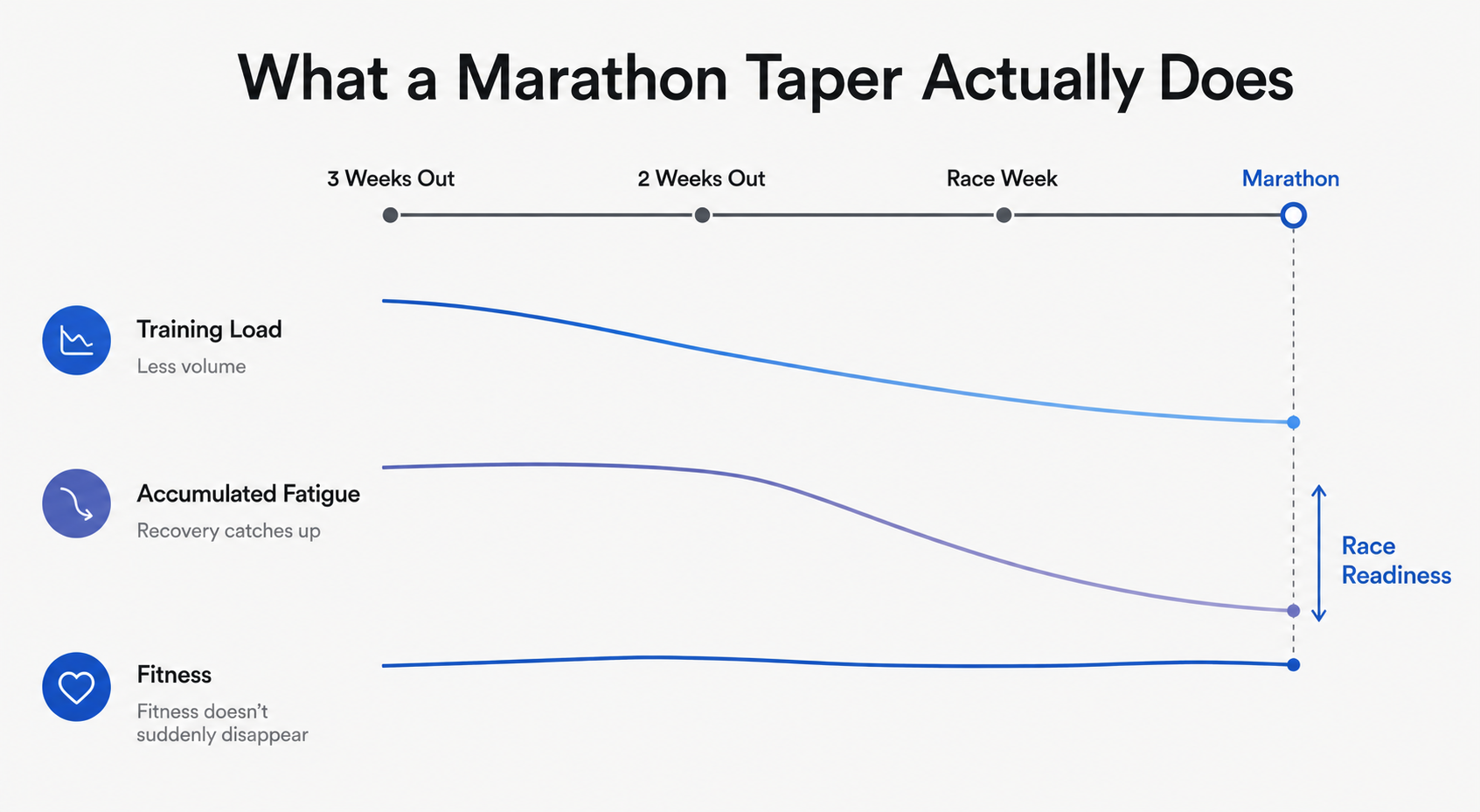
The most important thing to understand about a marathon taper is that you’re no longer trying to become substantially fitter.
That work has already happened. The aerobic development came from months of running. The long runs built durability. Marathon-specific sessions taught your body how to sustain effort. Hundreds of ordinary kilometres created adaptations that no final heroic workout can suddenly reproduce.
What you’re carrying into the taper isn’t just fitness, though. You’re carrying fatigue as well. That’s completely normal.
A productive marathon build almost inevitably creates some accumulated tiredness because each training week arrives before every trace of the previous one has disappeared. Your body adapts while the training continues, but you rarely get to experience all of that fitness without some fatigue sitting on top of it.
Then the taper changes the balance. Training stress falls. Recovery begins catching up. The fitness you’ve spent months developing remains, while some of the fatigue that has been masking it gradually starts to disappear.
This is where tapering becomes easier to understand. You’re not trying to add another layer of fitness at the last possible moment. You’re removing some of the fatigue covering the fitness that’s already there.
And that also explains why squeezing in one final massive workout is usually such an unattractive trade. Close to race day, there isn’t much time left to absorb a large new training stimulus. There is, however, plenty of opportunity to carry the fatigue from it onto the start line.
The final weeks therefore ask for a different kind of discipline. Earlier in the build, discipline meant doing the work. Now it means knowing when the work is done.
If the reduction in training makes you uneasy because you’re used to judging progress by how much work you’re doing, How to Know If a Hard Run Was Actually Productive is useful context. It explores the same distinction from another angle: a workout earns its value through the adaptation it creates, not simply through how demanding it feels.
Why Tapering Can Make You Feel Worse Before You Feel Better
This is the part nobody quite expects. You reduce the mileage, sleep a little more, remove the longest sessions and finally give your body the recovery you’ve been waiting for.
So naturally, you expect to feel fantastic. Then you go for an easy run and your legs feel strangely flat.
The pace that felt effortless two weeks earlier suddenly feels awkward. You notice a tight calf that you hadn’t thought about all season. Your watch shows something slightly unusual and, because the marathon is now only days away, every small sensation suddenly seems important.
It’s remarkably easy to conclude that the taper isn’t working. But feeling fresh isn’t always an immediate response to reducing training.
After months of high volume, your body has become accustomed to a certain rhythm. Running frequently, carrying some fatigue and moving through a predictable weekly structure have all become normal. When that workload suddenly changes, the sensations can change with it.
And there is another part that has nothing to do with physiology. You finally have time to notice things. A minor stiffness that would barely have registered during a 90-kilometer training week can suddenly become fascinating ten days before a marathon. A slightly elevated heart rate gets inspected. Sleep scores acquire enormous importance. Every easy run becomes an unofficial fitness test.
The body hasn’t necessarily become less reliable. You’ve simply started listening to it much more closely. I think this is where taper anxiety catches many runners. They expect race readiness to announce itself through spectacular training runs and wonderfully fresh legs.
Sometimes it does. Sometimes you arrive at race week feeling almost disappointingly ordinary.
That’s okay. The taper isn’t designed to make every run before the marathon feel amazing. It’s designed to improve the condition in which you arrive at the start line.
Those are not quite the same thing. Trying to prove your fitness during the taper usually solves very little. A brilliant workout won’t create much additional marathon fitness at that stage, while turning an easy session into an unnecessary test can bring back exactly the fatigue you’re trying to remove.
The difficult part is trusting that nothing dramatic needs to happen anymore. Your training has already made its argument. The taper is simply giving your body enough quiet to respond to it.
If those final days leave you unsure whether you’re genuinely tired or simply becoming hyper-aware of every small sensation, Should You Run Today or Rest? (Simple Decision Framework) offers a useful way to separate ordinary pre-race uncertainty from a genuine reason to back off.
How Much Training Should Actually Change?
Once runners accept that training needs to come down, another question usually appears almost immediately.
How much?
This is where tapering can become unnecessarily mathematical. Mileage percentages get compared. Final long-run distances are debated. Runners begin counting backwards from race morning, trying to find the exact point where serious training should stop and tapering should begin.
There are useful principles behind those numbers, but I think it’s easy to lose sight of what we’re actually trying to accomplish.
A taper isn’t a switch from training to resting.
You’re still a runner preparing for a marathon. You simply no longer need the same amount of training stress to move forward.
That’s why volume is usually the obvious thing to reduce. Long runs become shorter. Easy mileage comes down. The overall amount of mechanical work your body has to recover from gradually decreases.
But that doesn’t necessarily mean every run should become slow, short and completely uneventful.
There can still be value in touching marathon pace or including small amounts of faster running. Not because you’re trying to create another major fitness adaptation, but because familiar movement keeps the body connected to the rhythm you’ve spent months developing. I think that’s an important distinction.
Removing fatigue doesn’t require removing running.
And preserving intensity doesn’t mean continuing to train hard. The balance simply shifts.
Earlier in marathon preparation, a demanding session might be valuable because of what happens after it: the body recovers, adapts and becomes stronger.
During the taper, there is progressively less time available for that cycle to finish before race morning. So the question changes.
Instead of asking how much training you can still fit in, it becomes more useful to ask how little training you need to maintain everything you’ve already built.
That reversal can feel uncomfortable, especially for runners who associate confidence with mileage. But the goal of the final days isn’t to arrive at the start line impressed by your training log.
It’s to arrive with your fitness intact and less fatigue standing between you and it.
If reducing your workload makes you worry that you’re suddenly doing too little, How to Know If You’re Recovering Properly Between Runs adds useful context here. Recovery isn’t the opposite of training adaptation; it’s the period in which much of that adaptation becomes usable.
The Taper Is Also a Test of Trust
There comes a point in marathon preparation when another workout can no longer give you what you’re looking for.
Not physically, anyway. You might still want one. A final marathon-pace session that feels effortless. One last long run that confirms the endurance is there. Perhaps a few faster kilometres simply to reassure yourself that the legs haven’t forgotten how to move.
The temptation makes sense. For months, training has been the answer whenever uncertainty appeared. If you wanted to become more confident about the marathon, you trained for it.
During the taper, that relationship suddenly stops working. There isn’t enough time left for one impressive workout to transform your fitness. What it can change is how much fatigue you’re carrying into race day.
That’s what makes tapering such an unusual part of training. For most of the marathon build, confidence comes from completing the work.
At the end, confidence has to come from knowing that you’ve already completed it. Those are very different skills.
Perhaps this is also why experienced marathon runners often become calmer about tapering. They’ve learned that feeling slightly restless before a race isn’t a problem that needs fixing. Neither is an ordinary easy run. Neither is reaching Thursday without having done anything that made them feel particularly fit.
Nothing needs to happen now. That can be surprisingly difficult to accept. The training log is already written. The long runs happened weeks ago. The adaptations they created aren’t disappearing because you’ve stopped adding more fatigue on top of them.
If anything, you’re finally creating the conditions to use them. And I think this is where a good taper becomes psychological as much as physiological.
You’re practising the same patience the marathon itself will eventually require. Don’t spend energy simply because you have it. Don’t react to every uncomfortable sensation. Don’t change the plan because uncertainty has appeared. Trust what you’ve built and save the urge to prove it for the day when proving it actually matters.
If race week has you questioning every sensation and wondering whether one more session would help or hurt, How to Tell If You’re Close to Overtraining (Early Signs) provides a useful wider perspective on the difference between productive training stress and fatigue that no longer has time to reward you.
Conclusion
By the final weeks of marathon preparation, there is very little left to build. That can be surprisingly difficult to accept.
Training teaches us that improvement comes from work, and for months that relationship has been obvious. You run, recover, adapt and gradually become capable of handling more.
Then the taper asks you to stop adding. Not completely. Not suddenly. But enough that recovery can finally begin catching up with everything you’ve asked your body to absorb. Perhaps that’s the simplest way to understand the taper.
You’re not protecting fragile fitness. You’re revealing accumulated fitness.
The long runs don’t disappear because the final one was shorter. Your aerobic base doesn’t vanish because weekly mileage comes down. Your body doesn’t forget marathon pace because you stopped repeatedly proving that you can run it.
What changes is the amount of fatigue traveling with you. And once you understand that, those strangely quiet final days start to look different.
A short run doesn’t feel like missed training. A rest day doesn’t feel like lost fitness. Fresh legs don’t need to be tested simply because they’re finally beginning to appear.
The work has already been done. Race morning is where you get to find out what all of it created. That’s why I think the best mental model for tapering isn’t doing less.
It’s carrying less.
You want to arrive at the start line carrying months of adaptation, experience and confidence—but as little unnecessary fatigue as possible.
That’s the taper.
The taper is also one of those periods when training data is most useful as context rather than judgment. A single unusual heart-rate reading or recovery score shouldn’t define race readiness, but longer-term trends can help you understand how training load is changing as race day approaches. If you value that broader view, our guide to the Best Running Watches Used by Elite Runners looks at the watches and training features that can help endurance runners interpret the bigger picture.
Frequently Asked Questions
How long should a marathon taper last?
There isn’t one perfect duration for every runner. The appropriate taper depends on your training volume, experience and how much fatigue you’ve accumulated. The important principle is giving fatigue enough time to fall without unnecessarily abandoning the running rhythm you’ve built.
Will I lose fitness during a marathon taper?
A sensible taper is designed to preserve fitness while reducing accumulated fatigue. The anxiety often comes from doing noticeably less training, but less workload in the final period doesn’t mean the adaptations created over months suddenly disappear.
Why do my legs feel heavy during the taper?
Heavy or flat legs aren’t unusual. Your training rhythm has changed, accumulated fatigue may still be resolving and you’re probably paying much more attention to small sensations than you were several weeks earlier. One awkward easy run isn’t a reliable test of race readiness.
Should I still run marathon pace during the taper?
Small amounts of familiar intensity can remain useful because the goal isn’t to stop running. The important distinction is that these sessions are no longer there to create a major new training stimulus. They help maintain rhythm without recreating the fatigue you’re trying to shed.
What if I feel amazing during race week?
Enjoy it—but don’t test it. Feeling fresh is exactly what reducing training stress is supposed to make possible. Turning that freshness into an unnecessary hard workout simply because you have energy again works against the purpose of the taper.