
How to Prepare for Your First 10K?
There is a point in a new runner’s progress when 10K starts looking possible before it starts feeling possible.
Perhaps you’ve already run five kilometers. Maybe six or seven on a particularly good day.
An hour of running no longer sounds completely absurd, and suddenly you begin wondering whether you could actually cover ten kilometers without stopping.
Then you look at the number again. Ten kilometers.
If five still feels like a proper run, doubling it can seem like a much bigger step than the mathematics suggests. I think this is where runners often make their first 10K unnecessarily complicated. They assume they need to become dramatically faster, start doing difficult workouts or repeatedly test how close they are to the full distance.
But your first 10K is primarily an endurance problem.
Before worrying about how quickly you can cover the distance, your body needs to become comfortable spending enough time running to reach it. That changes what preparation should look like.
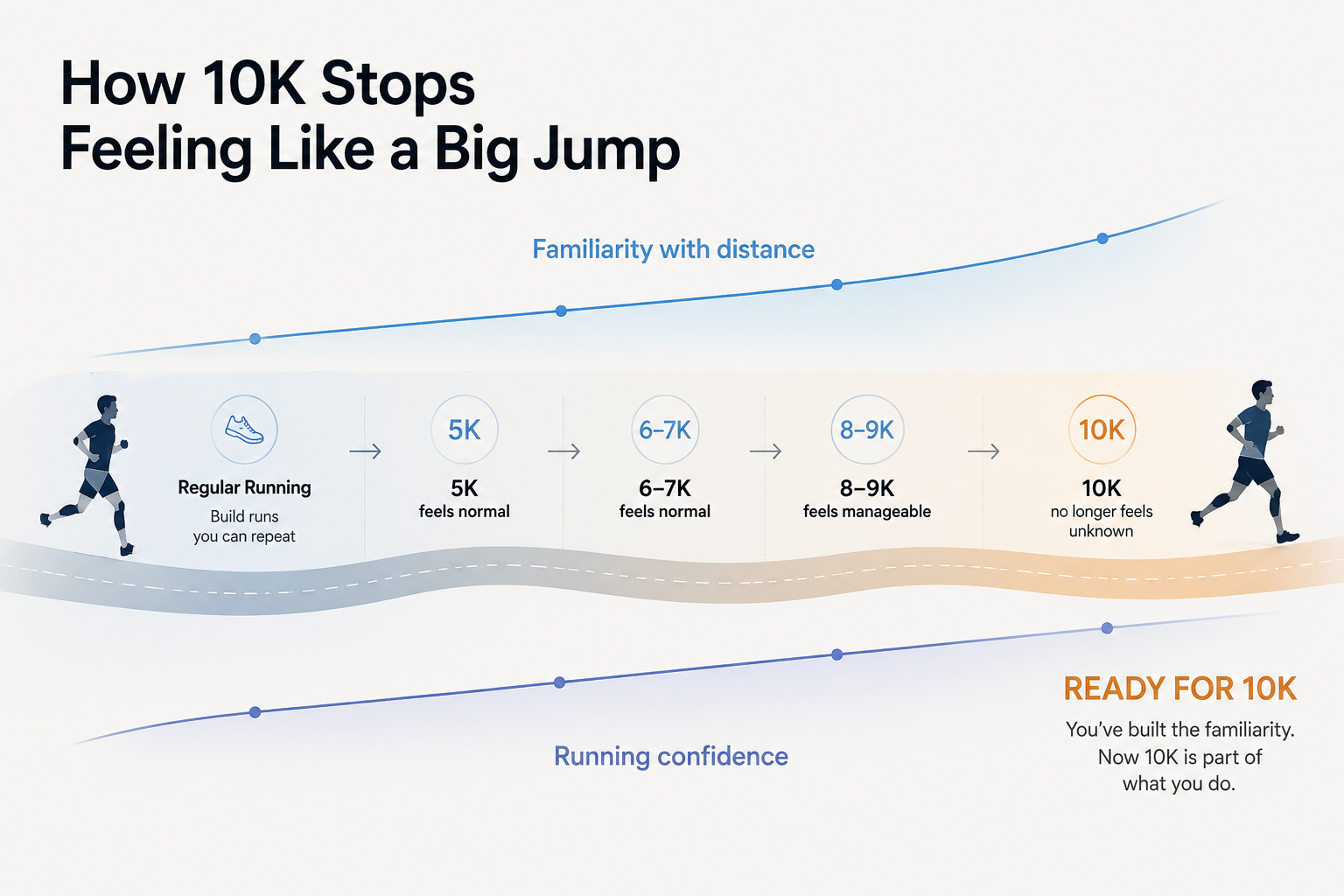
The important runs aren’t necessarily the ones that prove you’re ready. They’re the ordinary ones that gradually make running itself less demanding. Your easy runs become more familiar. Your weekly volume grows. A distance that once felt long becomes normal, which allows the longer run to extend a little farther without becoming an event every time.
Eventually, ten kilometers stops looking like twice five kilometers. It becomes simply another distance you know how to run.
That’s what we’re trying to build.
First Build the Habit of Running, Then Build the Distance
If you’re preparing for your first 10K, the most useful starting point isn’t the distance of your longest run. It’s the running you’re already able to repeat.
Someone who occasionally manages seven kilometres but needs several days to recover from it isn’t necessarily better prepared than someone comfortably running four or five kilometres several times each week.
The second runner has something valuable already developing underneath the distance. Consistency.
Each ordinary run gives the body another small exposure to running stress. Muscles become more accustomed to the movement. Tendons and connective tissues repeatedly experience manageable loading. The cardiovascular system becomes better at sustaining the effort, and the movement itself gradually requires less attention.
None of those changes are particularly dramatic from one run to the next. Together, they make longer running possible. This is why I wouldn’t rush to turn every weekend into a distance test. If your normal runs still feel unpredictable, adding kilometers to the longest one isn’t always the most useful next step.
Let the ordinary running become ordinary first.
Three manageable runs that you can recover from and repeat next week usually build a stronger foundation than one ambitious run followed by several days of fatigue.
This is the same principle behind How Many Times a Week Should You Run. Frequency isn’t about collecting more sessions for its own sake; it gives the body repeated opportunities to adapt without requiring one individual run to carry the entire training load.
As that consistency develops, something interesting happens. Five kilometres stops requiring preparation. Then six doesn’t seem particularly unusual. Your attention gradually shifts away from whether you can finish the run and toward how the run actually feels.
That’s when extending one of those runs begins making much more sense.
Let One Run Gradually Become Longer
You don’t need every run to move toward 10K. In fact, I think trying to increase several runs at once is one of the easiest ways to turn a simple goal into a surprisingly large increase in training load.
Most of your running can remain familiar. Then one run gradually becomes the place where you spend a little more time on your feet. Perhaps it moves from five kilometers to six. Later, six becomes seven.
There doesn’t need to be urgency behind every increase, and there certainly doesn’t need to be a new distance record every week. Sometimes repeating the same longer run is exactly what allows adaptation to catch up.
The useful change isn’t only that you’re covering more ground.
You’re learning what happens after the point where your normal runs usually end. You discover that the first twenty minutes don’t need to predict the last twenty. You become better at settling into an effort rather than constantly evaluating it. Your legs become accustomed to continuing when the run is no longer particularly short.
This is endurance developing in a very practical form. And the pace of that longer run doesn’t need to impress anyone. Trying to make it simultaneously your longest and fastest run adds a second challenge when one is enough.
Let distance be the new stimulus. Keep effort controlled. If that means the longer run is slower than your shorter runs, nothing has gone wrong.
How Slow Should Long Runs Be explores the same principle at larger training volumes, but it begins to matter surprisingly early: the purpose of extending a run is much easier to preserve when you aren’t also trying to defend a particular pace.
Over time, the gap between your normal runs and 10K begins shrinking. And somewhere in that process, the question changes. You’re no longer wondering whether you could somehow survive ten kilometres.
You’re beginning to realize that you probably can.
Do You Need to Run 10K Before Your First 10K?
There is something psychologically satisfying about seeing 10.00 km appear on your watch before race day.
Now you know. You’ve covered the distance once, so the uncertainty disappears. When you stand on the start line, you’re no longer asking your body to do something it has never done before.
For some runners, that confidence is genuinely useful. But physiologically, there is nothing magical waiting at exactly ten kilometers. If you’ve been running consistently, your normal runs feel controlled and you’ve gradually extended one run toward seven, eight or nine kilometers, the final part of the distance isn’t suddenly a completely different type of exercise.
Your body doesn’t know that 9.4 kilometers is preparation and 10.0 kilometers is success. It knows duration, effort and accumulated fatigue.
This is why I don’t think every runner needs to complete the full distance before their first 10K. You can arrive ready without having rehearsed the entire event.
What matters much more is whether the distance you’re currently running leaves enough capacity for a little more.
There is a big difference between finishing eight kilometers feeling controlled and finishing eight kilometers because you refused to stop. The watch may record the same distance.
The preparation behind it is very different. If eight kilometers feels manageable and you’re recovering normally afterwards, another two kilometers on race day isn’t an unreasonable leap.
If six kilometers still regularly leaves you exhausted, however, testing ten kilometers probably isn’t the solution. More time spent building ordinary endurance is.
And if you simply want to run 10K before the event? That’s fine too. Just don’t turn it into a race simulation. Run it easily. Let the distance become familiar. Finish knowing that you could have continued rather than using the session to prove how fast you might race.
I think that last distinction is important because confidence is useful when it comes from familiarity. It’s less useful when you have to exhaust yourself to obtain it.
The goal of training isn’t to pass the race before race day. It’s to arrive knowing the distance no longer asks for something dramatically beyond what you’ve already prepared to do.
You Don’t Need Much Speedwork for Your First 10K
Once ten kilometers starts feeling achievable, runners often assume the next stage of preparation must involve getting faster.
Intervals appear. Tempo runs enter the schedule. Suddenly a goal that began as running 10K becomes a collection of pace targets and workout sessions.
Those tools can absolutely improve 10K performance.
But there is an important distinction between preparing to run your first 10K and training to run your fastest 10K.
For the first goal, endurance still does most of the work. If you’re relatively new to running, simply becoming more consistent can improve pace without deliberately training speed. As aerobic fitness develops, the effort that once produced one pace may gradually produce a faster one.
Running economy can improve. The movement becomes more familiar. You can sustain running for longer before fatigue begins changing how everything feels.
A runner experiencing all of that doesn’t necessarily need a complicated interval program on top of it. In fact, adding hard workouts too early can create a strange situation where the most demanding part of your training has very little to do with the actual problem you’re trying to solve.
You weren’t struggling because you couldn’t run fast enough. You were trying to become comfortable running for long enough.
That’s why Can You Improve Running Without Speedwork? is particularly relevant when preparing for a first 10K. Faster training is one tool for developing running fitness, not an entry requirement for becoming a runner capable of covering ten kilometres.
There may still be room for some quicker running. A few relaxed strides, naturally faster moments during a run or eventually a controlled workout can introduce different speeds without making the entire week revolve around intensity.
But I wouldn’t rush there because a 10K sounds like a race. Build the ability to cover the distance first. Then speed has something to work with.
Your First 10K Pace Should Feel Almost Too Easy at the Start
Race day creates a problem that ordinary training rarely reproduces perfectly.
You feel good. You’ve rested. There are other runners around you. The event finally feels real, and the pace that seemed purposeful during training can suddenly feel ridiculously comfortable.
So you run a little faster. Nothing happens. You still feel good. That seems like confirmation that the faster pace was correct. The problem is that the opening kilometer of a 10K is a terrible place to ask whether you’re running too hard.
You’re fresh enough to make a pace feel reasonable long before you’ve discovered whether it’s sustainable. For a first 10K, I think there is very little to gain from solving that question aggressively. The first part of the race should feel controlled enough that you occasionally wonder whether you’re being too cautious.
Let people move ahead. Let the excitement settle. Give yourself time to discover what the effort feels like once you’ve actually been running for a while.
If you’re still comfortable halfway through, you haven’t wasted the race. You’ve earned options. You can gradually allow the effort to rise. The final kilometres can become genuinely hard if that’s what you want from the day, but now you’re spending energy with much better information about what remains.
The opposite strategy gives you fewer options. Start too hard and the second half becomes an attempt to preserve something you’ve already committed to.
This is where What Is a Good Running Pace becomes more useful than chasing an arbitrary 10K target. A good pace only makes sense relative to the runner producing it and the effort they can sustain.
Your first 10K doesn’t need a perfectly calculated split plan. It needs patience early enough that the distance gets a chance to unfold.
Don’t Change Everything in the Final Week
The final week before a first 10K can create a strange sense of urgency. The race is suddenly close enough to feel real, and that makes it tempting to check whether the training worked.
Maybe one more long run would provide reassurance. Maybe you should try your planned race pace again. Maybe missing a run now feels more significant because there are no longer many opportunities to replace it.
But by this point, there is very little fitness left to build before race day. The useful work happened earlier.
It happened during the ordinary weeks when you ran consistently, gradually extended your endurance and allowed the body to recover before doing it again.
Trying to squeeze another meaningful fitness gain into the final few days usually misunderstands how training works.
Adaptation takes time.
Fatigue arrives much faster.
So the final week doesn’t need to prove anything.
You can keep running, but there is little reason to make those runs unusually long or demanding. Familiar, comfortable running keeps the body moving without adding fatigue that you then need to remove before the race. I think first-time racers sometimes find this harder than experienced runners because resting can feel suspiciously like doing nothing.
Training feels productive. Backing off doesn’t. But the fitness you’ve built doesn’t disappear because the final few days are easier. If anything, reducing the workload slightly gives that fitness a better chance to appear.
The same principle sits behind Marathon Taper Explained, although preparing for a first 10K doesn’t require anything like the same tapering process. The distance and accumulated training load are different. The underlying idea is still useful: once the work is done, more work isn’t automatically more preparation.
And there is a psychological benefit to leaving something unused. Arriving at the start line with fresh legs and the feeling that you want to run is much more useful than arriving reassured because you completed one last test four days earlier.
You don’t need another test. The race will answer the question soon enough.
Conclusion
Preparing for your first 10K isn’t really about training yourself to survive ten kilometers.
It’s about gradually reducing how unusual ten kilometers feels. At the beginning, the distance may look enormous because you’re comparing it with what you can comfortably do today. Five kilometres feels familiar, so ten looks like twice the challenge.
But endurance doesn’t develop in neat mathematical steps. You run regularly. The ordinary runs become easier to repeat. One of them gradually becomes longer.
Seven kilometers becomes familiar enough that eight no longer feels ambitious. Eventually, the gap between what you already know you can do and what race day will ask becomes surprisingly small.
That’s the point I’d pay attention to. You don’t necessarily need to have completed 10K in training. You don’t need an impressive interval session or a perfectly calculated race pace.
You need enough running behind you that the distance is no longer a leap into the unknown. Then race day becomes much simpler.
Start patiently enough that the first kilometers don’t borrow too much from the last ones. Let the effort develop. Give yourself the chance to discover how much you have left rather than deciding that in the opening minutes.
Your first 10K can still become difficult near the end. In fact, if you decide to race it, it probably will.
But there is an enormous difference between becoming tired while running a distance your body understands and becoming tired because the distance itself exceeded what you were prepared for.
That, to me, is what preparation is really trying to change. Not whether ten kilometers requires effort. Whether ten kilometers still feels unknown.
Your first 10K is also often the point where pace, splits and race data start becoming more interesting than they were during ordinary easy running. They can be useful tools, as long as the watch helps you understand the race rather than dictate it. Our guide to the Best Running Watches Used by Elite Runners looks at the watches and training features designed around that broader endurance picture.
Frequently Asked Questions
How long should I train for my first 10K?
There isn’t one preparation period that fits everyone because your starting point matters more than the calendar. Someone already running several times each week and comfortably covering five or six kilometres needs a very different progression from someone who has only recently started running. Build from the running you can currently repeat and recover from rather than forcing the goal into a predetermined number of weeks.
Do I need to run 10K before my first 10K race?
No. If you’re running consistently and can comfortably complete a substantial part of the distance, you don’t necessarily need to cover the full 10K beforehand. Running it once can provide confidence, but it shouldn’t become a test you must pass before race day.
What should my longest run be before a first 10K?
There is no single required distance. Being comfortable around seven to nine kilometres can leave a relatively small step to complete on race day, but the quality of that running matters too. A controlled shorter run you recover from easily may indicate better preparation than a difficult 10K completed simply to prove you can do it.
How many times a week should I run when preparing for a 10K?
For many newer runners, consistency matters more than squeezing in as many sessions as possible. A few manageable runs each week can provide repeated aerobic and mechanical stimulus while leaving enough time to recover. The appropriate frequency depends on your current running background and how well you’re absorbing the training.
Do I need interval training for my first 10K?
Not necessarily. If the primary goal is completing your first 10K comfortably, developing consistency and endurance can take you a long way. Faster workouts become more useful when the goal shifts from being ready for the distance toward improving how quickly you can race it.
How fast should I run my first 10K?
Start more conservatively than the excitement of race day may encourage. The opening kilometres should feel controlled. Once you’re well into the race and understand how the effort is developing, you can gradually ask for more. A slightly cautious beginning leaves far more options than an opening pace you later discover was unsustainable.