
Some days, the decision feels simple.
Other days, it does not.
You wake up and your body feels somewhere in between. Not clearly fresh. Not clearly tired. And the question becomes harder than it should be.
Should you run today, or should you rest?
Many runners try to answer this based on motivation. Or discipline. Or habit.
But those are not the best signals. The better question is not what you feel like doing.
It is what your body is ready to absorb.
If you want your easy and recovery runs to feel smoother and reduce unnecessary strain, the shoes you use can make a difference.
You can explore options in our guide to the Best Running Shoes for Daily Training (2026).
The Wrong Way to Decide
Most decisions around training follow one of two patterns.
Either you run because it is on the plan, regardless of how you feel. Or you skip because you are not motivated enough.
Both approaches miss the point.
Running is not just about completing sessions. It is about applying the right stress at the right time.
If your system is not ready, the same run creates fatigue instead of adaptation. This is often how runners drift into imbalance, a pattern explained in What Happens If You Run Too Fast Too Often.
The Real Question
Instead of asking whether you should run, ask something slightly different.
Can your body benefit from running today?
That is a subtle shift, but it changes everything.
Because not every run creates progress.
Some runs build. Some maintain. Some simply add stress.
Learning to tell the difference is what makes your training more effective.
Three Signals That Matter
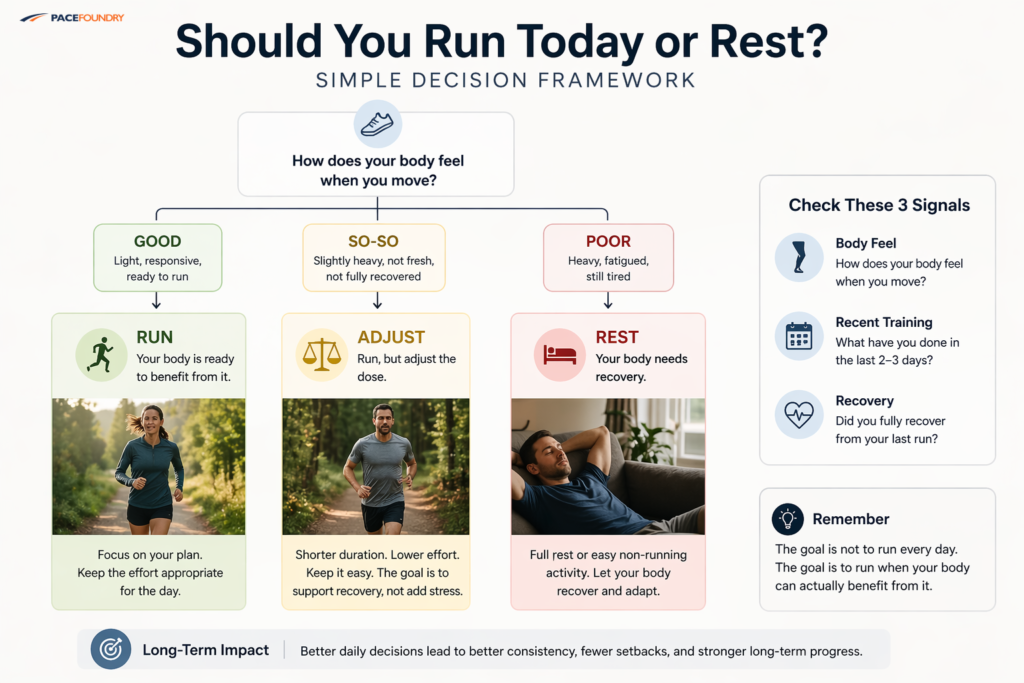
The decision becomes much clearer when you look at a few consistent signals.
Start with how your body feels when you move, not when you think.
Heavy legs, stiffness, or a lack of responsiveness often point toward fatigue.
Then consider your recent training.
If the last few days have included harder efforts or higher volume, your system may still be processing that load.
Finally, look at your recovery.
If your previous run did not fully reset, today is unlikely to improve things.
These signals do not need to be perfect.
They just need to be consistent enough to guide your decision.
When You Should Run
Running makes sense when your body feels stable.
Not perfect. Not exceptional. Just ready.
Your movement feels natural. Effort feels controlled. There is no lingering fatigue from previous sessions.
These are the days where even an easy run supports your system.
And this is where consistency is built, as explained in Why Consistency Matters More Than Intensity.
When You Should Rest
Rest is not a failure.
It is part of the structure.
If your body feels heavy, unresponsive, or slightly off, that is often a signal that recovery is not complete. Running through that state rarely creates progress.
It usually just delays it.
This is closely connected to understanding How to Tell the Difference Between Fatigue and Lack of Fitness, where the patterns behind these feelings become clearer.
The Middle Option Most Runners Ignore
It is not always a choice between running and full rest.
There is a middle option.
You can run, but adjust.
Shorter duration. Lower effort. No pressure to hit a pace. Just movement. This often restores balance without adding unnecessary stress.
And in many cases, it is the most effective decision.
Structure Makes Decisions Easier
If you constantly struggle with this decision, it usually means one thing.
Your structure is not clear enough.
When your week has a rhythm, hard days, easy days, and recovery built in, the decision becomes simpler. You are not guessing every day.
You are following a system.
This is exactly why structure matters, as explained in What a Balanced Running Week Looks Like.
Small Decisions Create Long-Term Progress
This decision may feel small.
But repeated over weeks, it defines your training.
Choosing to run when your body is ready builds consistency. Choosing to rest when needed protects it.
Together, these decisions create a system your body can actually adapt to.
Frequently Asked Questions
Should I run when I feel tired?
Sometimes yes — if it’s normal fatigue that improves with movement.
How do I know if I should rest?
If fatigue doesn’t improve or feels abnormal after warming up.
Is it bad to skip a run?
No — if it supports recovery and consistency.
What if I’m unsure?
Start easy and decide during the run.
Daily decisions become clearer when you can see how your body responds.
A reliable heart rate monitor helps you notice when your effort is higher than expected — see Best Heart Rate Monitors for Running (2026).
Key Takeaway
Not every day is a push day.
Learning when to run — and when to rest — is part of becoming a better runner.