
Life After Your First Marathon
The weeks before your first marathon have a remarkable sense of direction.
Every run has a purpose. Long runs gradually become longer. Recovery days feel meaningful because they’re helping you prepare for something specific. Even difficult sessions are easier to accept because the finish line is always there in the distance.
Then, almost suddenly, it’s over. The medal is hanging at home. Your running shoes are still by the door. But the goal that shaped your life for months has quietly disappeared.
I’ve always found that moment surprisingly interesting. Most runners spend so much time wondering what their first marathon will feel like that they rarely think about what comes afterwards. I don’t think the biggest challenge is physical.
It’s learning how to run again when there’s no longer a countdown on the calendar. To me, that’s where the next chapter of running really begins.
Finishing a Marathon Doesn’t Answer Every Question
One of the biggest surprises after a first marathon is how quickly life starts to feel normal again.
Your body gradually recovers. The soreness fades. Friends stop asking about the race. And before long, you’re left alone with a question that didn’t seem very important a few weeks earlier.
Now what?
It’s tempting to believe that finishing a marathon changes everything. In some ways, it does.
You’ve learned that you can prepare for something difficult over many months. You’ve experienced what forty-two kilometres actually feel like. You’ve probably discovered strengths—and weaknesses—you never knew you had.
At the same time, one marathon doesn’t suddenly define the rest of your running life. Some runners immediately start searching for another marathon. Others realise they miss shorter races.
Some simply enjoy returning to easy, unstructured running for a while. I don’t think there’s one correct answer. To me, the first marathon isn’t the finish line of your running journey.
It’s the first time you’ve truly seen how much there still is to explore. That’s why I think the weeks afterwards deserve just as much patience as the months before.
Not because you’re rebuilding fitness. Because you’re discovering what kind of runner you want to become next.
If you’re wondering how to let your body recover without feeling guilty about taking things easier, our article How to Recover Without Overthinking It explores why recovery is often far more productive than it first appears.
Learning to Run Without a Finish Line
One of the strangest things about finishing your first marathon is that nothing around you really changes. The same roads are still there. The same running shoes are waiting by the door. Your watch still finds GPS in exactly the same places.
And yet, something feels different.
For months, every run quietly belonged to a larger story. Even an easy Tuesday evening run had a purpose because it was helping you arrive somewhere that still lay weeks ahead.
Then, one Sunday morning, that story ends. Not dramatically. It simply… stops. I don’t think many runners expect that feeling.
We spend so much time imagining the finish line that we rarely imagine the ordinary Monday that comes afterwards. Looking back, I think that empty feeling surprises people because it isn’t disappointment.
The marathon may have gone exactly as planned. You might even have achieved every goal you set. What’s missing isn’t success.
It’s direction. For a little while, running no longer answers the question, “What am I preparing for?”
To me, that’s a fascinating moment. For the first time in months, you have the opportunity to run without needing every session to serve a bigger objective.
Some runners find that uncomfortable. Others discover it’s incredibly freeing. Eventually, I think almost everyone realises the same thing.
The marathon gave structure to your running. It didn’t give meaning to it. That meaning was already there long before race day. The finish line simply made it easier to see.
If you’ve caught yourself feeling restless after reaching a major goal, our article Should You Run Today or Rest? (Simple Decision Framework) explains why stepping back for a short while is often part of moving forward rather than falling behind.
Choosing What Comes Next
One of the questions runners hear most often after their first marathon is surprisingly simple.
What’s next? At first, it sounds like an exciting question. After a while, I think it can become a surprisingly distracting one.
There’s an unspoken assumption that every finish line should immediately lead to another start line. As though running only has value when the next race is already marked on the calendar.
I don’t think that’s necessarily true. For some runners, another marathon feels like the obvious next chapter. They’ve fallen in love with the distance and can’t wait to apply everything they’ve learned.
For others, the opposite happens. They suddenly realize how much they missed running simply because they enjoyed it. They look forward to shorter races, relaxed weekend runs or even an entire season without a major goal hanging over every training session.
Neither choice is more ambitious than the other. They’re simply different. Looking back, I think the first marathon teaches something that’s easy to overlook.
The real achievement isn’t discovering whether you’re capable of running 42.2 kilometers. It’s discovering what kind of runner you actually are.
Some people thrive on long-term preparation. Others find their greatest enjoyment in variety. Some love chasing personal bests. Others simply enjoy the quiet rhythm of consistent running.
To me, that’s one of the unexpected gifts of a first marathon. It doesn’t just show you what your body can do. It teaches you what keeps you coming back to running in the first place. That’s a far more valuable lesson than choosing your next race too quickly.
If you’ve started wondering whether another marathon is really the right next goal, our article Should You Run Your First Marathon? revisits an idea that remains true even after you’ve finished one: the best goals are the ones that genuinely fit where you are as a runner—not simply the ones that seem like the obvious next step.
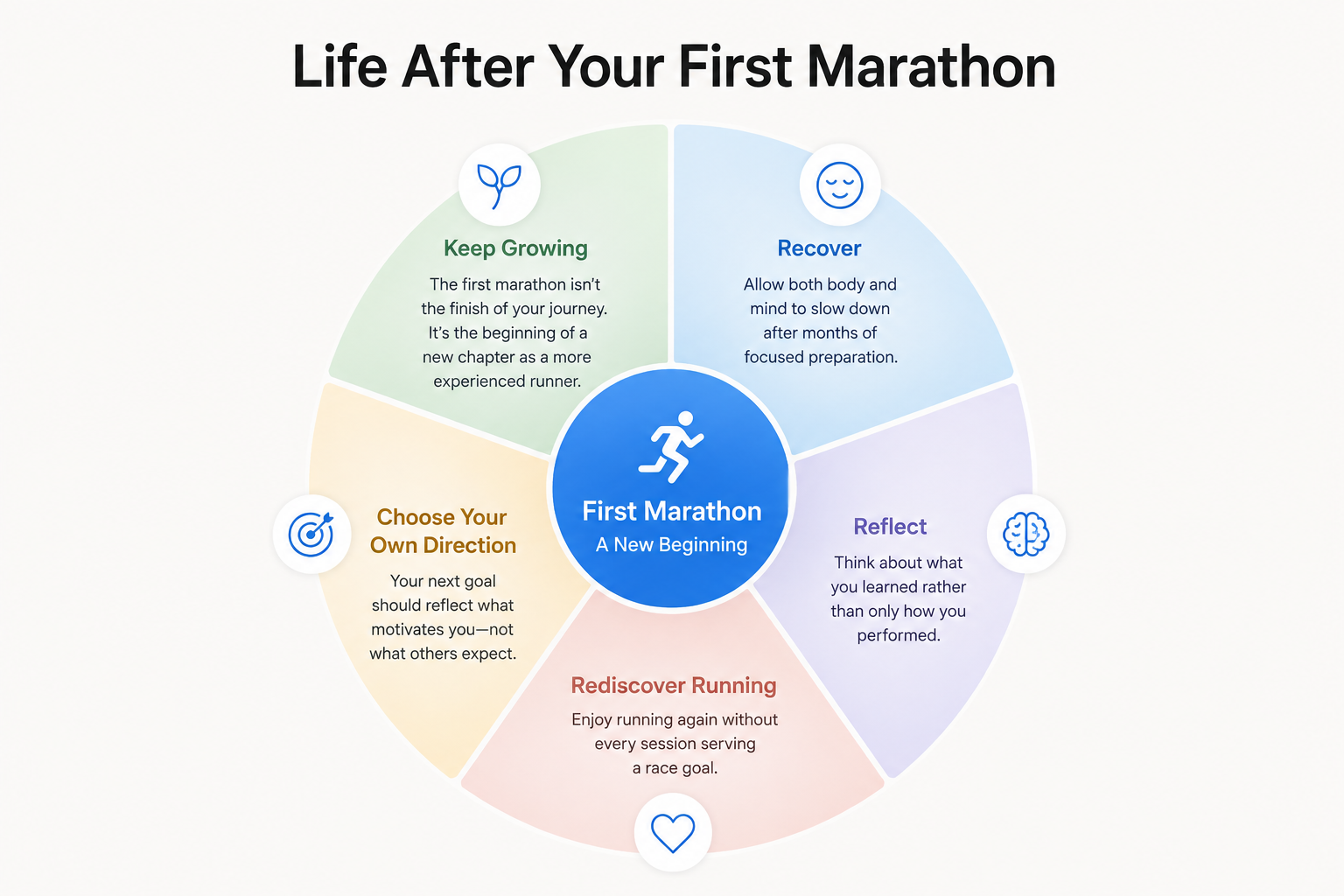
Conclusion
When people talk about a first marathon, they usually talk about the finish line. The medal. The finishing time. The photographs taken a few minutes after crossing the line.
Looking back, I think those are the parts we remember most clearly because they’re easy to see. The more interesting changes happen afterwards.
A few weeks later, you’re back on familiar roads. The watch starts another easy run. Your pace doesn’t really matter. Nobody is tracking your progress anymore.
And that’s when you begin to notice something unexpected. You’re no longer wondering whether you’re capable of being a marathon runner.
You already know the answer. That uncertainty has quietly disappeared. What replaces it is something much more valuable.
Freedom.
The freedom to choose your next goal because it genuinely excites you, not because you feel you have something left to prove. The freedom to enjoy an easy run without constantly thinking about the next race. The freedom to realise that running can still be deeply meaningful even when there’s nothing circled on the calendar.
Perhaps that’s the real finish line of a first marathon. Not the one painted across the road. The one that exists inside your own thinking. Once you’ve crossed it, you’re no longer chasing the idea of becoming a marathon runner. You’re simply a runner who happens to have completed a marathon.
To me, that’s a subtle difference. But it’s also one that changes everything.
If your next goal eventually turns into another marathon, choosing gear that keeps long training blocks comfortable becomes just as important as choosing the goal itself. Our guide to the Best Long Run Shoes looks at the shoes designed to make those long weekends more enjoyable, one run at a time.
Frequently Asked Questions
Is it normal to feel empty after your first marathon?
Yes. Many runners experience a temporary sense of emptiness after reaching a goal they’ve been working towards for months. It’s usually not disappointment, but the absence of the structure and purpose that marathon training provided.
Should I sign up for another marathon straight away?
Not necessarily. Some runners are eager to start another training cycle, while others benefit from spending time enjoying unstructured running before committing to a new goal.
How long should I wait before setting a new running goal?
There’s no universal timeline. Give yourself enough time to recover physically and mentally, then choose a goal that genuinely motivates you rather than one you feel pressured to pursue.
Will my running fitness disappear after the marathon?
No. A short period of reduced training won’t erase the fitness you’ve built over months. Recovery is part of the training process, not a break from it.
What is the biggest lesson from a first marathon?
For many runners, it’s discovering that the marathon itself was only part of the journey. The habits, patience and confidence developed during training often become more valuable than the finishing time.