
Marathon Recovery Explained
One of the strangest things about finishing a marathon is how unpredictable recovery can feel. You cross the finish line expecting to wake up the next morning barely able to walk.
Sometimes that’s exactly what happens. Other times, you feel surprisingly good after two or three days. You begin thinking that perhaps your recovery is almost complete. Maybe you’re one of the lucky ones.
Then, a week later, your legs suddenly feel heavy again during an easy run. For many first-time marathon runners, that doesn’t make much sense.
If the soreness has disappeared, shouldn’t recovery be over as well? I used to think so. Looking back, I realise I was treating recovery as though it were a single event. In reality, it’s a series of different processes unfolding at different speeds.
Some finish within days. Others quietly continue for several weeks, long after your muscles have stopped reminding you that you ran 42.2 kilometers. To me, that’s one of the most important things to understand after a marathon.
Recovery isn’t simply about feeling better. It’s about allowing your body to complete the work that the marathon has already started.
Recovery Doesn’t Happen All at Once
It’s easy to think of recovery as a countdown.
Three days. A week. Perhaps two. Then everything should be back to normal.
Our bodies rarely work that neatly. The soreness in your muscles is often the first thing to disappear, which makes it tempting to believe the marathon is already behind you.
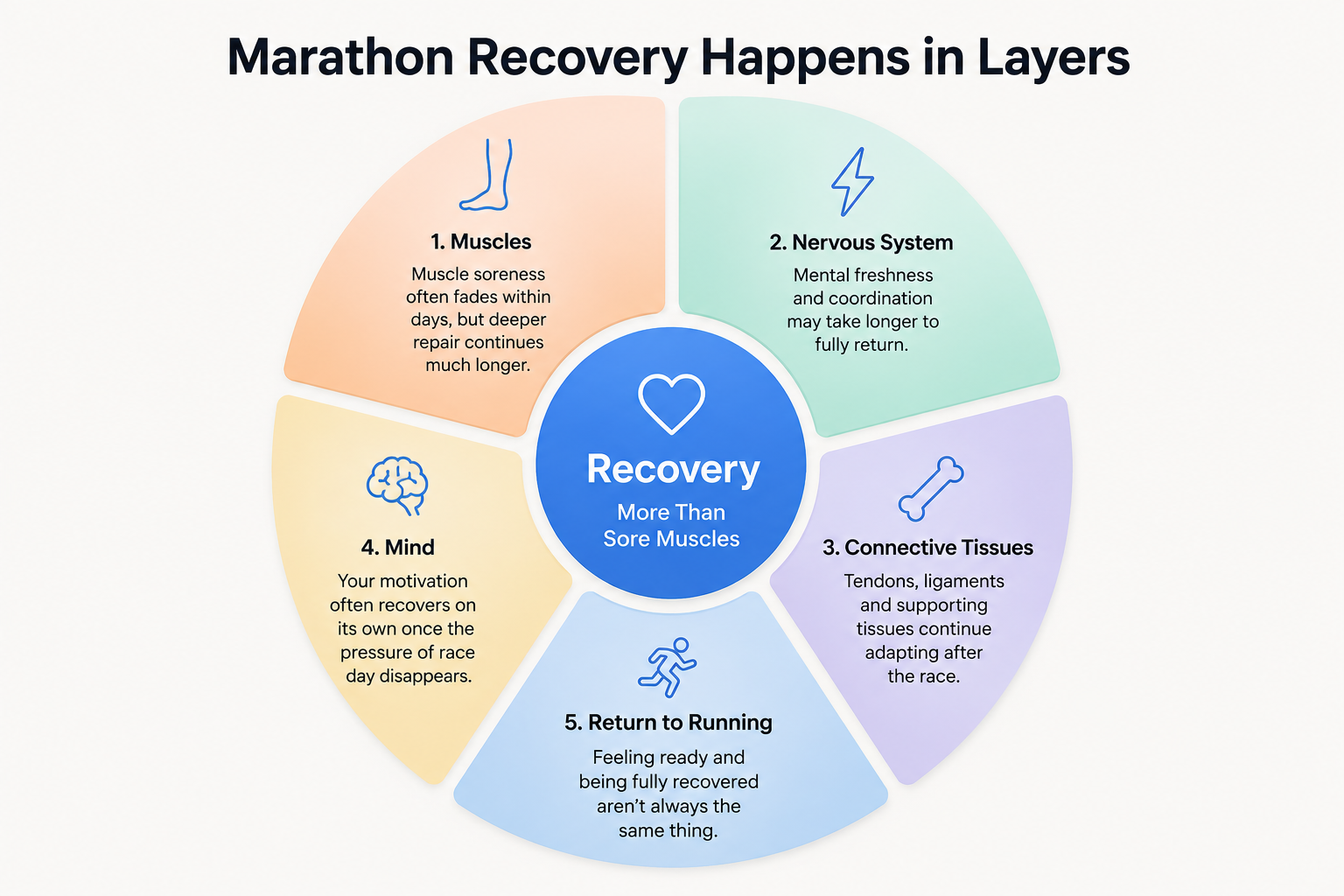
But soreness is only one small part of recovery. Your muscles are repairing microscopic damage. Tendons and connective tissues are adapting to the unusually high mechanical load they experienced over several hours. Glycogen stores are gradually returning to normal. Your nervous system is recovering from prolonged fatigue, while your immune system quietly deals with the stress created by the race.
Most of those processes happen without you noticing them. That’s why recovery can feel confusing. Your body may no longer hurt, yet it still hasn’t completely recovered. I think this is where many runners become impatient.
They judge recovery by how they feel during an easy walk or climbing the stairs. Their body, however, is still working in the background to restore systems that don’t announce themselves as clearly as sore muscles do.
Perhaps that’s why an easy run a week after the marathon can sometimes feel unexpectedly awkward. It’s not necessarily a sign that something has gone wrong.
It’s often a reminder that recovery isn’t one event. It’s several different timelines quietly overlapping.
If you’ve ever found yourself wondering whether you’re genuinely recovering or simply feeling better, our article How to Know If You’re Recovering Properly Between Runs explores the difference between feeling recovered and actually being ready to train again.
Why Marathon Recovery Feels Different From Normal Training
Perhaps the biggest mistake runners make after a marathon is expecting recovery to follow the same pattern as an ordinary hard workout.
That’s completely understandable.
After a difficult interval session, you might feel tired for a day or two before everything gradually returns to normal. Even after a demanding long run, your legs usually settle down within a few days.
A marathon often follows a different rhythm.
The effort isn’t simply harder. It’s longer than almost anything your body experiences during normal training, which means fatigue accumulates hour after hour instead of peaking during a single workout.
I think that’s why recovery can feel so inconsistent.
Your muscles may recover at one pace while your nervous system takes longer. Connective tissues continue adapting even after your energy levels have returned. Mentally, you may feel eager to run again long before your body has completely finished repairing itself.
Those different timelines don’t always move together. Looking back, I think many runners expect recovery to be linear. Every day should feel slightly better than the one before.
In reality, recovery often moves in waves. You might wake up feeling surprisingly fresh, enjoy a comfortable walk or an easy run, and then feel unexpectedly heavy the following day. That doesn’t necessarily mean you’ve gone backwards.
More often, it simply reflects the fact that your body is still balancing multiple recovery processes at once. To me, that’s one of the reasons patience matters so much after a marathon. Not because recovery should be slow for the sake of being cautious. Because your body is quietly rebuilding far more than sore muscles.
If you’ve recently finished your first marathon, our article Life After Your First Marathon explores another side of recovery that often receives less attention: how your motivation, expectations and relationship with running begin changing once the race is over.
Recovery Isn’t Only Physical
One thing that surprised me after my first marathon had nothing to do with my legs.
It was my motivation. I expected to feel excited about running again as soon as my body recovered. Instead, there were days when I simply didn’t feel the same urgency to lace up my shoes.
At first, that felt strange. After months of following a clear plan, running had become part of a routine that barely required any decisions. Every week already knew where it was going.
Then the race was over. The structure disappeared almost overnight. I think many runners mistake that feeling for a loss of motivation. I’m not sure that’s what’s really happening.
More often, I suspect it’s simply your mind adjusting to the absence of a goal that quietly shaped your everyday life for months.
Looking back, it makes perfect sense. Preparing for a marathon isn’t just physical training. It’s also a long period of anticipation. Week after week, your attention is focused on one event that’s gradually becoming more important.
When that event finally arrives, your body begins recovering from the effort.
Your mind begins recovering from the focus. Those two processes don’t necessarily finish at the same time.
To me, this is why I don’t think runners should rush into setting another major goal immediately after their first marathon. Sometimes the most valuable thing you can do is spend a few weeks rediscovering what running feels like without a finish line waiting in the distance.
Eventually, that curiosity almost always returns. The difference is that your next goal tends to come from genuine excitement rather than from feeling that you should always be preparing for something.
Recovery rarely follows the same timeline for everyone. If you’re unsure whether your body is simply feeling better or genuinely ready for normal training again, our Recovery Check can help you evaluate where you are before adding more training stress.
When Is Recovery Actually Complete?
If someone asked me how long marathon recovery takes, I’d struggle to give a single number. Not because the answer is unknown. Because the question is slightly too simple. Recovery isn’t a finish line you cross on a particular day.
It’s a gradual return to normal that often happens so quietly you barely notice it. One morning, an easy run starts feeling effortless again. A few days later, climbing the stairs no longer reminds you of race day. Your legs stop feeling as though they’re carrying a little extra weight. The hesitation you felt before running simply fades into the background.
Those moments rarely arrive together. That’s why I think runners sometimes become confused. They’re waiting for one clear signal that recovery is over.
In reality, it’s usually a collection of small signals that slowly begin pointing in the same direction. Your body starts responding to training the way it did before the marathon. Easy runs feel easy again. Recovery between sessions becomes predictable. Most importantly, you stop thinking about whether you’ve recovered.
You’re simply running. To me, that’s often the clearest sign of all.
Recovery is complete not when you stop noticing discomfort.
It’s when recovery itself stops being something you think about.
If you’re unsure whether your body is genuinely ready for normal training again, our Training Load Check Calculator can help you assess the signs that matter before increasing your training load.
Conclusion
Perhaps the biggest lesson marathon recovery teaches has very little to do with recovery itself. It teaches patience.
Before the race, patience means trusting months of consistent training instead of looking for shortcuts. After the race, it means trusting that your body knows how to adapt if you simply give it enough time.
Looking back, I think many runners judge recovery by what they can do. Can I run again? Can I train hard again? Can I start preparing for my next race?
Those questions are understandable. They’re just not the most helpful ones.
A better question might be this: What is my body still trying to finish?
Once you begin thinking that way, recovery stops feeling like time you’ve lost. It becomes part of the marathon itself. The finish line doesn’t end the adaptation. It simply marks the point where a different phase begins.
To me, that’s why recovery deserves the same respect as training. Neither one works properly without the other.
The marathon challenges your body for a single day. Recovery is where your body quietly turns that challenge into something lasting.
If you’re wondering whether you’re ready to return to structured training, our Today’s Run Decision Calculator can help you assess your current recovery status before increasing your workload again.
If your next goal eventually turns into another marathon, choosing gear that keeps long training blocks comfortable becomes just as important as choosing the goal itself. Our guide to the Best Long Run Shoes looks at the shoes designed to make those long weekends more enjoyable, one run at a time.
Frequently Asked Questions
Why do I feel recovered one day and tired again the next?
That’s completely normal after a marathon. Different systems in your body recover at different speeds, so recovery rarely follows a perfectly steady pattern.
Is muscle soreness a good indicator of recovery?
Not always. Muscle soreness often disappears before deeper recovery processes have finished, which is why feeling better doesn’t necessarily mean you’re ready for normal training.
How long does marathon recovery usually take?
There’s no single timeline. Recovery depends on your training background, race intensity, age and how well you recover afterwards. It’s usually more helpful to look for consistent signs of recovery than to focus on a specific number of days.
Should I avoid running completely after a marathon?
Not necessarily. Gentle movement and easy running often have their place, but the right timing varies from runner to runner. The important thing is allowing your body—not the calendar—to guide the return to normal training.
How do I know when I’m ready to train normally again?
When easy runs begin feeling natural, recovery between sessions becomes predictable and your body responds to training much as it did before the marathon, you’re usually close to normal training again. If you’re unsure, using a structured recovery assessment can provide additional reassurance.