
Should You Run Your First Marathon?
I’ve started noticing that the decision to run a first marathon often happens much earlier than the training itself.
Someone finishes a comfortable 10K. Another runner completes a half marathon and immediately begins looking at marathon dates. Sometimes it’s a conversation with friends. Sometimes it’s the atmosphere after watching a major city marathon. Before long, the question quietly appears.
Should I do it? I think many runners expect the answer to depend on pace, weekly mileage or finishing times.
Those things certainly matter. But I honestly believe they aren’t the first questions worth asking.
Running a marathon isn’t simply running a longer race. It’s asking your body—and your mind—to spend several months preparing for a goal that demands consistency more than talent.
To me, this is where the decision becomes much more interesting.
The real question isn’t whether you could survive 42.2 kilometres. It’s whether you’re ready to enjoy the journey that gets you there.
You’re not preparing to run 42.2 kilometres. You’re preparing to become the kind of runner who can
Why the Marathon Is Different
I think this is where many first-time runners underestimate what makes the marathon unique.
The distance itself is only part of the challenge.
Training for a marathon changes the rhythm of your life in a way that shorter races often don’t. Long runs gradually become part of your weekends. Recovery becomes something you think about more deliberately. Missing several weeks of training suddenly matters much more than it did when preparing for a 10K.
I’ve started noticing that experienced marathon runners rarely describe the race itself as the biggest achievement.
More often, they talk about the months leading up to it.
That’s because the marathon is less about one extraordinary day and more about dozens of ordinary training days linked together.
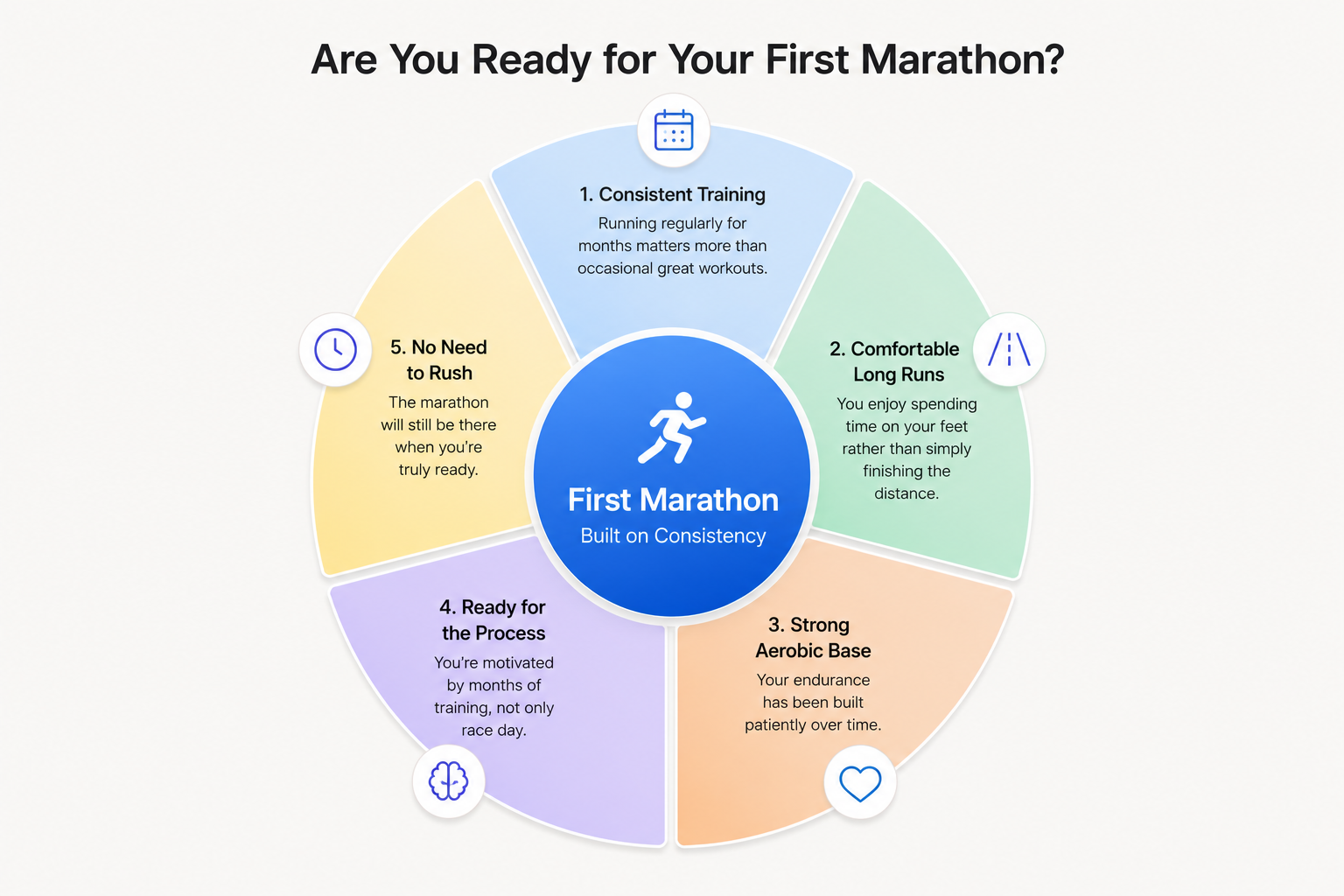
I honestly believe that’s why consistency matters so much. Very few runners become marathon-ready through a handful of brilliant workouts. Most arrive at the start line because they kept showing up, week after week, even when individual runs felt completely unremarkable.
To me, this is where the marathon quietly teaches something that extends far beyond running.
Progress is built through accumulation.
Not through perfection.
If you’re still building that consistency, our article What Consistency Actually Looks Like Over Months of Training explains why long-term progress is almost always less dramatic—and far more effective—than most runners expect.
Are You Ready to Train for a Marathon?
I think this is where many runners ask themselves the wrong question.
They wonder whether they’re capable of running 42.2 kilometres.
I honestly believe the better question is whether they’re capable of preparing for 42.2 kilometres.
Those aren’t the same thing.
A marathon isn’t won or lost on race day. Long before you stand on the start line, your body has already been shaped by months of easy runs, long runs, recovery days and ordinary weekday training sessions that rarely feel spectacular.
I’ve started noticing that runners who enjoy their first marathon are often not the fastest runners. They’re the ones who genuinely enjoy the process of becoming marathon runners.
That process asks for something quite different from shorter races.
It asks whether you can gradually increase your training volume without constantly chasing faster paces. It asks whether you’re comfortable spending two or three hours on your feet during a long run. It asks whether you’re willing to recover properly instead of trying to prove your fitness every time you lace up your shoes.
To me, this is where the marathon quietly rewards patience. The runners who arrive healthiest at the start line are rarely the ones who completed the hardest training. More often, they’re the ones who managed to string together months of uninterrupted, consistent running.
Another thing I’ve started noticing is that many runners become interested in the marathon immediately after a successful half marathon.
That excitement is completely understandable. At the same time, I don’t think completing a half marathon automatically means you’re ready for the demands of marathon training. It simply means you’ve reached the point where asking the question becomes reasonable.
The answer still depends on whether your current running routine is strong enough to support the extra volume, recovery and time commitment that marathon preparation requires.
If you’ve never built training around longer weeks before, our article Build a Weekly Running Structure explains why consistency across an entire week matters far more than a handful of impressive individual workouts.
Is a Marathon Really the Right Next Step?
I’ve started noticing that the marathon has become something of a milestone.
For many runners, it almost feels like the natural destination. You start with a few easy runs, eventually complete a 10K, then a half marathon, and before long the marathon seems like the obvious next box to tick.
I understand why. The marathon has a certain gravity around it. It carries history, prestige and the kind of challenge that appeals to people who enjoy testing themselves.
But I honestly don’t think every runner needs to rush towards it. Sometimes the best thing you can do for your long-term development is to spend another year becoming a stronger runner rather than simply becoming a marathon runner.
To me, this is where patience quietly becomes an advantage.
A runner who continues improving over 5K, 10K and the half marathon is still building exactly the qualities that will eventually make marathon training more enjoyable. Better aerobic fitness, stronger connective tissues, greater running economy and more experience with structured training don’t disappear when you move up in distance. They come with you.
Another thing I’ve started noticing is that runners often worry about missing their chance. They think if they don’t run a marathon this year, they’re somehow falling behind.
Running doesn’t work that way. There is no perfect age to run your first marathon. There is no deadline that suddenly closes. In fact, many runners discover that waiting until they’re physically and mentally ready makes their first marathon a far more rewarding experience.
I think that’s an idea we don’t hear often enough.
The goal isn’t simply to become someone who has finished a marathon. The goal is to become the kind of runner who can enjoy marathon training, arrive at the start line healthy and cross the finish line wanting to do it again.
If you’re still enjoying shorter races and wondering whether it’s worth continuing to build your foundation first, our article How to Build an Aerobic Base explains why patience is rarely wasted in endurance training.
Conclusion
I’ve started noticing that the runners who enjoy their first marathon the most rarely talk about the finish line first. They talk about the months that led them there.
The early morning long runs that gradually became easier. The confidence that grew almost without them noticing. The quiet satisfaction of looking back and realising they had become stronger simply by showing up week after week.
I honestly believe that’s what marathon training is really about. The race itself lasts a few hours.
The journey lasts several months.
To me, this is where the question changes one final time. Instead of asking whether you’re ready to run a marathon, ask yourself whether you’re excited about becoming the kind of runner who can train for one.
Those are very different ambitions. One is focused on a single day. The other is focused on becoming a stronger, more consistent endurance athlete.
If that process genuinely appeals to you, then your first marathon may be the perfect next step.
If it doesn’t, there’s absolutely nothing wrong with spending another season enjoying shorter races, building your aerobic base and becoming a better runner before taking on 42.2 kilometres.
The marathon will still be there. And I think that’s one of the most reassuring things about endurance running.
There’s no prize for getting there first. There is, however, enormous value in arriving when you’re truly ready.
If you’re beginning to think seriously about marathon training, a reliable GPS watch that helps you manage long runs, recovery and weekly training load can make the entire process much easier to navigate. Our guide to the Best Running Watches Used by Elite Runners compares the models trusted by experienced marathon runners.
Frequently Asked Questions
Should my first marathon be my next running goal?
Not necessarily. If you’re enjoying consistent training and have built a solid foundation through shorter races, a marathon can be a rewarding next challenge. But there’s no disadvantage in spending more time developing as a runner before moving up in distance.
Do I need to run a half marathon before my first marathon?
You don’t have to, but many runners find it helpful. A half marathon provides valuable experience with pacing, nutrition and race-day preparation while helping you understand how your body responds to longer efforts.
How many months should I train for my first marathon?
That depends on the foundation you already have. Most runners benefit from several months of specific marathon preparation built on top of an existing habit of consistent running rather than starting from scratch.
Is it okay to walk during my first marathon?
Absolutely. Many first-time marathon runners include planned or unplanned walking, particularly at aid stations. Finishing your first marathon is about managing the entire distance rather than maintaining a perfect running rhythm.
What is the biggest mistake first-time marathon runners make?
I think it’s focusing too much on race day and not enough on the months beforehand. A successful first marathon is usually the result of patient, consistent training rather than one exceptional workout.