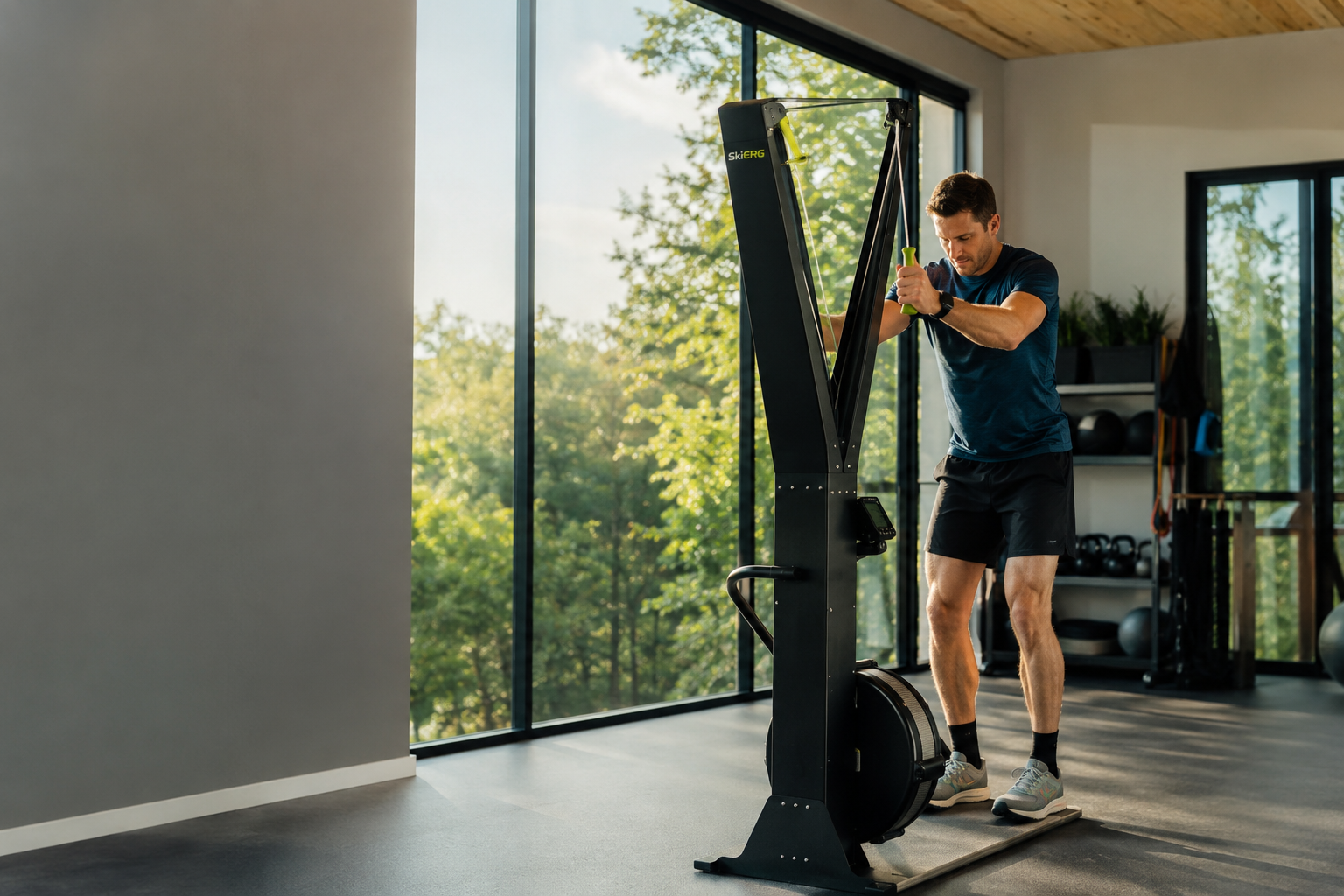
Is SkiErg Good Cross-Training for Runners?
The SkiErg can be slightly confusing the first time a runner uses one. You expect cardio. You start pulling. Heart rate begins rising quickly enough, breathing follows, and within a few minutes there is no question that you’re exercising. But the effort doesn’t feel much like running.
Your arms are involved. Your back and trunk are working. The repeated pulling movement starts exposing muscles that can remain almost invisible during an ordinary easy run.
Meanwhile, your legs aren’t experiencing anything close to the familiar rhythm of thousands of running strides.
So you finish the session knowing you’ve done aerobic work while also wondering how much of it actually matters for running. I think that’s the right question. Not whether SkiErg is good exercise. It clearly can be.
The more useful question is what kind of running problem you’re asking it to solve. If you’re trying to replace the adaptations created by running itself, SkiErg has obvious limitations. There is almost no running-specific impact, the movement pattern is completely different and much of the muscular work is distributed through areas that running uses far less aggressively.
But those differences aren’t necessarily disadvantages. They may be the reason a runner chooses it.
There are times when the cardiovascular system could comfortably absorb more aerobic work while the legs don’t particularly need another hour of running load.
SkiErg gives you a way to separate those two things. And once you look at it that way, its role in a runner’s training becomes much clearer.
SkiErg Trains the Engine Without Reproducing the Run
Running normally bundles several forms of stress together. Your cardiovascular system works to deliver oxygen. Your legs repeatedly produce and absorb force. Tendons and connective tissues experience thousands of loading cycles. The movement itself is practised again and again.
That’s useful because running is what you’re trying to improve. But it also means that adding more aerobic work through running usually means adding more running load at the same time.
SkiErg changes that relationship. You can raise oxygen demand and maintain sustained cardiovascular work without repeatedly landing on the ground.
Heart rate can climb substantially. Breathing can become demanding. Energy turnover increases. From the perspective of the central aerobic system, there is real work happening.
But the route used to create that work is very different. The pulling motion places much more emphasis on the upper body and trunk, while the hips and legs contribute differently depending on technique and resistance. You’re not reproducing the elastic loading and repeated ground contact that define running.
That means SkiErg can develop or maintain parts of the aerobic system that support running without creating the complete training stimulus of an easy run.
We’ve already seen the same underlying principle in Elliptical vs Easy Run, although the elliptical stays considerably closer to a lower-body endurance movement. SkiErg takes the separation much further.
And that’s precisely why I wouldn’t judge it by asking whether it feels enough like running. It isn’t supposed to.
The question is whether the aerobic work it provides is useful inside the training week you’re already doing. Sometimes it can be very useful indeed.
Your Upper Body May Limit You Before Your Aerobic System Does
This is where runners can have an unusual first experience with SkiErg. You may have enough aerobic fitness to run comfortably for an hour or considerably longer.
That doesn’t mean you can immediately SkiErg for an hour at the cardiovascular intensity you expected. The arms, shoulders, lats and trunk simply may not be accustomed to producing repeated force for that long. So something interesting happens. Your aerobic system still has room. Your local muscular endurance doesn’t.
The session begins feeling difficult, but not for the reason you intended. This distinction matters if you’re trying to use SkiErg as aerobic cross-training. Increasing resistance or pulling harder won’t necessarily solve it. It may simply make those relatively untrained muscles become the limiting factor even sooner.
I suspect this is where runners can accidentally turn SkiErg into something quite different from the session they planned. The machine feels powerful. Each pull gives immediate feedback.
It’s easy to start chasing watts, split times or resistance because those numbers create the same temptation pace creates in running. Before long, what was supposed to be controlled aerobic work becomes repeated hard pulling.
That’s a legitimate workout. It just isn’t necessarily the workout you needed. If the goal is additional aerobic volume, technique and restraint matter more than proving how much power you can produce.
As familiarity develops, local muscular endurance improves and the movement becomes more economical. Then it becomes easier to keep the cardiovascular system working without the upper body constantly demanding attention.
This is another reason not to compare SkiErg heart rate directly with running heart rate and assume the numbers should match.
Different muscles are creating the demand. The relationship between effort, heart rate and fatigue won’t necessarily be identical. The useful target is the training effect you’re trying to create, not a perfect imitation of the numbers from running.
When SkiErg Makes Sense in a Runner’s Week
The obvious way to use SkiErg is to replace something. A run disappears, SkiErg takes its place, and you compare the two. But I don’t think that’s always where the machine is most useful for runners.
Sometimes there is nothing you particularly want to remove. Your running volume is appropriate. The legs are handling it well. Easy runs feel genuinely easy and the important sessions are being absorbed without creating excessive fatigue.
You may still have room for a little more aerobic work. Adding another run is one way to get it. But another run also means another collection of running strides, another dose of impact and another small increase in the mechanical load the legs need to absorb.
SkiErg offers a different route. Twenty or thirty minutes of controlled work can increase the aerobic content of a training day without turning it into another running day. A longer easy SkiErg session can do the same thing when weather, schedule or accumulated leg load makes additional running less attractive.
To me, this is where the distinction between more running and more endurance training becomes useful. They aren’t always the same thing.
A runner needs enough running to develop the specific adaptations the sport requires. But once that requirement is being met, not every additional minute of aerobic training necessarily needs to come from another kilometre.
SkiErg can occupy some of that space. There is a catch, though. Low impact doesn’t mean free. If you add thirty minutes of SkiErg after an easy run, you’ve added thirty minutes of training. If you do it several times each week, the cardiovascular and metabolic cost accumulates even though your running mileage hasn’t changed.
The same applies to muscular fatigue. Your legs may feel perfectly normal while your upper body and trunk are still absorbing a type of work they aren’t accustomed to. This is why I’d resist treating SkiErg as bonus cardio that somehow sits outside the training plan.
It belongs inside the week.
What Makes a Training Week Actually Effective looks at this broader relationship between individual sessions and the stress they create together. A workout doesn’t become insignificant simply because it wasn’t a run.
Used deliberately, SkiErg can expand the amount of aerobic work a runner can tolerate. Used simply because it doesn’t hurt the legs, it can become another way to quietly add more training than you intended.

Can SkiErg Replace an Easy Run?
Sometimes. But this is where I’d make a stronger distinction than I would with something like an elliptical.
An easy run gives you controlled aerobic work while repeatedly practising the exact movement you’re training for. SkiErg preserves the first part reasonably well. It barely reproduces the second.
There is no repeated ground contact. The lower leg isn’t absorbing and returning force in the same way. Running-specific coordination isn’t being reinforced, and the muscular contribution is distributed very differently across the body.
So if your training week needs another exposure to running, SkiErg isn’t an equivalent replacement. But perhaps that isn’t what you need today. Maybe yesterday’s workout left the calves and quads carrying more fatigue than expected while the rest of you feel ready to train. Maybe you’re already running frequently enough that removing one occasional easy run won’t meaningfully reduce your running-specific stimulus.
Or perhaps you’re deliberately trying to maintain aerobic work during a period when total running load needs to come down. Then the equation changes. The thing you’re trying to preserve is the aerobic session, not necessarily the running.
In that situation, SkiErg can make sense. I wouldn’t try to convert the planned run into an exact SkiErg equivalent either. There is no useful formula where sixty minutes of easy running becomes a particular number of SkiErg meters or calories. The movement, muscular demand and mechanical stress are too different for that conversion to tell you much.
Duration and effort are more useful guides. If the run was supposed to be an easy aerobic session, the replacement should still behave like one.
You should be able to settle into the work rather than repeatedly attack the handles. Breathing should remain controlled enough that the session doesn’t quietly become threshold training for your upper body.
And you should finish understanding why you made the substitution. That last part matters. If every easy run begins looking replaceable because SkiErg offers aerobic work with less impact, eventually you remove too much of the ordinary running that makes the body durable enough to run.
The machine can replace a session. It cannot replace the accumulated effect of being a runner.
SkiErg Is Not Automatically a Recovery Session
This is probably the easiest misunderstanding to make. Your legs are tired, so instead of running you use SkiErg. No impact. Less loading through the lower legs. Therefore, recovery.
But recovery isn’t defined by what your feet are doing.
A SkiErg session can be extremely demanding. Increase the intensity and the cardiovascular load rises quickly. Pull hard enough and the upper body accumulates substantial muscular fatigue. Extend the session and you’re still using energy that the body has to restore afterwards.
You may have reduced one type of stress while adding another. That can still be a good decision. It just shouldn’t be confused with rest. I think this distinction becomes especially important after hard running sessions. If the purpose of the following day is genuinely to recover, there is no obligation to replace the missing training stress with a different kind.
Sometimes easy SkiErg work fits. Sometimes complete rest fits better. And sometimes an ordinary easy run is already the least complicated option.
The choice depends on what you’re trying to recover from. If the cardiovascular system feels fine but the legs would benefit from less impact, SkiErg can give you movement without repeating the same mechanical stress. If you’re generally fatigued, however, moving the workload from the legs toward the upper body doesn’t necessarily solve the problem.
Should You Run Today or Rest? (Simple Decision Framework) is useful here because the underlying decision is bigger than choosing between running and SkiErg. First decide whether today needs training at all. Only then does the choice of training mode become relevant.
That’s a much healthier role for cross-training. Not a way to avoid ever taking a day off. A way to change the type of stress when changing the type of stress actually helps.
SkiErg Works Best as SkiErg
There is a temptation with almost every form of cross-training to make it behave like running. Runners know running.
We know what an easy pace feels like. We understand the rhythm of intervals. We have familiar heart-rate ranges, workout durations and training habits that give sessions context.
So when we move to another machine, we naturally try to bring those reference points with us. The SkiErg doesn’t really need them. An easy SkiErg session doesn’t have to reproduce your easy-run heart rate perfectly. A harder SkiErg workout doesn’t need to copy the exact structure of your running intervals.
And the distance shown on the monitor doesn’t need to correspond to any imaginary number of running kilometers. The movement is different enough that forcing those comparisons often creates more confusion than useful information.
Let the SkiErg provide what it is particularly good at providing.
It can involve a large amount of muscle mass in rhythmic aerobic work. It can create substantial cardiovascular demand without repeated running impact. It can challenge upper-body and trunk endurance that ordinary running barely asks you to think about.
Those are features, not problems that need to be corrected. The important part is keeping the purpose of the session clear. If you’re using SkiErg for easy aerobic work, keep it sustainable. If you’re deliberately using it for a harder cardiovascular session, then let it become hard. If you’re using it because the legs need a break from running load, don’t turn the session into a competition against the numbers on the screen.
This is where perceived effort becomes particularly useful. Machines change. Movement patterns change. The meaning of a particular pace, wattage or heart rate can change with them.
But you can still recognize the difference between an effort you could comfortably sustain and one that is gradually turning into a workout. That ability is more transferable than any number on the monitor.
The SkiErg doesn’t need to become running without the running. Its usefulness comes from giving you another way to train endurance.
Conclusion
SkiErg can be very good cross-training for runners. But not because it reproduces running particularly well.
It doesn’t.
There is almost no running-specific impact. The movement pattern is different. The upper body contributes much more, while the calves, tendons and other structures involved in repeated running strides receive far less of their usual stimulus.
If you judged SkiErg entirely by specificity, those would all look like limitations.
Inside an actual training week, they can become advantages. There are days when you want aerobic work without another dose of running impact. There are periods when you’re already running enough but have room for additional endurance training. And there are situations where temporarily replacing an easy run allows you to maintain aerobic work while reducing the mechanical load on the legs.
SkiErg gives you another way to do those things. What it doesn’t give you is permission to ignore total training load. Thirty minutes on the SkiErg is still thirty minutes of training. A hard session is still hard. Moving stress away from the legs doesn’t make that stress disappear.
And if too much running is replaced, eventually something important goes missing. Running-specific durability is built by running. The repeated ground contact, tissue loading and movement economy that allow you to keep running aren’t developed completely by pulling handles in a gym, regardless of how strong your aerobic system becomes.
So I wouldn’t ask whether SkiErg is good enough to replace running. I’d ask a much simpler question. What does today’s training need? If you need running-specific work, run.
If you need aerobic work but don’t particularly need more running impact, SkiErg becomes much more interesting. Its value comes from being different from running. Not from pretending to be the same.
Cross-training also makes individual metrics harder to interpret in isolation because heart rate, pace and power don’t mean exactly the same thing across different activities. Looking at duration, effort and longer-term training patterns can provide much better context. Our guide to the Best Running Watches Used by Elite Runners looks at watches designed to bring running and broader endurance training into the same training picture.
Frequently Asked Questions
Is SkiErg good cardio for runners?
Yes. SkiErg can create substantial cardiovascular demand and can be used for both easy aerobic work and harder sessions. Because the movement recruits the body differently from running, however, effort and heart rate shouldn’t necessarily be expected to match your running numbers.
Can SkiErg replace an easy run?
Occasionally, yes. If the purpose of the session is primarily aerobic work and you’re already getting sufficient running-specific stimulus elsewhere, SkiErg can replace much of the cardiovascular component of an easy run. It doesn’t reproduce the mechanical adaptations created by running.
How long should runners use a SkiErg?
There isn’t a universal duration. The session should reflect its purpose and your familiarity with the movement. Runners new to SkiErg may initially find that upper-body muscular endurance becomes limiting before cardiovascular fitness does, so building duration gradually makes sense.
Should I use my running heart-rate zones on SkiErg?
Treat them as context rather than exact targets. Muscle recruitment and movement are sufficiently different that the relationship between heart rate and perceived effort may not be identical to running. For easy sessions, controlled breathing and sustainable effort can be more useful than forcing heart rate to match a running value.
Is SkiErg good for recovery days?
It can reduce running-specific impact, but that doesn’t automatically make it recovery. A hard or long SkiErg session still creates cardiovascular, metabolic and muscular fatigue. If the purpose of the day is genuine recovery, sometimes doing less is more appropriate than replacing the run with another workout.
Is SkiErg or an elliptical better for runners?
They serve slightly different purposes. An elliptical retains more lower-body involvement and a movement pattern somewhat closer to running, while SkiErg shifts considerably more work toward the upper body and trunk. Neither needs to be universally better. The useful choice depends on why you’re cross-training in the first place.