
Is Cross-Country Skiing Good for Runners?
Running builds the runner.
Cross-country skiing can help build the engine.
There is a particular kind of winter training day that can make running seem strangely unnecessary.
You head out on cross-country skis expecting a relatively relaxed endurance session. The effort settles. Breathing becomes rhythmic. An hour passes, then another, and somehow you’ve accumulated a substantial amount of aerobic work without thousands of running strides hitting the ground.
You finish tired. But it’s a different tired. The cardiovascular system has clearly worked. The upper body has been involved far more than it would during a run. Legs have been working continuously, yet they haven’t experienced the familiar repeated impact of running.
For a runner, that’s an interesting combination. And it explains why cross-country skiing has such a strong reputation as endurance training.
At first glance, the appeal seems obvious. If you can train aerobically for a long time while reducing impact, skiing looks almost like an ideal winter substitute for running.
But I think the word substitute makes the comparison less useful than it needs to be. Cross-country skiing doesn’t have to imitate running to help a runner. It can develop some of the same underlying endurance systems through a very different movement.
The important question is what transfers. And just as importantly, what doesn’t.
Cross-Country Skiing Can Create a Serious Aerobic Stimulus
One of the first things runners notice when they begin cross-country skiing is that easy skiing isn’t necessarily effortless skiing. There is a lot happening.
The legs are working, but so are the arms, shoulders, back and trunk. Depending on technique and terrain, a surprisingly large amount of the body can contribute to forward movement.
That matters physiologically. Working muscle requires oxygen, and when a large amount of muscle is active simultaneously, the cardiovascular system has a considerable job to do.
Heart rate rises. Ventilation increases. Energy demand grows. Sustain that work for long enough and you’ve created a substantial endurance session without running a single kilometre.
This is where cross-country skiing becomes particularly interesting for runners.
The heart and cardiovascular system aren’t exclusively running adaptations. They respond to sustained aerobic demand regardless of whether that demand came from running, cycling, an elliptical or skis.
That means hours spent skiing aren’t somehow lost simply because the movement looks different. They can contribute meaningfully to the aerobic capacity supporting your running. But skiing has another advantage that becomes especially noticeable during longer sessions.
There is very little of the repeated landing impact that normally accompanies running. That changes how aerobic volume can be accumulated.
A runner may have the cardiovascular capacity to train for two hours while the mechanical cost of running for two hours makes doing so regularly inappropriate. Cross-country skiing can allow substantial endurance work without adding exactly the same stress to the legs.
This is similar to the principle we explored in Elliptical vs Easy Run: aerobic work and running-specific mechanical load usually arrive together during running, but cross-training allows us to separate them. Cross-country skiing just does it in a much more dynamic way.
The Whole-Body Nature of Skiing Changes the Effort
There is one reason runners shouldn’t expect skiing effort to map neatly onto running effort.
You’re using the body differently. Running is dominated by the lower body, with the upper body contributing to balance, rhythm and movement without producing most of the propulsion.
Cross-country skiing asks much more from above the waist. Poles become part of propulsion. The trunk helps transfer force. Arms and shoulders contribute repeatedly, sometimes for hours.
A runner who is aerobically very fit can therefore step onto skis and encounter a strange limitation.
The lungs feel capable. The legs feel capable. The arms are wondering what exactly happened.
That’s not a failure of aerobic fitness. It’s specificity appearing again.
The body can have an excellent central cardiovascular system while individual muscles are relatively unprepared for a particular movement.
Technique makes this even more noticeable. An efficient skier turns each movement into forward progress with relatively little wasted effort. A less experienced skier may produce plenty of cardiovascular stress while spending much more energy simply managing balance, timing and propulsion.
I think this is why comparing skiing pace, heart rate or perceived effort directly with running can become misleading. The session doesn’t need to look like an easy run to create useful aerobic work.
It needs to serve the role you’re asking it to serve. If today is supposed to add controlled endurance volume, then turning every climb into a hard effort simply because skiing allows it isn’t necessarily helpful.
The skis have changed. The purpose of the training day hasn’t.
Why Skiing Can Let Runners Train for So Long
There is something unusual about finishing a long cross-country ski session.
You’ve clearly trained. Perhaps you’ve been moving for two or three hours. Your heart rate has spent most of that time elevated, you’ve climbed repeatedly and there is no question that the session required real endurance.
Yet the legs can feel remarkably different from how they would after a run of the same duration. Not necessarily fresh. Just differently tired.
That difference comes largely from how the two sports interact with the ground. Running repeatedly asks you to absorb the impact of landing. Muscles work eccentrically to control those forces, tendons are repeatedly loaded and the musculoskeletal system accumulates stress with every stride.
Cross-country skiing largely removes that landing cycle. You’re still producing force. The legs are still working continuously, and climbing on skis can become extremely demanding. But you’re gliding rather than repeatedly leaving the ground and landing on it.
That changes what eventually limits the duration of the session. For runners, I think this is one of the most useful things about skiing.
There are times when your aerobic system could comfortably handle more endurance work, but adding another long run would create more mechanical stress than you actually want.
Skis offer another route. You can spend a long time working aerobically without accumulating exactly the same kind of fatigue that comes from spending the equivalent time running.
This doesn’t make skiing free training. A long ski is still a long endurance session. Glycogen is still being used. Muscles still fatigue. Hard climbing can turn what looked like an easy day into a substantial workout remarkably quickly.
But the distribution of stress is different. And that difference can create room for aerobic volume that would be difficult to obtain sensibly through running alone.
This is where I think cross-training becomes most valuable. It isn’t necessarily about replacing a 60-minute run with 60 minutes of something else. Sometimes it allows you to do training you wouldn’t have added as running in the first place.
A two-hour easy ski doesn’t need to pretend to be a two-hour long run. It can simply be two hours of useful endurance work.
But Skiing Doesn’t Build Running Durability
This is where the story needs a little caution. Imagine someone spends most of the winter cross-country skiing.
They ski frequently, accumulate long aerobic sessions and become extremely fit. By spring, the cardiovascular system may be capable of supporting a substantial amount of endurance work.
Then they return to running. The first few runs feel wonderful. Breathing is easy. Heart rate looks good. The runner naturally assumes that because the engine is ready, normal running volume should be ready too.
A week or two later, the legs may disagree. This isn’t particularly surprising once you separate aerobic fitness from running-specific durability.
While skiing, you weren’t repeatedly landing on one leg thousands of times per hour. Your calves weren’t experiencing exactly the same loading. Your Achilles tendons weren’t doing exactly the same work. Bones and connective tissues weren’t receiving the same repeated running stimulus. Even muscular coordination was different.
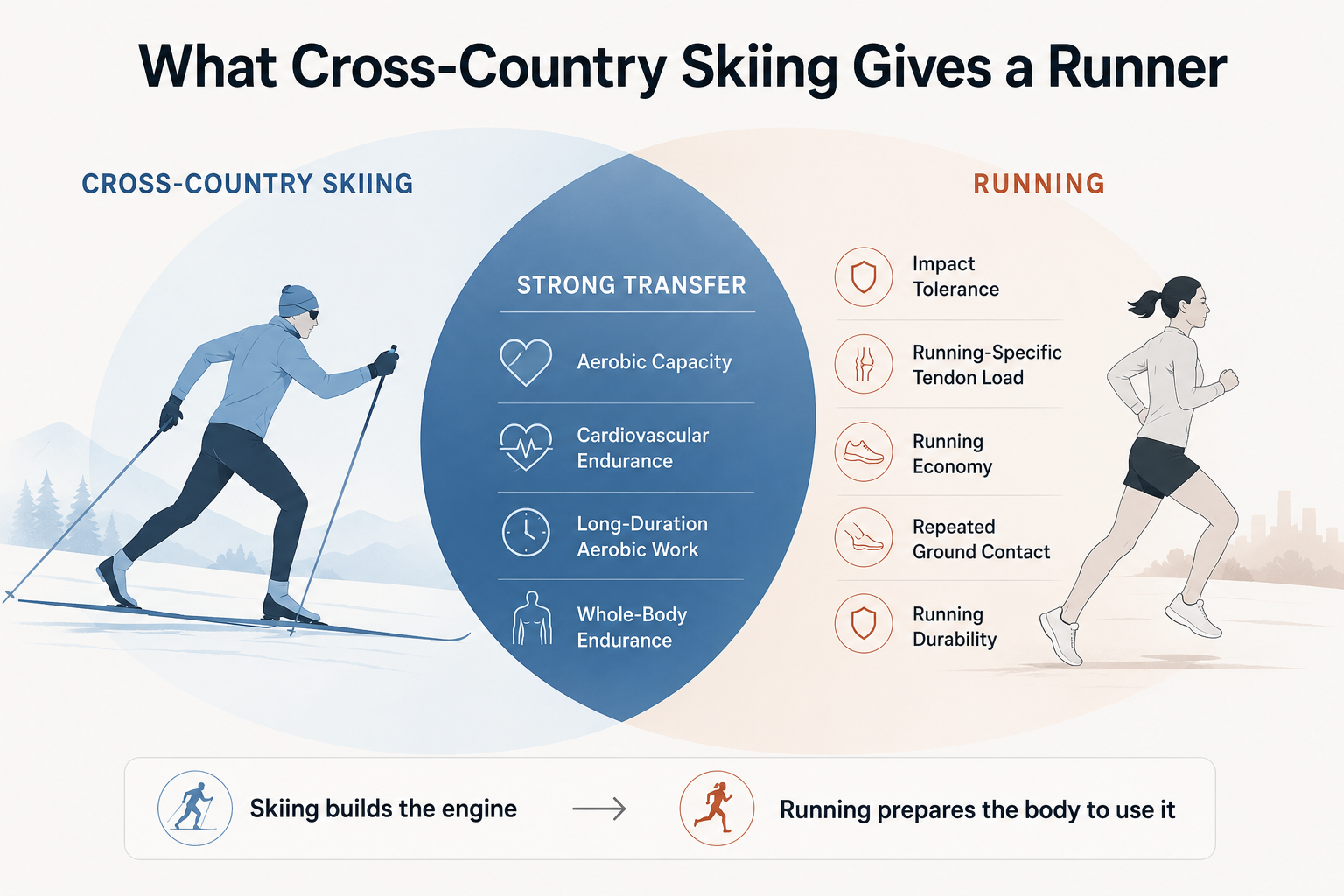
So although much of the aerobic fitness transfers, the mechanical preparation doesn’t transfer completely. This creates an interesting mismatch. You can be fit enough to run farther than your body is currently prepared to tolerate.
And I suspect that’s one of the more dangerous things about returning to running after a winter dominated by another endurance sport. Cardiovascular fitness makes the pace feel easy, which removes one of the natural signals that might otherwise encourage patience.
The lungs say go. The running tissues are still catching up. That’s why cross-country skiing can support running extraordinarily well without replacing the need to run.
If running remains part of your winter, even a relatively modest amount of regular running helps preserve familiarity with that mechanical load. If skiing largely replaces it for a period, the return deserves some progression rather than immediately matching the running volume your aerobic fitness seems capable of supporting.
This is the same reason How To Increase Weekly Running Volume Safely matters even when general fitness is already high. The question isn’t only whether you have enough aerobic capacity for more running. It’s whether the structures absorbing thousands of repeated strides are prepared for it too.
Skiing Can Complement Running Without Replacing It
Once that distinction is clear, the relationship between the two sports becomes much easier to manage. You don’t need to decide whether skiing counts as running.
It doesn’t. And it doesn’t need to. A runner can keep enough running in the week to maintain running-specific durability while using skiing to add aerobic work that might otherwise have required more mileage.
That can be an unusually good winter combination. Perhaps you keep your important running sessions and replace an easy day with skiing. Perhaps a long relaxed ski becomes additional endurance volume rather than replacing the weekly long run. Or perhaps, during a period when running volume deliberately comes down, skiing temporarily becomes a much larger part of the aerobic week.
The exact combination matters less than understanding what each activity is contributing.
Running gives you specificity. Skiing gives you substantial aerobic work with a different mechanical cost.
Together, they can sometimes allow more total endurance training than trying to obtain everything through running alone. But more is only useful when you can recover from it.
This is where runners can underestimate cross-country skiing precisely because it doesn’t leave the same soreness as running. A three-hour ski may feel mechanically forgiving, but it’s still three hours of training.
Put it beside a long run, a tempo session and the rest of the week, and the cardiovascular and metabolic load hasn’t somehow disappeared because you were on snow.
I wouldn’t treat skiing as bonus training that sits outside the plan. I’d treat it as part of the plan. That’s the difference between using cross-training to support running and simply adding more exercise because your legs happen to tolerate it.
And it fits naturally with the broader idea in Build a Weekly Running Structure: individual sessions make much more sense when you judge them by the role they play inside the entire week.
What About Skiing Instead of an Easy Run?
This is probably where cross-country skiing fits most naturally into a runner’s week. An easy run and an easy ski can both create sustained aerobic work without requiring particularly high intensity. You settle into a rhythm, breathing remains controlled and the session can continue for a considerable amount of time.
From the cardiovascular side, there is plenty of overlap. So if an easy run disappears from the schedule and an easy ski takes its place, you haven’t suddenly lost the entire purpose of the day.
You’ve changed how that purpose is delivered. The distinction is the same one we’ve been building throughout this article.
The ski gives you aerobic work. The run gives you aerobic work while also giving you another exposure to running.
Whether that difference matters today depends on the rest of the week. If you’re already running regularly and your body is receiving plenty of running-specific load, replacing an occasional easy run with skiing may cost very little while giving you a useful change in mechanical stress.
In some situations, it may actually improve the week. Your cardiovascular system still gets trained, but the legs avoid another round of running impact. You return to the next running session having accumulated endurance work without accumulating exactly the same fatigue.
But I wouldn’t automatically treat skiing as a recovery session. That’s an important distinction.
A relaxed hour on skis may be relatively gentle. Ninety minutes over rolling terrain can become something quite different. Add repeated climbs, harder snow conditions or enthusiastic skiing with friends and the session that replaced your easy run may end up considerably more demanding than the run you removed.
The absence of impact can hide that. You finish without the familiar muscular heaviness of running and assume the session was easy, even though the cardiovascular and metabolic demand was substantial.
This is where What Is The Difference Between Easy Runs and Recovery Runs becomes relevant. Low impact doesn’t automatically mean recovery, just as easy running and recovery running aren’t necessarily interchangeable ideas.
So I wouldn’t decide whether skiing can replace an easy run based simply on duration.
I’d look at what you wanted from the day. If the purpose was controlled aerobic work and you’re already getting enough running-specific stimulus elsewhere in the week, skiing can fit beautifully.
If the purpose was accumulating running volume itself, the ski doesn’t provide the same thing.
Again, neither answer makes one activity better. They simply do different jobs.
The Best Transfer Happens When You Keep Running
There is a slightly counterintuitive thing about cross-training. The fitter you become through another endurance sport, the easier it is to believe that all of that fitness should transfer automatically.
Some of it does. A great deal of it can. But the transfer becomes much more useful when there is still enough running in your training for those aerobic improvements to attach themselves to.
Think about what happens when you maintain a few regular runs while skiing substantially during winter. The skiing keeps feeding the aerobic system.
Meanwhile, running continues reminding the body what running requires. The calves keep working through the familiar movement. Tendons continue receiving running load. Coordination remains practised. The sensation of settling into running rhythm doesn’t disappear.
You don’t need every aerobic hour to be a running hour in order to preserve that relationship. You simply need enough running for the movement and its mechanical demands to remain familiar.
To me, this is where cross-country skiing becomes particularly powerful for runners. It doesn’t have to compete with running for ownership of the training week.
It can sit beside it. A runner might emerge from winter having accumulated a large amount of aerobic work without having forced running mileage upward simply to obtain that volume.
Then, when running becomes more important again, the aerobic foundation is already there. What needs to increase is the running-specific part. And that transition is much easier to manage when running never disappeared completely.
This is also why I wouldn’t obsess over converting skiing hours into running kilometers. There isn’t a useful universal equation.
Two hours of skiing doesn’t equal a particular number of kilometres running because the mechanical demands, technique, terrain and muscular involvement are different.
The training still counts. It just counts as what it actually was.
Cross-country skiing. A very good endurance sport that happens to complement running unusually well.
Conclusion
Cross-country skiing is good for runners for a fairly simple reason. It allows you to train endurance without asking your body to experience every endurance session as running.
That’s useful.
The cardiovascular system can work hard. Large amounts of muscle are involved. Long sessions can build substantial aerobic capacity, while the absence of repeated landing impact changes the mechanical cost of accumulating that work.
But that difference is also the limitation. Skiing doesn’t prepare the body for thousands of running strides in quite the same way running does.
It doesn’t need to. I think the mistake is expecting cross-training to reproduce running perfectly before we’re willing to consider it valuable. A better question is what it can contribute that running doesn’t always provide as easily.
Cross-country skiing can give a runner more room for aerobic work. Running gives that aerobic fitness somewhere specific to go.
Keep enough running in the picture and the two can complement each other remarkably well. Remove running almost completely and you may still return in spring with an excellent engine.
You’ll just need to give the running body some time to catch up. That’s the mental model I’d keep.
And when both are developed together, winter doesn’t have to be a period when running fitness simply waits for spring.
Cross-country skiing is also a good example of why endurance training becomes harder to understand if you look only at running mileage. When skiing, cycling and running all contribute to the same training week, duration, heart rate and broader training-load trends can provide useful context across different sports. Our guide to the Best Running Watches Used by Elite Runners looks at watches designed to bring that wider endurance picture together.
Frequently Asked Questions
Is cross-country skiing good cross-training for runners?
Yes. Cross-country skiing can provide substantial aerobic training while avoiding much of the repeated landing impact of running. It also involves considerably more upper-body work, making the overall muscular demand different from running.
Can cross-country skiing replace an easy run?
Occasionally, yes. If the purpose of the easy run is primarily aerobic work and you’re already getting enough running-specific load elsewhere, an easy ski can serve a similar cardiovascular role. It doesn’t reproduce the mechanical stimulus of running.
Can cross-country skiing improve running fitness?
It can improve aerobic capacities that support running. However, running performance also depends on running economy, tissue tolerance, muscular endurance and movement-specific adaptations that skiing doesn’t fully develop.
Is cross-country skiing good for runners during winter?
It can be particularly useful during winter because it provides another way to accumulate endurance volume without making every aerobic session a run. Keeping some regular running alongside skiing helps maintain running-specific durability.
Is cross-country skiing a recovery workout?
Not automatically. Easy skiing can be gentle, but terrain, technique, duration and intensity can make a ski session surprisingly demanding. Low impact and low training stress aren’t the same thing.
Should runners use classic or skate skiing?
Both can provide excellent aerobic training, and neither needs to be chosen specifically for running transfer. Technique, experience, terrain and which style you enjoy enough to practice consistently are likely to matter more than trying to identify one as the runner’s version of cross-country skiing.