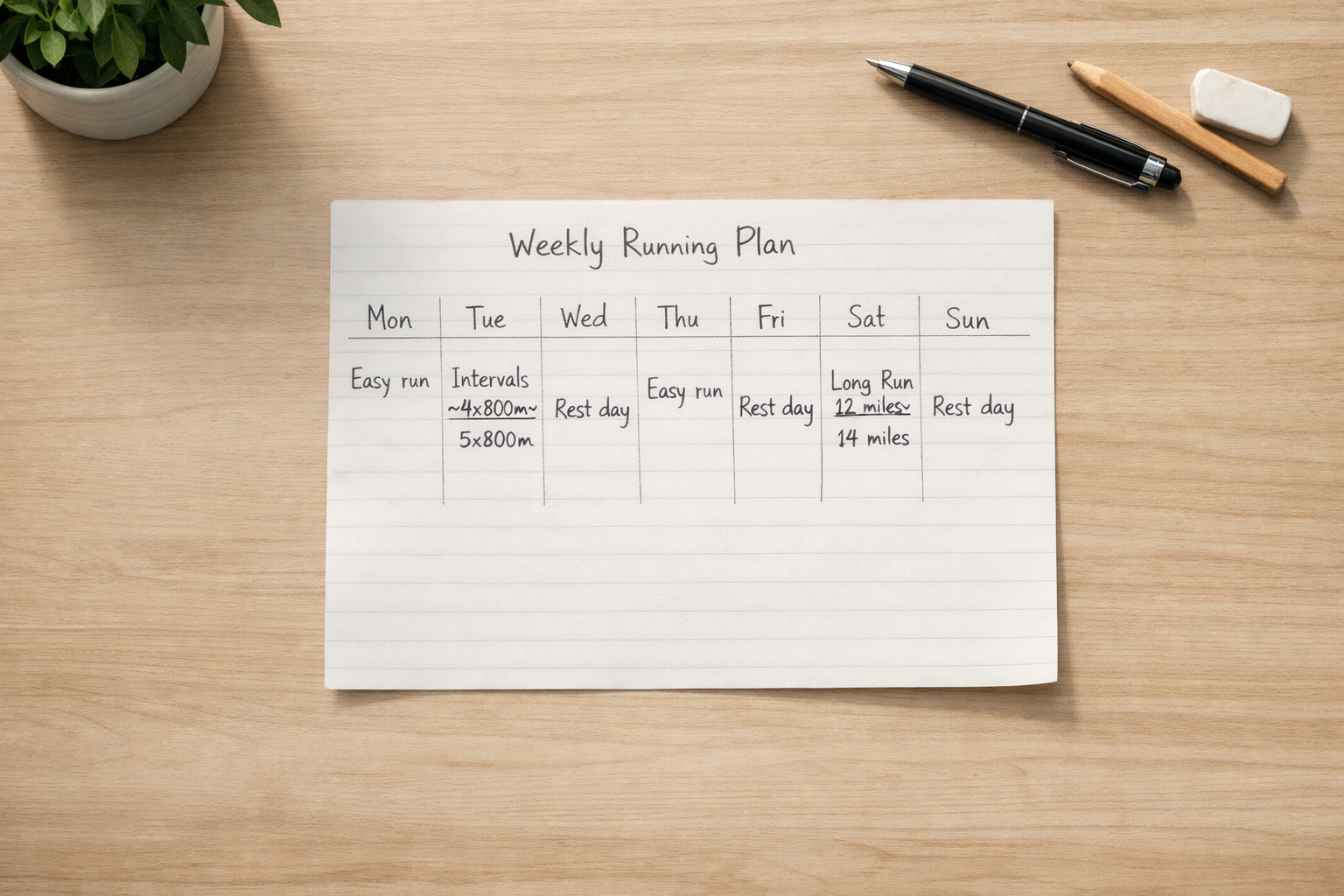
It’s easy to look at a week of training and focus on the individual runs.
A long run. A faster session. A few easy days in between.
And if those runs feel good on their own, it’s tempting to assume the whole week worked.
But training doesn’t really work like that. Because improvement doesn’t come from single runs.
It comes from how those runs connect.
If you want your training to feel more stable and reduce unnecessary strain during runs, supportive gear can help as well.
You can explore options in our guide to the Best Running Shoes for Daily Training (2026).
Why a week is more than just individual runs
Each run has a purpose.
But that purpose only makes sense in context.
A harder session creates stress.
An easy run helps you absorb it.
A longer run builds endurance over time.
On their own, these are just sessions. Together, they become a system.
That’s why focusing only on individual workouts can be misleading.
A good run does not automatically mean a good week.
The balance between stress and recovery
Every effective training week follows the same basic principle.
Stress → Recovery → Adaptation
Without enough stress, your body has no reason to improve.
Without enough recovery, it cannot adapt to that stress.
This is also why many runners feel stuck even when they are training regularly. They are either adding too much stress, or not allowing enough recovery to support it.
And most of the time, the problem is not obvious during a single run.
It shows up across the week.
Why structure matters more than intensity
It’s easy to think that harder training leads to better results.
But intensity only works when it sits inside a stable structure.
Without that structure, harder sessions often create more fatigue than progress.
This is the same idea behind Why Consistency Matters More Than Intensity, where improvement comes from what you can repeat, not what you can survive once.
Structure is what makes training repeatable. And repeatability is what makes it effective.
How different runs support each other
A training week is not a collection of separate efforts. It’s a sequence.
An easy run prepares you for a harder session.
A harder session creates the need for recovery.
A long run builds endurance on top of that structure.
If these elements are placed well, they support each other. If they are not, they start to interfere. This is also why understanding Build a Weekly Running Structure matters.
Because the value of each run depends on where it sits in the week.
What breaks a training week
Most training weeks don’t fail because of one bad run.
They fail because the overall balance is off. Too many moderate-to-hard efforts.
Not enough true easy running.
Poor spacing between harder sessions.
This often leads to the same pattern described in What Happens if You Run Too Fast Too Often, where fatigue accumulates faster than your body can adapt.
And when that happens, the whole week starts to feel heavier — even if each run seemed reasonable on its own.
What makes a training week effective
The goal is not to make every run hard. It is to make the whole week work together.
What a good week actually feels like
A good training week is not defined by how hard it felt. It is defined by how well it held together.
Your harder sessions feel controlled, not forced.
Your easy runs feel genuinely easy.
Your long run feels like a progression, not survival.
And most importantly, you finish the week feeling like you could repeat it.
That’s the signal many runners miss.
Because effective training does not feel like maximum effort.
It feels like something you can continue.
Frequently Asked Questions
How many hard sessions should a week include?
For most runners, one to two harder sessions per week is enough when supported by easy running and recovery.
Do all runs need a specific purpose?
Not in isolation, but across a week, each run should support the overall structure.
What is the most common mistake in weekly training?
Too much moderate intensity and not enough true recovery.
If you want to better understand how your effort and recovery behave across a week, using a reliable watch can help you see patterns instead of guessing.
You can explore options in our guide to the Best Running Watches for Running (2026).
Key takeaway
A training week becomes effective when its parts support each other.
Not when each run feels impressive on its own.