
Some workouts feel wrong much earlier than expected.
You start the session knowing roughly how the effort should feel. The pace looks realistic. The structure itself makes sense.
But within the first intervals or tempo segment, something already feels different. Breathing becomes heavier too early. The pace feels strangely expensive. The legs respond slower than normal. The effort rises much faster than it should.
And immediately, another thought appears:
Should I push through this… or is something actually off today?
This is one of the most difficult decisions in endurance training because hard workouts are supposed to feel challenging. That is part of their purpose.
But there is still a difference between: productive training stress, and a body that is no longer responding sustainably to the session in front of it.
Learning how to recognize that difference matters enormously long term.
Because strong endurance progress depends less on forcing every planned workout perfectly and more on understanding when the body is: ready for hard stress, temporarily resistant, or quietly overloaded underneath the surface.
Hard Runs Are Supposed To Feel Hard — But Not Chaotic
One reason runners struggle interpreting difficult workouts is that hard effort itself already includes discomfort.
Breathing becomes more noticeable. Muscles fatigue. Concentration increases.
The body works close to important physiological limits. That is normal. But productive hard running usually still feels controlled underneath the strain.
Breathing stays rhythmical. Movement remains coordinated. The body responds proportionally to effort instead of unpredictably.
Even when the workout becomes difficult, the system still feels organized. The problem starts when that structure disappears unusually early. Breathing becomes erratic instead of controlled. The pace feels unsustainably expensive immediately. Movement quality starts deteriorating much sooner than expected.
That usually signals something different than normal hard training discomfort.
This is closely connected to What a Good Training Day Actually Feels Like, because productive training stress often feels more stable and manageable than runners initially expect — even during harder sessions.
Good hard workouts feel demanding. They usually do not feel physically chaotic.
Sometimes The Body Simply Is Not Ready For The Planned Stress
One difficult reality about endurance training is that the body does not operate on perfect schedule timing.
The workout may look appropriate on paper.
But recovery, sleep, stress, previous training load, nutrition, and accumulated fatigue all influence how prepared the body actually is that day. And sometimes the body simply has less available capacity than expected.
That does not mean fitness disappeared. It does not mean training failed. And it does not automatically mean the session should stop immediately. But it does mean the original workload may no longer be the most productive option available.
This becomes especially important because hard sessions create disproportionately larger recovery cost than aerobic running. Forcing intensity into an already stressed system often produces much more fatigue than adaptation afterwards.
This is one reason experienced runners become surprisingly attentive to how hard workouts develop during the opening stages. They understand that the body often reveals readiness very quickly once intensity begins rising.
If recovery itself has recently felt inconsistent, How to Read Your Body Before a Run (Simple Daily Check) explains how subtle fatigue signals often appear before obvious performance decline becomes visible.
Sometimes a difficult workout is not a toughness problem. Sometimes it is simply a recovery timing problem.
One Of The Worst Decisions Is Panicking Early
Interestingly, one common mistake is overreacting too quickly the moment a hard run feels uncomfortable.
Because many hard workouts naturally feel awkward during the beginning.
The body still needs time to settle into rhythm. Aerobic systems are still stabilizing. Muscles and coordination are still adapting to rising effort.
That means the first few minutes of intensity are not always reliable indicators by themselves.
This is why experienced runners often wait briefly before making major decisions.
Does breathing stabilize after the first repetition? Does rhythm improve once the body settles? Does effort stop escalating after adjusting slightly?
Or does the workout continue becoming progressively more expensive regardless?
That distinction matters enormously. Because many workouts that initially feel rough become manageable once the body transitions properly into the session.
Others continue deteriorating despite adjustments. And those are very different situations physiologically.
This is one reason How to Adjust a Run Mid-Workout Without Ruining It matters so much. Many difficult sessions are still very salvageable through controlled adjustments before fatigue escalates further.
Not every uncomfortable start means the workout is failing. But not every worsening session should be forced either.
Small Adjustments Often Save The Workout
Many runners think workouts only “count” if completed exactly as written. But endurance adaptation is rarely that rigid.
Sometimes reducing pace slightly, shortening intervals, extending recoveries, or lowering total volume preserves far more productive training value than forcing the original session deeper into exhaustion.
Because once fatigue crosses a certain threshold, recovery cost often rises much faster than adaptation benefit.
That is especially true when:
movement quality deteriorates, breathing becomes unstable, or effort keeps escalating despite trying to maintain control.
In those situations, slightly reducing stress often allows the body to: regain rhythm, stabilize effort, and continue absorbing productive work instead of simply surviving the session.
This becomes increasingly important as training volume and workout density grow across longer endurance blocks.
What Happens If You Run Too Fast Too Often (And Why It Slows You Down) explains why repeatedly forcing unresolved strain often quietly limits progress much more than runners realize initially.
Sometimes preserving control creates more adaptation than proving toughness.
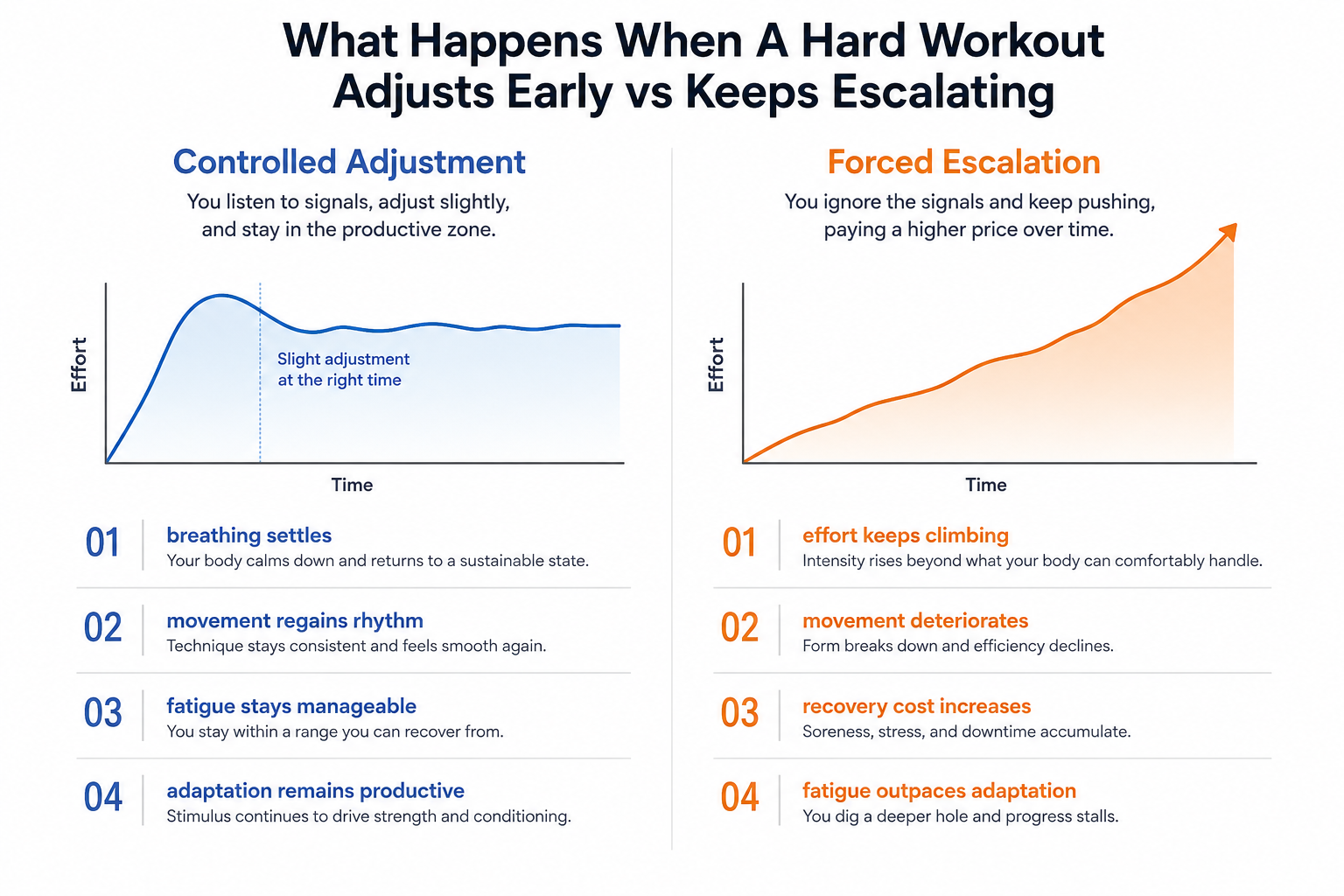
The Body Usually Tells The Truth Through Stability
One useful way to evaluate a difficult hard session is asking: “Is the body stabilizing or deteriorating?”
That question often reveals more than pace itself.
Stabilizing usually looks like: breathing settling slightly, movement becoming smoother, effort becoming more manageable once adjustments happen.
Deterioration usually looks different. Breathing keeps escalating. The body feels increasingly disconnected from pace. Movement becomes mechanically strained. Recovery between intervals stops restoring control.
That distinction matters because endurance training works best when stress remains absorbable.
Once the system clearly stops responding proportionally, additional forcing often creates much larger recovery cost than productive adaptation afterwards.
This is one reason strong endurance runners become less emotionally attached to perfect workout execution over time.
They stop treating training as: pass/fail.
And start treating it more like: stress management inside a living system.
Sometimes Protecting The Next Workout Is The Smartest Decision
One overlooked part of workout quality is what happens afterwards.
A session should not only be judged by whether every split was completed perfectly.
It should also be judged by how recoverable the session remains afterwards.
Can the body absorb it? Does tomorrow still feel manageable? Will recovery stabilize normally?
Because sustainable endurance progress depends heavily on training continuity across weeks and months — not isolated heroic workouts.
This is why runners who improve consistently long term usually become surprisingly willing to reduce stress early when the body clearly stops responding normally.
They understand that one adjusted session rarely matters negatively.
But accumulated unresolved fatigue often does.
What a Balanced Running Week Looks Like becomes extremely important here because strong endurance systems are usually built through stable recoverable stress distribution rather than constantly forcing intensity into already stressed recovery systems.
Sometimes the smartest hard workout is the one that leaves the body capable of adapting tomorrow too.
Frequently Asked Questions
Is it normal for hard workouts to feel difficult early?
Yes. Many hard sessions feel awkward during the opening minutes before breathing and rhythm fully settle.
How do I know if the workout is too hard that day?
Signs include effort escalating unusually fast, unstable breathing, deteriorating movement quality, and the body never settling despite adjustments.
Should I stop the workout completely?
Not necessarily. Many sessions become manageable again after reducing pace, extending recovery, or lowering total volume slightly.
Does adjusting the workout ruin the training effect?
Usually not. Controlled adjustments often preserve more productive adaptation than forcing unsustainable fatigue deeper into the system.
Why do experienced runners adjust workouts more calmly?
Because they understand that long-term progress depends more on sustainable adaptation than perfectly executing every planned session.
If You Want Better Control During Hard Workouts
Reliable pacing and heart rate feedback can help identify when effort is remaining appropriately controlled versus escalating beyond sustainable training intensity.
The goal is not obsessing over numbers.
It is understanding how the body is responding to stress throughout the session.
If you want a practical comparison of the best tools available, Best Running Watches for Running (2026) breaks down the most useful options for pacing control, recovery monitoring, and endurance-focused training.
Conclusion
When a planned hard run suddenly feels too hard, the goal is not automatically pushing harder or giving up immediately.
It is understanding what the body is actually communicating underneath the discomfort.
Because productive hard training usually still feels:
controlled, proportional, and mechanically stable even while difficult.
And when the body clearly stops responding sustainably, adjusting the session often protects adaptation far better than forcing intensity deeper into exhaustion.
Long-term endurance progress is rarely built through isolated perfect workouts.
More often, it is built through recognizing when the body is:
ready for stress, temporarily resistant, or quietly overloaded before fatigue becomes larger than the adaptation itself.