
You finish a run and catch yourself looking at the numbers sooner than usual.
The pace was stronger. The effort felt more controlled. Sections that normally require concentration seemed to happen almost automatically. Instead of fighting the run, you felt like you were moving with it.
For a moment, it feels as if something has changed. Maybe the training is finally paying off. Maybe this is the breakthrough you have been waiting for.
I think every runner experiences moments like this. One run suddenly feels different from the ones that came before it, and the temptation is to treat it as proof that a new level has been reached.
But the reality is rarely that simple.
Some exceptional runs are genuine signs of progress. Others are simply days when recovery, fitness, weather, and timing happen to align unusually well.
The challenge is that both experiences can feel almost identical while they are happening.
Learning to tell the difference is what prevents a good day from becoming a misleading conclusion.
Modern running watches allow you to track pace, distance, heart rate, cadence, VO2 max and much more during workouts.
If you’re choosing one for training, see our guide to the Best Running Watches for Running (2026).
Why Good Days Feel Like Breakthroughs
Most runners can remember a run that felt unusually easy. The pace was stronger than expected. The effort felt lower than normal. The whole session seemed to flow in a way that does not happen every day.
Naturally, it feels important.
I think this is because running is so repetitive. When most training weeks follow familiar patterns, any run that feels noticeably better immediately attracts attention. The brain starts looking for an explanation.
Maybe fitness has improved. Maybe a new level has finally been reached. Sometimes that interpretation is correct.
The challenge is that good days and breakthroughs often feel identical while they are happening.
A breakthrough is usually the result of many weeks of adaptation becoming visible at once. A good day can be created by something much more temporary, such as better recovery, lower stress, cooler weather, or simply arriving at a workout feeling unusually fresh.
That is why one run, no matter how encouraging, rarely provides a complete answer.
Over time, I think many runners realize that progress is not confirmed by a single performance. It is confirmed when the same improvement begins to appear repeatedly under similar conditions.
This is closely related to How to Recognize Real Progress vs Random Good Days, where the focus shifts from isolated results to patterns that hold over time.
What a Real Breakthrough Actually Looks Like
One of the reasons breakthroughs are difficult to identify is that they rarely announce themselves clearly.
I think many runners expect a breakthrough to feel dramatic. They imagine a run that changes everything overnight.
In reality, it is usually much quieter than that.
A breakthrough often begins with a single strong run, but it does not end there. The same feeling starts appearing again. Similar workouts become more manageable. Effort becomes easier to predict. Paces that once required concentration begin to feel more natural.
The important difference is repetition. A good day happens once and then disappears. A breakthrough leaves evidence behind. It starts showing up in other runs, other workouts, and eventually across entire weeks of training.
To me, this is where many runners misjudge what they are experiencing. They look for one exceptional performance when the more meaningful signal is often a series of slightly better performances that continue to repeat.
This is closely connected to How to Tell If Your Running Is Improving, where progress becomes visible not through isolated efforts but through patterns that remain stable over time.
A real breakthrough is rarely louder than a good day. What makes it different is that it stays.
Where It Becomes Difficult to Tell the Difference
The challenge is that breakthroughs and good days often begin in exactly the same way.
One run feels unusually smooth. The pace comes naturally. The effort feels lower than expected. Everything seems to align. In that moment, there is very little difference between the two.
I suspect this is why runners so often confuse them. The experience itself feels convincing. When a run exceeds expectations, it is natural to assume that fitness has suddenly taken a step forward.
But the run is only the beginning of the story. The real answer appears in the days and weeks that follow.
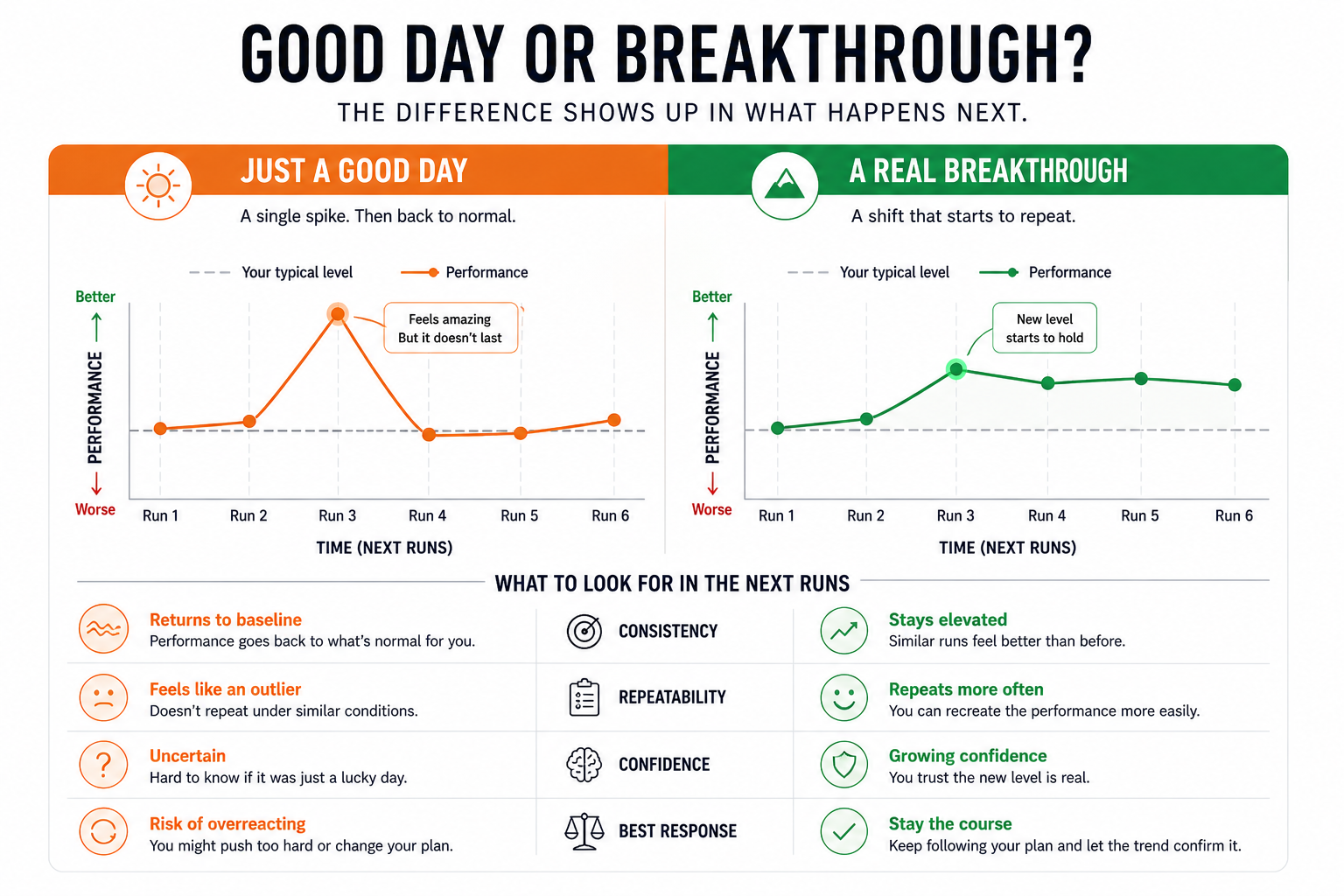
If the next similar sessions return to normal, it was probably just a good day. If the same improvement starts showing up repeatedly, something more meaningful may be happening. That is why breakthroughs can only be identified in hindsight. They reveal themselves through repetition, not through a single performance.
The run may start the conversation. What happens afterward provides the answer.
What to Look for in the Following Runs
The most reliable answer rarely comes from the run itself. It comes from what happens afterward.
If it was simply a good day, training usually returns to its familiar pattern. The next runs feel normal again. The unusually strong performance remains an isolated event rather than the start of a new trend.
A breakthrough behaves differently.
You may not immediately repeat the exact same pace or performance, but something feels slightly more stable. Similar runs become easier to manage. Effort becomes more predictable. Workouts that once felt demanding begin to feel more routine.
The individual run becomes less important because the overall baseline starts to change.
Over time, I think many runners realize that breakthroughs are rarely about producing one exceptional performance. They are about making a higher level of performance feel normal.
This is where runners often make the mistake described in What to Do After a Bad Run (And What Not To Do), just in reverse. A single positive signal feels so convincing that they immediately assume something permanent has changed.
But fitness does not reveal itself through one run. It reveals itself when the same improvement begins appearing again and again under similar conditions.
Without repetition, it is simply a moment. With repetition, it becomes a new reality.
A breakthrough repeats.
A good day doesn’t.
Why Misreading This Can Slow Your Progress
The way you interpret a strong run often matters more than the run itself.
If you treat a good day as a breakthrough, there is a temptation to react immediately. Expectations rise. Paces start feeling easier than they really are. The next workouts become slightly more aggressive because you believe your fitness has already moved to a new level.
I think this is one of the most common ways runners accidentally create inconsistency.
The problem is not the good run. The problem is building future training decisions around a conclusion that has not been confirmed yet.
When that happens, training begins to drift ahead of fitness instead of growing alongside it.
Interestingly, the opposite mistake is much less harmful.
If you fail to recognize a genuine breakthrough, nothing really goes wrong. You continue training, the improvement remains, and the pattern becomes clearer over the following weeks. The evidence eventually accumulates on its own.
That is why I honestly believe it is usually safer to be conservative when interpreting unusually strong performances.
A breakthrough does not need to be announced immediately. If it is real, it will keep showing up.
This aligns closely with What Counts as Progress in Running, where progress is something you confirm through repetition rather than something you assume from a single result.
How to Respond Without Overreacting
Once you realize that breakthroughs can only be confirmed over time, the response becomes surprisingly simple.
Keep training.
I think many runners feel an urge to do something after an unusually strong run. The performance feels meaningful, so it seems natural to adjust the plan, increase expectations, or test whether the improvement is real.
But there is usually no need to rush.
If the run was the beginning of a genuine breakthrough, the evidence will continue to appear in the sessions that follow. Similar workouts will feel more controlled. The new level will start showing up repeatedly without being forced.
If it was simply a good day, the pattern will fade naturally and training will return to its usual rhythm.
Either way, the best approach is often the same. Continue as planned and allow the next runs to provide more information.
To me, this is where consistency becomes so valuable. It removes the pressure to make conclusions too early and allows progress to reveal itself at its own pace.
This connects naturally to Why Your Progress Is Not Linear, because improvement rarely arrives in a straight line. It appears through patterns, and patterns take time to recognize.
Consistency protects you from both overestimating and underestimating your progress.
Conclusion
A breakthrough and a good day can feel almost identical while they are happening.
Both can produce stronger pace, lower effort, and the feeling that something has suddenly clicked into place.
The difference only becomes visible later.
A good day is a moment. A breakthrough is a pattern.
One appears once and fades. The other begins showing up repeatedly until a higher level of performance starts feeling normal.
Over time, I think many runners realize that the most meaningful improvements are rarely the most dramatic ones. They are the changes that quietly remain after the excitement of a single run has passed.
That is why the goal is not to identify breakthroughs immediately. The goal is to recognize them when they become impossible to ignore.
Frequently Asked Questions
How many runs does it take to confirm a breakthrough?
There is no exact number, but you should see a pattern across multiple similar runs. Consistency is more important than frequency.
Can a breakthrough feel easy?
Yes. Many breakthroughs feel smoother rather than harder, because your body is working more efficiently.
What if I never see clear breakthroughs?
Progress often appears gradually rather than dramatically. Many improvements are subtle and become visible only over time.
Should I push harder after a strong run?
No. It is better to stay consistent and let the next runs confirm whether the improvement is real.
If you want to track whether improvements are repeating across runs, using consistent data can help.
A guide like Best Heart Rate Monitors for Running can help you choose a device that makes patterns easier to see over time.