
You head out expecting an ordinary run. Nothing about the day seems unusual. The route is familiar. The effort should feel manageable. There is no obvious reason to expect anything different.
But within the first few minutes, something feels wrong. The pace feels unusually expensive. Your breathing never quite settles. The rhythm that normally appears on its own refuses to show up.
Instead of enjoying the run, you find yourself counting down the remaining distance. And when the session finally ends, the run often follows you home.
I think most runners know this feeling. Not because bad runs are rare. Because they are surprisingly memorable. A good run creates confidence. A bad run creates questions.
Have I lost fitness? Am I getting sick? Is the training no longer working? Did I do something wrong?
The difficult part is that a single bad run rarely provides enough information to answer any of those questions. And honestly, I believe this is where many runners make their biggest mistakes. They treat one difficult run as evidence. The body usually treats it as data.
Because in most cases, a bad run is not something that needs to be fixed immediately.
It is something that needs to be understood first. And learning the difference is often what separates productive training decisions from emotional ones.
Modern running watches allow you to track pace, distance, heart rate, cadence, VO2 max and much more during workouts.
If you’re choosing one for training, see our guide to the Best Running Watches for Running (2026).
Why Bad Runs Happen Even When Training Is Going Well
One reason bad runs can feel so unsettling is that they often appear without an obvious explanation.
The training has been consistent. Recovery seems normal. Nothing in the plan appears broken. Yet the run still feels unusually difficult.
I think many runners assume there must be a specific reason. Sometimes there is. But often there is simply a collection of small factors working in the background. Running does not happen inside a controlled laboratory. It happens inside a human body.
Sleep changes. Stress changes. Hydration changes. Weather changes. Life changes. And all of those factors influence how a run feels long before they influence fitness itself.
This is why a single bad run is usually a poor indicator of overall progress. The body can have an off day even when adaptation is moving in the right direction.
To me, this is where many runners accidentally confuse daily variation with meaningful change. A difficult run feels important because it is happening right now.
But the body is often telling a much larger story than one workout can reveal.
This is closely connected to Why Some Runs Feel Easy and Others Feel Hard, because variation is not evidence that something has gone wrong.
It is often evidence that training is happening inside a living system rather than a perfectly predictable machine.
Over time, I think many runners become less concerned by individual bad runs and more interested in whether those bad runs start repeating.
Because one difficult day is normal. A recurring pattern is what deserves attention.
A bad run is usually information. A series of bad runs becomes a signal.
Why the Immediate Reaction Matters More Than the Run Itself
One difficult run rarely changes the direction of your training. The response to that run often can.
I think this is one of the least appreciated aspects of long-term development. A bad run feels important. It feels like something needs to be explained, corrected, or compensated for. And that is exactly what makes these situations so tricky.
The natural reaction is often to prove that the run did not mean anything. Maybe the next workout should be harder. Maybe effort should increase. Maybe the body simply needs a stronger signal. At first glance, those responses seem reasonable. But they are often driven more by emotion than by information.
To me, this is where many small training fluctuations become much larger problems. The bad run itself is usually temporary. The reaction to the bad run can create consequences that last much longer.
Instead of allowing the system to return to its normal rhythm, additional stress is added before the situation is fully understood. And once that happens, it becomes much harder to know what the body was trying to communicate in the first place.
This is closely connected to What To Do When Your Training Suddenly Feels Wrong, because the response can sometimes create more disruption than the original issue ever did.
Over time, I think many runners develop a surprisingly valuable skill. They stop reacting immediately. They become curious first. Was this a bad run? Or was it the beginning of a pattern?
The answer is rarely available in the first few hours after the workout. That is why patience often becomes more useful than action. Because the goal is not fixing every difficult run. The goal is understanding whether anything actually needs fixing at all.
What a Bad Run Actually Tells You
One reason bad runs create so much anxiety is that runners often treat them as a verdict. The run felt difficult. The pace was disappointing. The effort seemed unusually high. And almost immediately, the mind starts drawing conclusions.
Maybe fitness is declining. Maybe the training is no longer working. Maybe something has gone wrong.
I think this is where many runners accidentally give one run far more authority than it deserves. Because a single workout rarely has enough information to tell the whole story. A bad run is not a verdict on your fitness. It is a snapshot of your current state.
It reflects how the body responded on that particular day, under those particular conditions, with that particular combination of recovery, stress, fatigue, and readiness.
That information is useful. But it is not the same thing as a trend. To me, this is one of the most important distinctions in training. The body experiences individual days. Progress happens across many days.
That is why the most valuable question is rarely: Was this run bad?
The more useful question is: Does this run fit into a larger pattern?
If similar runs keep becoming harder, recovery keeps becoming slower, and the same signals continue repeating, then the situation becomes more meaningful.
If the next few runs return to normal, the difficult session was probably just part of the natural variation that exists in every training cycle.
Over time, I think many runners become much more confident once they stop treating every run as a prediction of the future.
Because one workout can describe today. Only a pattern can describe where training is actually heading.
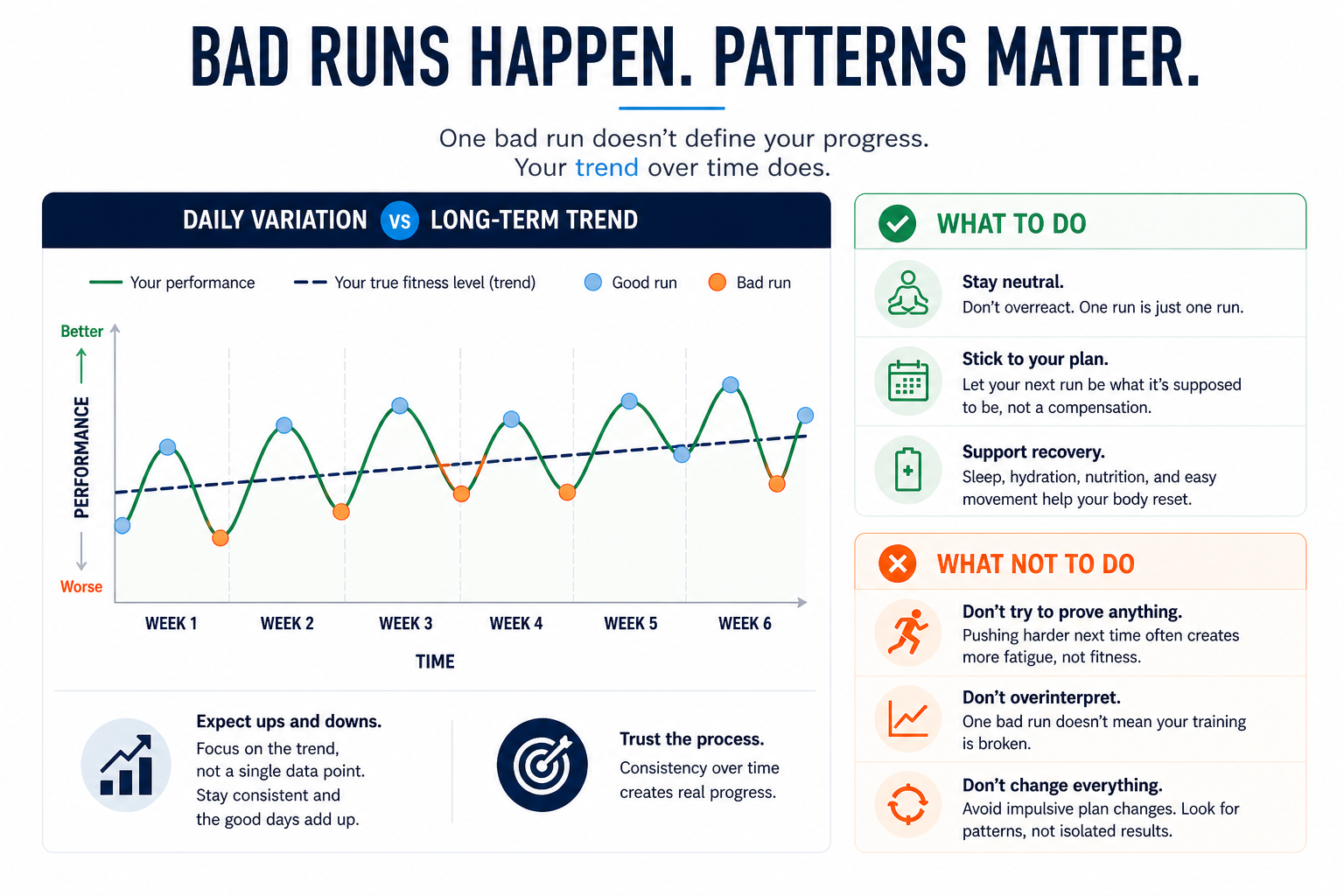
What to Do After a Bad Run
The most productive response to a bad run is often the least dramatic one. Stay neutral. I think this can feel surprisingly difficult.
A disappointing run naturally creates a desire to respond. The mind starts searching for adjustments, explanations, or ways to regain confidence as quickly as possible. But most bad runs do not require an immediate solution.
They require observation.
In many cases, the best next step is simply returning to the structure you already planned. The next run does not need to compensate for the previous one. It only needs to serve its own purpose.
This is one reason How to Adjust a Run Mid-Workout Without Ruining It becomes such a useful skill. Learning to manage effort while the run is happening often prevents a temporary problem from becoming a larger one afterward.
To me, this is where many runners accidentally create unnecessary instability. A bad run feels unusual. So they make the next run unusual as well. Then the training week starts reacting to one isolated event instead of following a consistent process.
If fatigue was clearly present, reducing effort slightly for a few days may help restore balance.
If the run simply felt off but recovery, motivation, and overall readiness remain normal, continuing as planned is often the most productive option.
Because the goal is not proving that the bad run did not matter. The goal is allowing the body to return to its normal rhythm.
Over time, I think many runners discover that confidence does not come from fixing every difficult run. It comes from trusting a training structure that can absorb difficult runs without falling apart.
And that is why the most important objective after a bad run is surprisingly simple: Do not let one difficult day become a recurring pattern.
What Not to Do
The most common mistake after a bad run is trying to erase it.
I think almost every runner has felt this temptation at some point. The workout felt disappointing. Confidence took a small hit. And suddenly there is an urge to prove that the run did not mean anything.
Maybe the next session should be harder or maybe extra intensity will restore confidence. Maybe one strong workout can cancel out the previous one.
The problem is that training rarely works that way. A bad run is usually a temporary event. The reaction to that run can become a much bigger issue.
When extra stress is added before the body has returned to balance, the original problem often becomes harder to interpret and harder to resolve.
To me, this is where many runners accidentally create inconsistency. They stop following the plan and start negotiating with individual workouts.
The second mistake is assigning too much meaning to a single result. One difficult run feels important because it is emotionally memorable. But emotionally memorable is not the same thing as statistically meaningful.
This is closely connected to How to Recognize Real Progress vs Random Good Days, because the same mistake works in both directions.
A single great run cannot prove improvement. A single bad run cannot prove decline. Both become meaningful only when they start repeating.
Over time, I think many runners become much calmer once they stop treating individual workouts as verdicts. Because training is rarely decided by one run. It is shaped by the patterns that emerge across many runs.
A bad run does not change your progress.
Your reaction to it can.
Why Consistency Protects You From Bad Days
One of the biggest misconceptions in running is believing that consistent training should eliminate bad runs.
It does not. Even highly experienced runners have days where the body feels unusually heavy, the pace feels expensive, and nothing seems to click.
Consistency does not remove those experiences. What it changes is their significance.
I think this is one of the most underrated benefits of a well-structured training system. When training is consistent, a bad run becomes much less powerful.
It no longer has the ability to redefine the entire week.
The system is already strong enough to absorb it. The next runs arrive. The normal rhythm returns. The larger pattern remains intact.
To me, this is where consistency becomes more valuable than perfection. A training plan built around perfect execution becomes fragile. A training plan built around consistency becomes resilient.
This is closely connected to What Makes a Training Week Actually Effective, because effective training is rarely about executing every session perfectly.
It is about creating a structure that continues working even when individual sessions do not. Over time, I think many runners stop asking how to avoid bad runs completely.
They start asking a better question: Can my training absorb them without losing direction?
That is usually the real measure of a healthy system. Because consistency does not eliminate bad runs. It simply prevents them from becoming important.
Conclusion
Bad runs are an unavoidable part of training. No amount of fitness, experience, or preparation removes them completely.
I think one of the most important lessons runners learn over time is that a difficult run does not automatically require a response. Sometimes it simply requires perspective.
A bad run reflects how the body responded on a particular day. It does not automatically describe your fitness. It does not automatically predict the future. And it certainly does not have the power to erase months of consistent training.
That is why the most productive question after a difficult run is rarely: How do I fix this?
The more useful question is: Does this actually change anything?
Most of the time, the answer is no. The next run arrives. The training continues. The larger pattern remains intact.
Over time, I think many runners become more confident once they stop treating bad runs as interruptions and start treating them as normal parts of the process.
Because progress is not built from individual workouts. It is built from the ability to continue moving forward despite them.
Frequently Asked Questions
How often should I expect bad runs?
Regularly. Every runner experiences off days, even when training is going well. They are part of normal variation.
Should I change my plan after a bad run?
Not immediately. Wait to see if the pattern repeats. Most of the time, continuing as planned is the best approach.
What if several bad runs happen in a row?
That may indicate accumulated fatigue, stress, or imbalance in your training. At that point, adjusting load or recovery becomes more relevant.
Can a bad run still be useful?
Yes. It provides information about your current state. The key is interpreting it in context rather than reacting to it emotionally.
If you want to track how your body responds to different days more clearly, using consistent data can help you separate patterns from random variation.
A guide like Best Heart Rate Monitors for Running can help you choose a device that supports that consistency.