
You head out for an ordinary run with no particular expectations.
Nothing about the day feels special. The route is familiar. The workout is routine. If anything, you are simply trying to tick another session off the week.
Then something unexpected happens.
The pace feels smooth. Your breathing settles quickly. The effort feels lighter than it normally does.
For a moment, everything seems to click. And almost immediately, a hopeful thought appears. Maybe this is progress. Maybe all those weeks of consistent training are finally starting to show.
I think every runner experiences moments like this. A run feels unusually good, and the temptation is to treat it as proof that something has changed.
But the difficult question is not whether the run was good. The difficult question is whether it means anything. Because running is full of good days. Progress is something else.
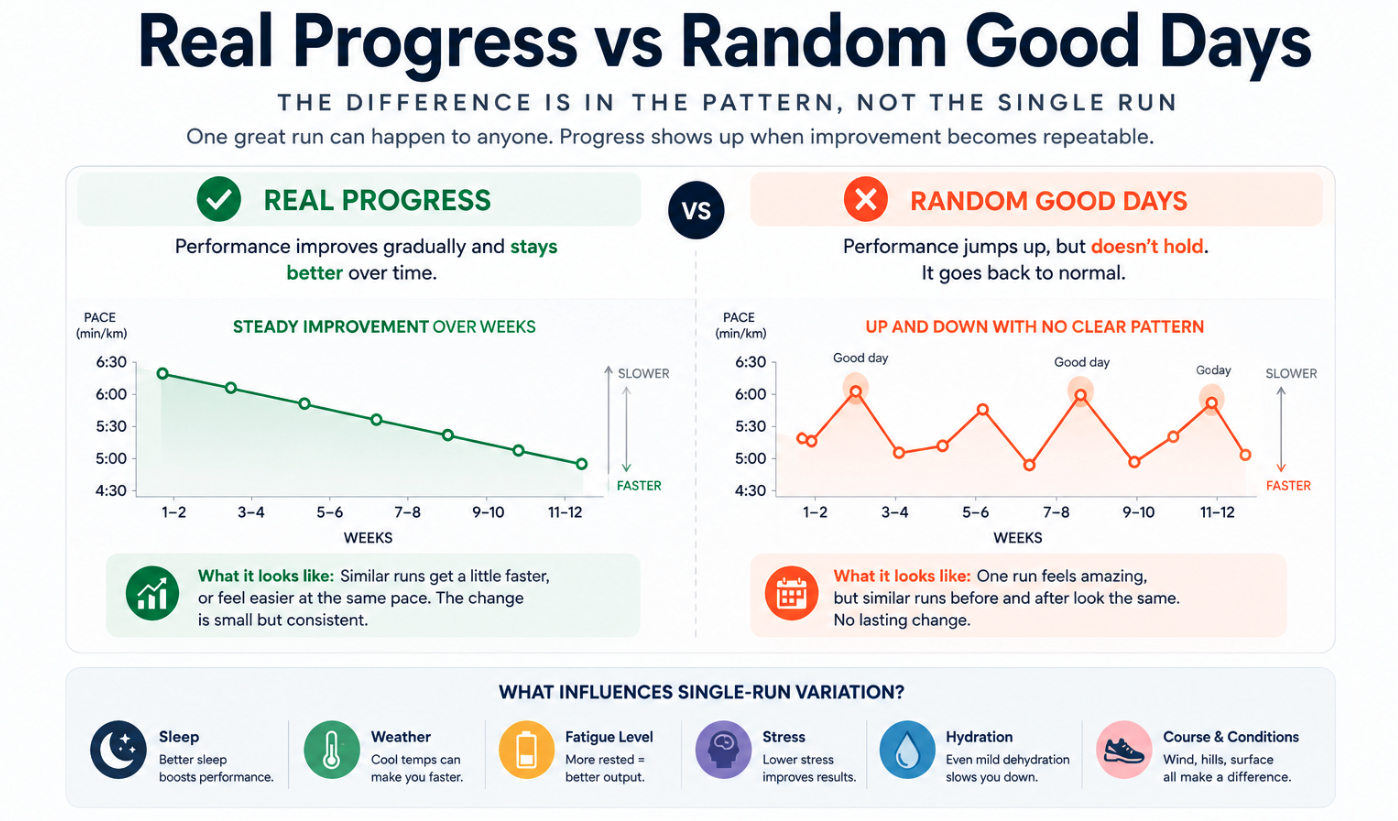
A good day happens once. Real progress tends to come back and repeat itself.
If you want your running to feel more consistent and comfortable, the gear you use can make a difference.
The right shoes help reduce unnecessary strain and support smoother movement.
If you’re unsure what to choose, take a look at our guide to the Best Running Shoes for Daily Training (2026).
Why One Good Run Feels So Convincing
One reason good runs are so persuasive is that runners spend a lot of time waiting for signs of progress. You train consistently. You trust the process. You complete weeks of running without seeing dramatic changes.
Then suddenly a run feels noticeably better. The pace flows naturally. The effort feels lighter. Everything seems to work the way you hoped it would. Of course it feels meaningful.
I think most runners immediately start looking for an explanation. Maybe fitness has improved. Maybe training is finally paying off. Maybe something has changed. And sometimes that is exactly what happened.
The problem is that a single good run cannot tell you which explanation is correct. The body does not adapt in isolated moments.
Adaptation happens quietly through repeated cycles of training, recovery, and time.
That is why What Counts as Progress in Running is ultimately less about individual performances and more about recurring patterns.
A good run tells you what happened today. Real progress reveals itself when similar runs start happening again and again.
Over time, I think many runners realize that improvement rarely arrives as one unforgettable workout. It usually arrives as a growing number of ordinary runs that feel slightly better than they used to.
What Real Progress Actually Looks Like
One reason progress can be difficult to recognize is that it rarely arrives in the form most runners expect. We tend to imagine improvement as a breakthrough.
A personal best. A surprisingly fast workout. A run that feels dramatically easier than everything that came before it.
But real progress is usually much quieter than that.
I honestly believe this is why so many runners underestimate how much they are improving. Because adaptation often appears as small changes that are easy to overlook while they are happening. The same pace feels slightly more controlled. Recovery becomes a little more predictable. Easy runs settle sooner. Training weeks feel more stable than they did a month ago.
None of these changes are particularly exciting on their own. What makes them meaningful is that they keep showing up.
That is the difference between a good day and genuine progress.
A good day happens once. Progress repeats itself.
This is closely connected to How to Tell If Your Running Is Improving, because the strongest signals of improvement are rarely found in isolated performances. They emerge when similar positive patterns continue appearing across multiple weeks of training.
Over time, I think many runners realize that progress is not something you discover in a single run. It is something you recognize after noticing that the same things have quietly been getting better for a while.
Where Random Good Days Come From
The tricky thing about random good days is that they often feel exactly like progress. The run feels smoother. The effort feels lower. The pace comes more easily than expected.
From the inside, there is very little difference between a genuinely improving system and a day where several favorable factors happen to align at the same time.
That is what makes these runs so convincing. Better sleep, cooler temperatures, lower stress, extra recovery, or simply good timing within a training cycle can all create a day where the body performs above its normal baseline.
Nothing unusual has happened. The conditions have simply become more favorable.
I think most runners have experienced this at some point. A run feels unexpectedly good and immediately raises a question:
Have I improved? Sometimes the answer is yes. Sometimes the answer is simply that today happened to be a very good day.
The important thing is understanding that neither explanation is a problem.
Random good days are not meaningless. They are part of normal training variability.
In fact, this is closely connected to Why Some Runs Feel Easy and Others Feel Hard, because even highly consistent training does not produce identical experiences from one day to the next.
The body is not a machine. It responds to sleep, stress, recovery, environment, and countless small influences that are constantly changing in the background.
That is why one exceptional run should be treated as a signal worth noticing, not immediate proof that something has fundamentally changed.
Real progress becomes convincing when the good days stop feeling random and start becoming normal.
Progress repeats.
Good days don’t.
Why This Distinction Matters for Your Training
At first glance, the difference between a good day and real progress may seem unimportant. After all, both feel positive.
The run went well. The numbers looked good. Motivation increased.
What difference does it make?
I think it matters because the conclusions we draw from training often influence the decisions we make next. When a single good run is mistaken for a major breakthrough, there is a temptation to accelerate the process.
The next workout becomes slightly harder. Expectations become slightly higher. Patience becomes slightly more difficult. None of these decisions seem significant on their own. But over time, they can slowly pull training away from the steady rhythm that created improvement in the first place.
On the other hand, recognizing genuine progress tends to create a different response. It encourages patience. It reinforces consistency. It allows you to trust that adaptation is happening even when the evidence is subtle.
This is one reason Why Your Progress Is Not Linear remains such an important idea for runners to understand.
Improvement rarely follows a clean upward path. Some days feel exceptional. Some days feel disappointing. Most days fall somewhere in between. The goal is not reacting to every individual run.
The goal is learning which signals deserve your attention and which ones simply belong to the normal variation of training.
Over time, I think many runners discover that progress becomes easier to recognize once they stop chasing individual performances and start paying attention to recurring patterns.
Because the strongest evidence of improvement is not one great run. It is a training system that keeps quietly producing more of them.
How to Read Your Own Runs More Accurately
One of the most useful habits a runner can develop is learning to stop judging training one run at a time. That sounds simple. In practice, it is surprisingly difficult.
Every run feels important while you are living through it. A great day feels meaningful. A disappointing day feels concerning. The temptation is to explain each run individually and immediately.
But the body rarely works that way.
I think one of the biggest shifts that happens as runners gain experience is that they stop looking for answers inside single sessions.
They start looking for trends. Instead of asking whether today’s run was good, they begin asking a different question: Is something gradually changing? Are similar runs becoming more controlled? Is recovery becoming more predictable? Does the same effort create slightly less strain than it did a month ago?
Those are the kinds of questions that tend to reveal genuine progress. Because meaningful adaptation almost always behaves like a pattern rather than an event.
If a positive change appears once and then disappears completely, it was probably just variation.
If it keeps returning under similar conditions, it becomes much more interesting.
Over time, I think many runners realize that training becomes easier to understand once they stop treating every run as a verdict.
One run is information. A collection of similar runs becomes evidence.
This is where tools can help, but only if they are consistent.
Reliable data makes patterns easier to see over time.
If you are tracking effort closely, something like Best Heart Rate Monitors for Running can help ensure that what you are seeing reflects reality rather than measurement noise.
Conclusion
A single good run can be exciting. Sometimes it feels like the confirmation you have been waiting for.
The pace is better. The effort feels easier. Everything seems to suggest that fitness has finally taken a step forward.
And sometimes it has. But I think one of the most valuable things a runner can learn is that progress rarely reveals itself through isolated moments.
The body adapts through repetition. The same positive signals begin appearing again and again. Similar runs feel more controlled. Recovery becomes more predictable. Good days stop feeling unusual.
They start feeling normal. That is why real progress is often less dramatic than people expect. It does not announce itself. It gradually becomes part of your baseline.
Over time, I think many runners realize that the goal is not finding one exceptional run that proves everything is working. The goal is building a training system that keeps producing more of them.
Because a good day can happen by chance. Progress is what remains when the pattern starts repeating itself.
Frequently Asked Questions
How many good runs does it take to confirm progress?
There is no fixed number, but you should see a pattern across multiple similar runs over time. Consistency matters more than frequency.
Can a random good day still be useful?
Yes. It shows what your body is capable of under the right conditions. It just should not be used as a baseline for future expectations.
What is the clearest sign of real progress?
Stable improvement in similar conditions. The same run becomes slightly easier, more controlled, or faster without extra effort.
Why do I sometimes feel worse even if I am improving?
Because perception does not always match adaptation. This is explained in why you feel slower even when you are improving, where internal signals lag behind physical changes.