
You are training consistently.
Your structure is stable. Your easy runs are controlled. Your harder sessions are not excessive. From the outside, everything looks correct.
And yet, you still feel tired.
Not broken. Not completely exhausted. Just slightly heavy more often than expected. Your legs need a little more effort to settle. Easy runs sometimes feel strangely expensive.
I think this is one of the most confusing phases in running because it feels emotionally contradictory.
You are doing things better. But your body does not always feel better immediately.
That gap between correct training and how training actually feels is where many runners start doubting themselves.
And honestly, I’ve started noticing that this is exactly where many runners accidentally interrupt progress that was already beginning to happen.
If you want to better understand how your body responds to fatigue and recovery during training, using a reliable watch can help you see patterns more clearly.
You can explore options in our guide to the Best Running Watches Used by Elite Runners (And Why Simpler Often Wins).
Training Load Does Not Feel Neutral
One of the biggest misconceptions in endurance training is expecting good training to feel balanced all the time.
It rarely does.
Even well-structured running creates load. Your body absorbs stress, accumulates fatigue, and carries that fatigue into the next session. Recovery clears part of it, but not always all of it.
That means your “normal” state gradually changes.
You stop operating from complete freshness and begin operating from manageable fatigue.
To me, this is where running starts becoming psychologically difficult for many people. Because improvement often feels less clean than people imagine before they experience it themselves. You expect progress to feel energetic and smooth.
Instead, it often feels slightly heavy first.
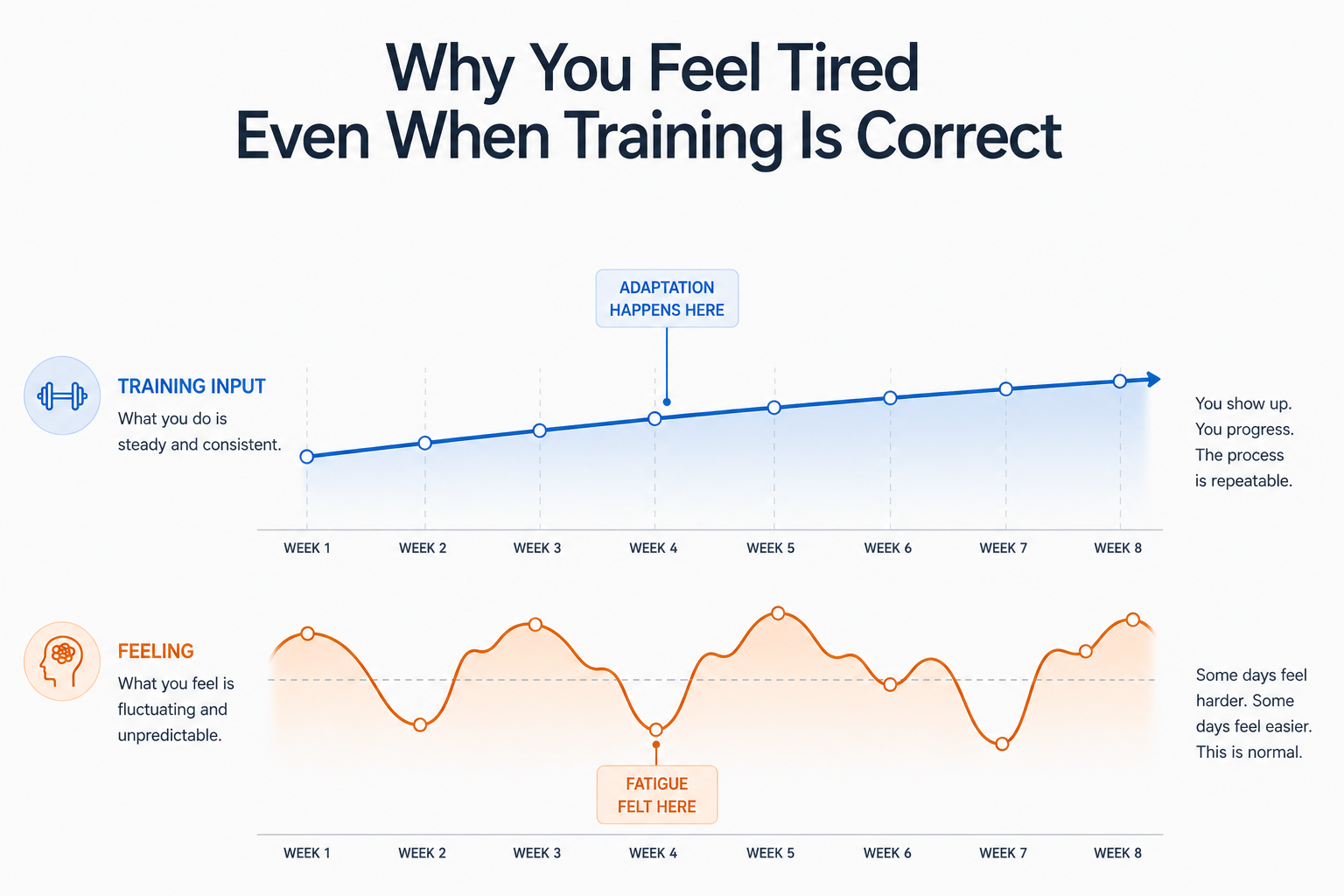
Your body usually feels the workload before it feels the adaptation.
You Are Feeling the Work, Not the Result
Running adaptations happen quietly.
Your aerobic system improves beneath the surface. Recovery capacity slowly expands. Your ability to tolerate volume improves over weeks and months.
But fatigue is immediate. That creates a strange timing mismatch inside training.
You feel the work today.
You feel the result later.
This is closely connected to Why You Feel Slower Even When You Are Improving, because fitness progression rarely feels linear from inside the body itself.
Over time, I think many runners realize that effort perception is emotionally louder than actual progress. Fatigue gets your attention immediately. Adaptation stays mostly invisible until enough time passes.
That is why doubt appears so easily during otherwise productive training phases.
Your Baseline Has Changed
Another important thing starts happening once training becomes consistent.
Your baseline shifts.
You are no longer comparing today’s run against a fully rested version of yourself. You are comparing it against a body that is already carrying accumulated training load from previous days.
That changes how effort feels.
Not because you are losing fitness.
But because your body is now operating inside a deeper training cycle.
I honestly believe many runners underestimate how significant this transition is psychologically. Especially when they first move from casual running into structured training.
Because suddenly, “normal” no longer feels completely fresh. And that is actually expected.
Not All Fatigue Means Something Is Wrong
This is where interpretation becomes important. Fatigue itself is not automatically negative.
Productive fatigue usually feels stable. Your legs may feel slightly flat or heavy, but your movement still feels controlled. Your breathing settles normally. Easy pace remains accessible even if it requires slightly more concentration.
Problematic fatigue behaves differently. It becomes unstable. Recovery stops feeling predictable. Easy effort starts drifting upward repeatedly. Some runs feel disconnected for no obvious reason.
That distinction matters enormously, and it connects closely with Fatigue vs Lack of Fitness, because many runners mistakenly interpret normal adaptation fatigue as declining fitness.
Easy Runs Quietly Become Harder
I suspect this is one of the most common hidden reasons behind persistent fatigue.
Easy runs slowly drift faster. Not intentionally. Not aggressively. Just gradually.
As fitness improves, runners naturally begin moving slightly quicker at the same perceived effort. But eventually that shift starts increasing total training stress without the runner fully noticing it.
Then fatigue begins accumulating silently.
This is exactly why What Does Easy Pace Actually Mean matters so much. Easy pace is not a number you defend. It is a physiological purpose you protect.
And I honestly believe many runners unintentionally turn recovery-supportive running into low-grade moderate training.
That usually feels manageable at first. Until suddenly everything starts feeling slightly too difficult all the time.
Recovery Is Not Supposed To Feel Perfect
One thing I think many runners slowly learn over time is that good recovery does not always feel amazing.
It simply restores enough function for the system to continue adapting.
That is different.
In a healthy training structure, you often feel functional rather than fully fresh. Your body is capable of running again. Your aerobic system continues adapting. Your recovery is sufficient even if perfection is absent.
And strangely enough, this is where a huge amount of endurance progress actually happens.
Not during magical perfect-feeling weeks. But during stable, repeatable, sustainable training.
Consistency usually feels more ordinary than people expect.
When Tired Is Actually a Problem
Of course, there is a line where fatigue stops being productive.
If effort keeps rising at normal pace, if recovery feels incomplete repeatedly, or if easy runs stop settling entirely, your system may no longer be balancing stress successfully.
That is when adjustments become important.
Usually not dramatic adjustments.
Just intelligent ones.
Slightly easier easy days. A little more recovery. Reducing intensity accumulation before the system starts spiraling.
This connects naturally with Should You Run Today or Rest?, because the quality of long-term progression often depends on recognizing patterns early rather than reacting late.
Feeling tired is normal. Feeling progressively worse over time is not. The direction matters more than individual days.
Small Adjustments Usually Solve More Than Big Changes
One of the most reassuring things about this phase is that it rarely requires rebuilding your entire training structure.
Most of the time, small adjustments solve the problem surprisingly well.
Slightly reducing intensity. Allowing easier recovery runs. Protecting sleep.
Keeping your easy effort truly easy again.
These changes often restore stability faster than runners expect.
And honestly, I think many runners underestimate how much unnecessary strain comes from equipment that subtly changes mechanics or increases impact stress during already fatigued phases.
That is partly why Best Running Shoes for Daily Training (2026) focuses so heavily on comfort, stability, and sustainable training feel rather than pure excitement.
Because when fatigue is already elevated, small reductions in mechanical stress matter more than people realize.
Why This Phase Matters
This phase feels uncomfortable partly because progress and fatigue overlap at the same time.
That creates emotional confusion.
You feel tired, so you assume something must be wrong.
But often, your system is simply adapting underneath visible fatigue.
I think this is where patience quietly becomes one of the most important endurance skills.
Because many of the biggest aerobic adaptations happen during periods that feel surprisingly average from inside the body itself.
Not dramatic. Not heroic. Just consistent.
And over time, I think strong runners slowly stop chasing perfect-feeling training weeks. They start trusting stable long-term structure instead.
Conclusion
Feeling tired during good training does not automatically mean your training is failing.
Very often, it means your body is carrying exactly the kind of stress that adaptation requires.
That does not mean fatigue should be ignored.
But it also does not mean every heavy run is a warning sign.
The important thing is learning to recognize patterns instead of reacting emotionally to single sessions.
Because endurance progress usually comes from staying stable long enough for the body to quietly become stronger underneath the fatigue itself.
Frequently Asked Questions
Is it normal to feel tired during consistent training?
Yes. A certain level of fatigue is a natural part of adaptation.
Does this mean I am overtraining?
Not necessarily. Look at patterns over time rather than single runs.
Should I slow down if I feel tired?
Sometimes. Especially if your easy runs are drifting too fast or recovery feels incomplete.
Will this feeling go away?
It usually does. As your body adapts, your perception of effort improves again.