
Why Running Feels So Hard at the Beginning
Running feels unusually hard at the beginning because your body is not only producing the effort — it is still learning how to make that effort economical.
You may be perfectly capable of walking for an hour. You can climb stairs, spend a day on your feet and do all kinds of ordinary physical activity without thinking much about it. Then you start jogging at what seems like a very modest pace and, within a few minutes, your breathing is loud, your legs feel unexpectedly heavy and the idea of continuing for half an hour seems almost ridiculous.
It can make running feel harder than it should. For many beginners, the immediate conclusion is that they are simply very unfit. There may be some truth in that — aerobic fitness obviously matters — but it does not explain the whole experience.
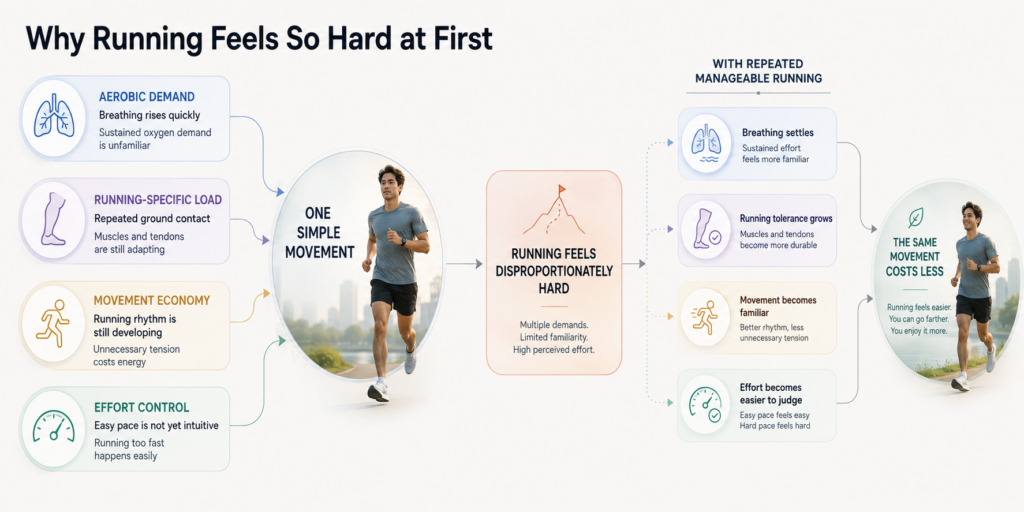
Running asks the body to solve several new problems at the same time.
You have to repeatedly support and move your body against gravity. Muscles and tendons have to absorb and return force with every step. Your cardiovascular system has to supply considerably more oxygen than it does during ordinary walking. Meanwhile, you are still learning how fast you can run without pushing the effort too high.
Even the movement itself is relatively expensive at first.
An experienced runner can settle into an easy pace almost without thinking about it. A beginner often carries unnecessary tension, changes pace repeatedly, takes slightly awkward steps and has not yet developed the rhythm that makes running feel automatic.
That means the first runs are not simply testing the fitness you already have. They are asking you to perform a movement your body has not yet become efficient at performing.
This is why the approach in How to Start Running From Scratch is deliberately conservative. Short running periods, walking breaks and plenty left in reserve are not ways of avoiding real running. They give the body enough exposure to start solving all of these problems without requiring it to solve them in one exhausting session.
And gradually, something changes. You may still be running at almost exactly the same pace. But it stops costing quite so much to do it.
Your Easy Pace May Not Be Easy Yet
One of the hardest things about beginning to run is that slow running does not necessarily feel slow.
Walking has a very obvious comfortable speed. Running is different. The moment you change from walking into a jogging movement, there is often a natural tendency to settle into a pace that feels like what running is supposed to look like.
For a beginner, that pace can already be too demanding. You may not notice it immediately. The first minute feels fine, so you continue. Then breathing begins to rise, the legs become heavier and within a few minutes the effort has moved from manageable to something you are trying to sustain.
At that point, slowing down can feel surprisingly difficult.
Part of the problem is mechanical. Very slow running can initially feel awkward because you have not yet developed a comfortable rhythm at low speeds. Part of it is psychological. Running slowly enough to keep the effort easy can feel almost absurd when walking would only be slightly slower.
But there is no minimum speed at which running suddenly becomes worthwhile.
This is where How Slow Should Easy Runs Be? becomes useful even for someone who has only just started. Easy pace is not a particular number on the watch. It is the pace that allows the effort to remain controlled enough for the purpose of the run.
For a beginner, that may mean running much slower than expected. It may also mean that there is not yet a running pace slow enough to keep the effort genuinely easy for very long.
That is exactly where walking breaks make sense. Instead of forcing yourself to maintain continuous running while the effort keeps rising, you can walk briefly, let breathing settle and begin running again before the session turns into a test of endurance.
Over time, an interesting thing tends to happen. The gap between walking and comfortable running becomes easier to manage. You find a slower rhythm without fighting it. The pace that once pushed your breathing upward almost immediately begins to feel sustainable.
You have not only become fitter. You have learned how to run without making every step more expensive than it needs to be.
Your Body Is Still Learning to Handle the Impact
Breathing tends to get most of the attention when running feels hard. It is immediate and obvious. You notice when you are out of breath, and when breathing begins to settle after a few weeks, it can feel like clear evidence that fitness is improving.
The adaptation happening in the legs is quieter. Every running step creates a small impact that walking does not reproduce in quite the same way. The calves, thighs, hips and feet repeatedly absorb force, while tendons store and return some of that energy for the next stride.
None of those individual steps is particularly demanding. The difficulty comes from repeating them hundreds or thousands of times.
When running is new, the body has not yet accumulated much experience with that repetition. Muscles can become tired surprisingly quickly, calves may feel stiff afterwards, and the legs can develop that peculiar heavy sensation where the cardiovascular effort seems manageable but continuing to run still feels increasingly difficult.
This also explains why breathing can improve before running as a whole begins to feel easy. As we discussed in Your First Month of Running — What to Expect, different parts of the adaptation do not necessarily move at the same speed.
Your heart and lungs may already be saying that another five minutes would be fine. Your legs may have a different opinion.
I would not see that mismatch as something to overcome by force. It is useful information about which part of the system is currently setting the limit.
With repeated manageable exposure, the same number of steps gradually becomes less disruptive. Muscles tolerate the work better. The lower legs stop reacting to every run as though something unusual has happened. Recovery between sessions becomes more predictable.
This is one of the less visible reasons running eventually starts feeling easier. The ground has not become softer. Your body has simply become better at meeting it.
Running Is Still an Inefficient Movement for You
The way to make running feel easier is not to practise suffering through it. It is to accumulate enough manageable running for the body to stop treating it as something new.
There is another reason the first runs can feel disproportionately expensive: you are spending energy on things that experienced runners barely notice.
This does not mean your running form is bad. It means the movement is not yet familiar. A new runner may hold tension in the shoulders, move the arms more than necessary or subtly change stride whenever breathing becomes uncomfortable. Pace can surge and fade without being noticed. Hills produce sudden increases in effort because there is not yet an instinctive adjustment in speed.
Even deciding how to run takes attention. Experienced runners have repeated the movement enough that much of this happens automatically. They slow slightly when the gradient changes, settle into a sustainable rhythm and make countless small adjustments without consciously managing each one.
That familiarity has an energy cost too. This is essentially the beginning of what runners eventually describe as running economy: how much energy and oxygen the body needs to maintain a given running speed. But beginners do not need to deliberately optimize their stride to improve it.
In fact, trying to manufacture perfect technique can make running even less natural.
The early improvement often comes simply from repetition. You run. Your nervous system gets another opportunity to organize the movement. You run again. Gradually there is less unnecessary tension and fewer corrections, and the stride begins to find its own rhythm.
This is why I would resist treating the uncomfortable first weeks as evidence that something about your technique needs fixing. Can You Improve Running Form Naturally? looks at this process in more detail, and its central idea matters particularly well here: running form can change simply because the body becomes more experienced at running.
A month later, you may look almost identical from the outside. But from the inside, the movement can feel completely different.
Less attention is required to maintain it. Less energy is wasted fighting the rhythm. Running begins to feel less like a movement you are deliberately producing and more like something your body knows how to do.
That change is difficult to measure. It is also one of the reasons the beginning does not last forever.
You Have Not Learned What Easy Effort Feels Like Yet
Experienced runners carry around a kind of internal reference library. They know what an easy run feels like. They recognize the point where steady running starts becoming moderate. They can usually tell when a hill is temporarily raising the effort and when the entire run is beginning to drift too hard.
A beginner has almost none of those reference points. If running itself feels demanding, it can be difficult to distinguish normal running effort from unnecessarily hard running. Heavy breathing may seem inevitable. Tired legs may feel like proof that the workout is working. Finishing exhausted can even seem reassuring because it makes the session feel substantial.
But running does not need to leave you exhausted to create adaptation.
This is one reason perceived effort becomes more useful with experience. You are not simply getting fitter; you are becoming better at interpreting what the body is telling you.
The first few weeks provide those reference points. You experience a run that becomes too hard and begin recognizing how the effort changed beforehand. Another day you slow down earlier and discover that you can keep moving much longer. Eventually you finish a genuinely controlled session and realize that easy running has a very different character from simply running until you need to stop.
If you are still unsure where a particular session landed, the Run Effort Check Calculator can help turn those sensations into something easier to interpret. The goal is not to give every beginner another metric to chase, but to help connect breathing, muscular effort and overall control with the kind of run you actually completed.
Over time, you need that external confirmation less. You begin to recognize the effort while you are still running. And that changes the beginning of running more than it might seem.
Once you know what sustainable running feels like, you stop accidentally turning so many ordinary runs into hard ones.
Conclusion
Running feels hard at the beginning partly because you are not yet adapted to running, but that explanation is almost too simple.
What makes the beginning unusual is how many things are new at the same time.
Your cardiovascular system is learning to support sustained running. Your muscles and tendons are learning to tolerate repeated ground contact. Your movement is still becoming more economical. And while all of that is happening, you are also trying to learn something experienced runners often take for granted: how slowly you need to run for the effort to remain controlled.
That is a lot for one simple-looking movement to ask from the body. It also explains why the beginning can improve without anything dramatic happening. You may not suddenly become fast. Your route may remain exactly the same. You may still use walking breaks.
But breathing begins to settle earlier. The legs stop treating every run as an unusual event. You find a pace without constantly adjusting it. And somewhere along the way, you realize that you are no longer spending the entire run thinking about how difficult running feels.
That is real progress.
The useful response to a difficult beginning is therefore not to prove that you can tolerate more difficulty. It is to give the body enough manageable running that the movement has a chance to become familiar.
Run slowly enough. Walk when it keeps the effort controlled. Recover.
Then come back and expose the body to running again. As those repetitions accumulate, running gradually stops asking so many new questions at once.
And what initially felt disproportionately hard begins to feel surprisingly ordinary.
Shoes cannot make the normal adaptation of beginning running disappear, and a more expensive shoe will not suddenly turn a difficult effort into an easy one. Comfort still matters, especially while your legs are getting used to repeated running. If you are choosing a simple everyday pair rather than looking for a shortcut, our guide to the Best Running Shoes for Daily Training 2026 compares versatile shoes designed for ordinary training.
Frequently Asked Questions
Why do I get out of breath so quickly when I start running?
Running increases oxygen demand much more quickly than ordinary walking, and beginners often start at a pace that is harder than they realize. As aerobic fitness improves and you learn to control pace better, breathing usually becomes easier to settle.
Why do my legs get tired before I feel out of breath?
Running places repeated muscular and mechanical demands on the legs. Your cardiovascular system may be capable of continuing while the calves, thighs or other running muscles are still developing the tolerance needed to repeat thousands of running steps.
Why does even slow running feel hard?
Your current slow running pace may still represent a relatively high effort. Very slow running can also feel mechanically awkward when you are inexperienced. Walking breaks can bridge this gap while your fitness and running rhythm develop.
Is it normal to walk when running feels too hard?
Yes. A controlled walking break can lower the effort before you begin another running period. For a beginner, this is often more productive than repeatedly forcing continuous running until the session becomes exhausting.
How long before running starts to feel easier?
There is no exact timeline because different adaptations develop at different rates. Some people notice easier breathing relatively quickly while running-specific muscular tolerance takes longer. Look for gradual changes across several weeks rather than expecting a particular run to suddenly feel easy.
Does running feel hard because I am unfit?
Aerobic fitness can certainly be part of it, but it is not the whole explanation. Running economy, pace control, muscular tolerance and familiarity with the movement all influence how difficult early running feels.
Should I push through when running feels hard?
Not simply because you are a beginner. Some effort and temporary muscular fatigue are normal, but every run does not need to become a test. If you are uncertain whether a difficult session was still appropriate or whether today should be another running day, the Today’s Run Decision Calculator can help put recovery and readiness into context.