Can You Improve Running Form Naturally?
I’ve started noticing that many runners assume improving their running form means consciously changing the way they run.
They try to lift their knees higher. They shorten their stride. They think about arm swing, posture, cadence, and foot strike—all at the same time. It’s an understandable reaction.
If running form affects efficiency and comfort, it seems logical that deliberately changing your technique should lead to better running. In reality, the body often learns movement in a different way.
Good running form usually develops gradually as strength improves, coordination becomes more refined, and thousands of comfortable strides reinforce efficient movement. That’s why experienced runners often appear relaxed rather than carefully controlled.
Their movement isn’t being managed step by step. It’s simply become natural through consistent practice. I honestly believe that’s encouraging. It means improving your running form doesn’t necessarily require rebuilding your stride.
More often, it means becoming a stronger, more experienced runner and allowing your movement to evolve alongside your training.
Consistency Shapes Movement More Than Constant Corrections
I’ve started noticing that runners often underestimate how much their movement changes simply through consistent training. When someone first starts running, almost every part of the stride can feel awkward.
The rhythm isn’t quite there. The posture changes as fatigue builds. Even simple coordination takes conscious effort. Months later, many of those same runners move much more smoothly without ever having spent hours analysing their technique.
What changed? Usually, they became stronger, fitter, and more comfortable with the movement itself. The body gradually learned a more efficient way to run. That’s one of the remarkable things about human movement. Given enough repetition, it naturally becomes more coordinated.
I honestly believe this is why consistency deserves far more attention than perfection. Running regularly gives your body thousands of opportunities to refine its movement. Most of those improvements happen quietly, without you even noticing them.
If you’re interested in why efficient movement develops over time, Does Running Form Actually Matter? explores why good running form is often the result of becoming a better runner rather than trying to imitate someone else’s technique.
Strength And Mobility Create Better Conditions
One thing I’ve started noticing is that runners sometimes focus entirely on how they move while forgetting what allows them to move well in the first place.
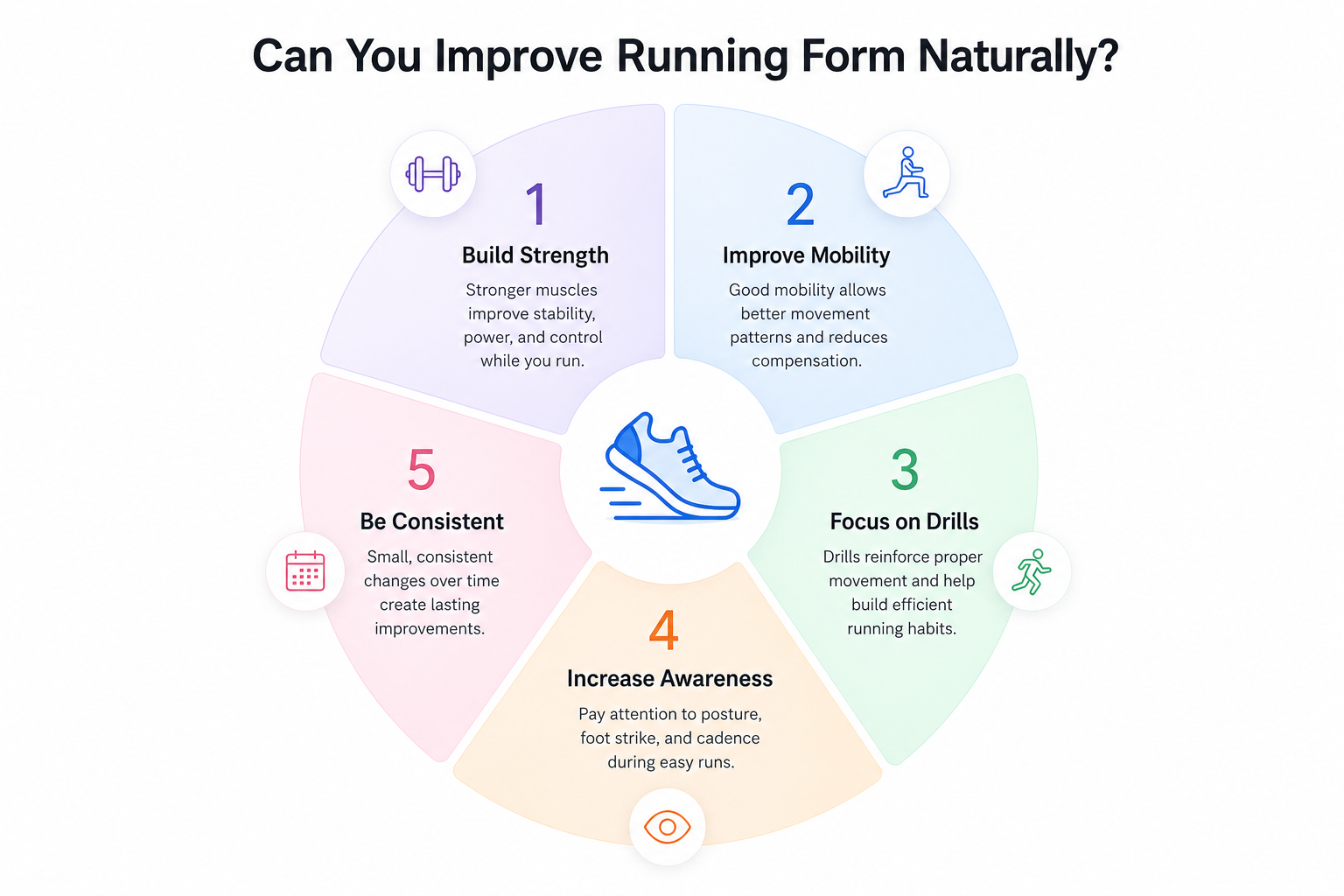
Good running form doesn’t exist in isolation. It’s supported by the body underneath it. Stronger hips help stabilise each stride. A stable core makes it easier to maintain relaxed posture. Healthy ankle mobility allows the foot and lower leg to move naturally without unnecessary compensation.
None of these improvements instantly change your running technique. Instead, they create better conditions for efficient movement to develop on its own. That’s why two runners can receive exactly the same technical advice yet respond very differently.
The runner with greater strength, mobility, and coordination often finds it much easier to adopt that change naturally.
To me, that’s a healthier way to think about improving running form. Instead of forcing your body into a new movement pattern, give it the physical tools to move more efficiently. Over time, your stride often adapts on its own.
Running Drills Can Reinforce Natural Movement
I’ve started noticing that some runners avoid drills because they’re worried they’ll make their running feel artificial. Others expect drills to completely transform the way they move. The truth usually lies somewhere in between.
Running drills aren’t designed to replace your natural running style. They’re there to reinforce movement patterns that already support efficient running.
Simple exercises like high knees, skipping, or butt kicks encourage balance, rhythm, coordination, and relaxed posture.
Over time, those qualities can begin to appear more naturally during your normal running without you consciously thinking about them.
That’s why drills work best when they’re treated as preparation rather than correction. You’re reminding your body how efficient movement feels before asking it to repeat that movement throughout the workout.
I honestly believe that’s one of the reasons drills remain part of training plans from beginners to elite runners. They don’t force a new running style. They simply make it easier to express the one your body is gradually learning.
If you’re building a warm-up routine, Why Running Drills Matter explains how a few minutes of simple preparation can reinforce efficient movement before quality sessions.
Trust The Process More Than The Mirror
One thing I’ve started noticing is that runners often judge their running form by how it looks instead of how it functions. They record videos, compare themselves with elite athletes, and immediately notice every movement that appears different.
While video analysis can sometimes reveal useful information, it rarely tells the whole story.
Efficient running isn’t a beauty contest. It’s about moving comfortably, economically, and consistently while staying healthy enough to keep training.
Many runners gradually develop smoother mechanics without ever noticing a dramatic visual change. What changes first is often how running feels.
The stride becomes more relaxed. The rhythm feels easier to maintain. The body wastes less unnecessary effort. Only later might those improvements become visible on camera.
To me, that’s a much healthier perspective. Don’t chase a perfect-looking stride. Chase consistent training. As your fitness, strength, and confidence improve, your running form will often improve alongside them.
Conclusion
Yes, you can improve your running form naturally. In fact, that’s how many of the biggest improvements happen.
Rather than consciously rebuilding every part of your stride, focus on becoming a stronger, healthier, and more consistent runner. Regular training, strength work, mobility, and simple running drills all create the conditions for better movement to develop over time.
I honestly believe that’s a more sustainable approach than constantly searching for technical fixes. Good running form isn’t something you manufacture. It’s something that gradually emerges as your body adapts to consistent training.
Trust the process, keep running, and allow your movement to evolve naturally.
If you’d like to understand how common mistakes can slow that process down, Common Running Drill Mistakes explains the habits worth avoiding, while our guide to the Best Running Shoes for Daily Training compares versatile shoes that support comfortable, natural movement across every type of run.
Frequently Asked Questions
Can running form improve naturally?
Yes. Running form often improves naturally as you become stronger, fitter, and more experienced through consistent training.
Should I consciously change my running form?
Usually, only small adjustments are helpful. Trying to change every aspect of your running technique at once often feels unnatural and is difficult to maintain.
Do strength exercises improve running form?
Yes. Better strength and stability provide the foundation for more efficient movement, making it easier for good running mechanics to develop naturally.
Can running drills improve running form naturally?
Running drills can reinforce coordination, rhythm, and posture, helping efficient movement become more automatic over time rather than forcing immediate changes.
How long does it take for running form to improve?
There is no fixed timeline. Running form usually develops gradually over weeks, months, and years of consistent training rather than changing after just a few sessions.